
In Norway, chemical company Yara had a problem: its pollution-conscious government told it to stop trucking fertilizer and other cargos thousands of miles a year. The result was the birth of an autonomous solution and movement toward Kongsberg Maritime becoming a substantial standalone oceanic company.
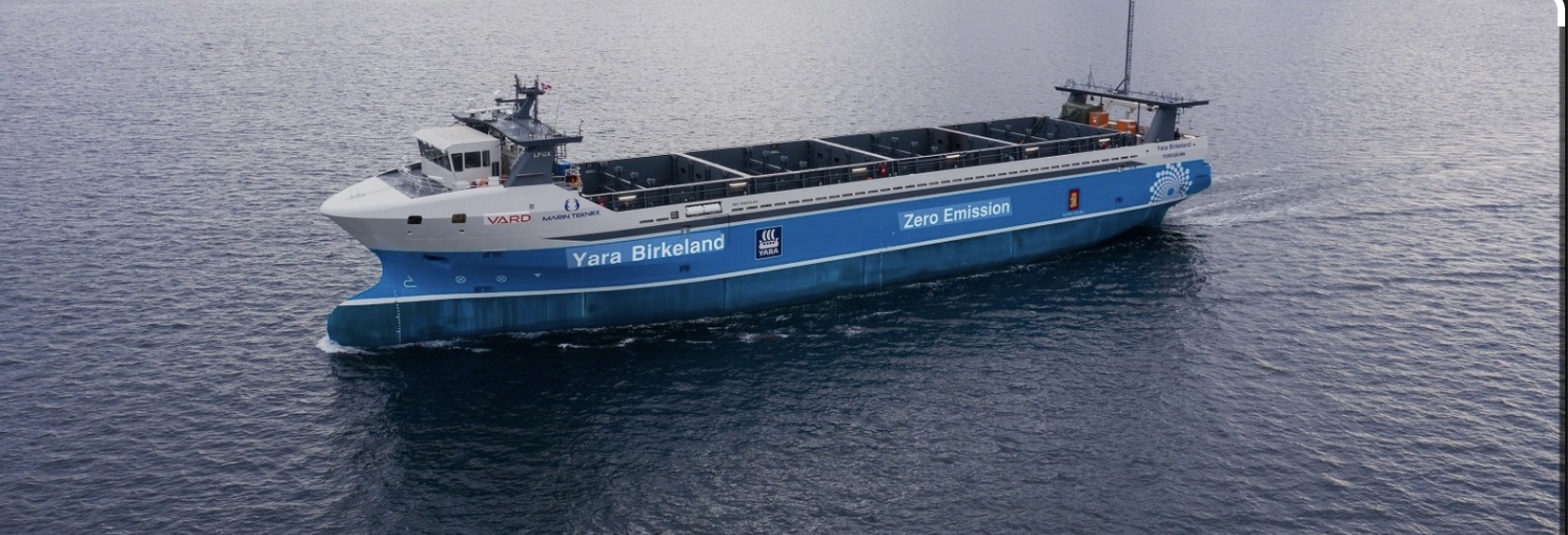
Aileen Kehoe, VP of sales special vessels for what is now Kongsberg Maritime, recalled the genesis of the Yara Birkeland, which lays claim to being the world’s first fully electric, zero-emission autonomous container ship.
“They had this idea of, well, ‘If we had an autonomous vessel that went up and down the fjord, that would take away the pollution. And if we make it autonomous, that would save us a lot of money.”
Christened in 2022, the 200-plus foot Yara Birkeland has completed hundreds of voyages with a goal of replacing 40,000 diesel truck journeys annually, without producing its own emissions.
Kongsberg contributed design elements and technologies from sensors for autonomy to the propulsion and control systems. Fast-forward, and those solutions are part of why Kongsberg—generally known for multidomain defense and security solutions—confidently calved off Kongsberg Maritime into a standalone company this past April. “The feeling was that maritime was sufficiently happening,” Kehoe said. The new company’s 8,000-plus employees matches the size of the defense, geospatial, aerospace and discovery wings remaining with the original Kongsberg.
“Kongsberg Maritime makes about everything you put on the ship apart from building the ship itself,” Kehoe continued. “Essentially from propellers up to the integrated bridge, DB and handling systems, automation systems—we even do ship design. We have a portfolio that has 1,000 sailing ships.”
Kongsberg Maritime has “full autonomy as the independent entity we are now,” Kehoe said. But “autonomy” of course has a second meaning, as in “unmanned.” “It’s new in the maritime space but it’s not new to us. We have several vessels that are already operating, and there are step differences of how far the automation goes.” Ferries in Norway and Finland, for example, have auto docking, auto crossing. And the Yara Birkeland is probably our most well-known.”
Kehoe differentiated Kongsberg’s process. “A lot of what happens these days is what people do is take an existing ship and say, ‘OK, how can I make this existing design autonomous?’” Yara Birkeland was “designed to be autonomous from the ground up,” Kehoe said. Nevertheless, new unmanned technology capable of sending a large ship through an environmentally sensitive, regulated area argued for a step by step approach: “First, people on board, and it’s got a removable bridge as well. Then experiment and see how it works, and then start taking people off until eventually there are no people on board. Then move into systems so it will be managed remotely until finally fully autonomous.”
As noted, Yara Birkeland is fully electric for zero emissions. “We wanted to solve one problem, not make another.”
Kongsberg’s maritime solutions also include the free-swimming Hugin family of autonomous underwater vehicles, Sounder uncrewed surface vehicles and an array of navigation, sensor and communication systems. Kehoe noted that the new division is looking to further leverage its autonomy experience. “Obviously, there’s a lot of money going into the Golden Fleet and we just hope to play more in that space. We do know that commercial versions will come over here and we’re already doing them in Europe so we want to see if there’s anything else we can do.”