
BAE Systems has successfully test-fired the AGR-20A Advanced Precision Kill Weapon System (APKWS) from a Eurofighter Typhoon, completing the first live-fire trial of the laser-guided rocket on the platform and marking a significant step in the effort to equip fourth-generation fighters with affordable counter-UAS intercept capability.
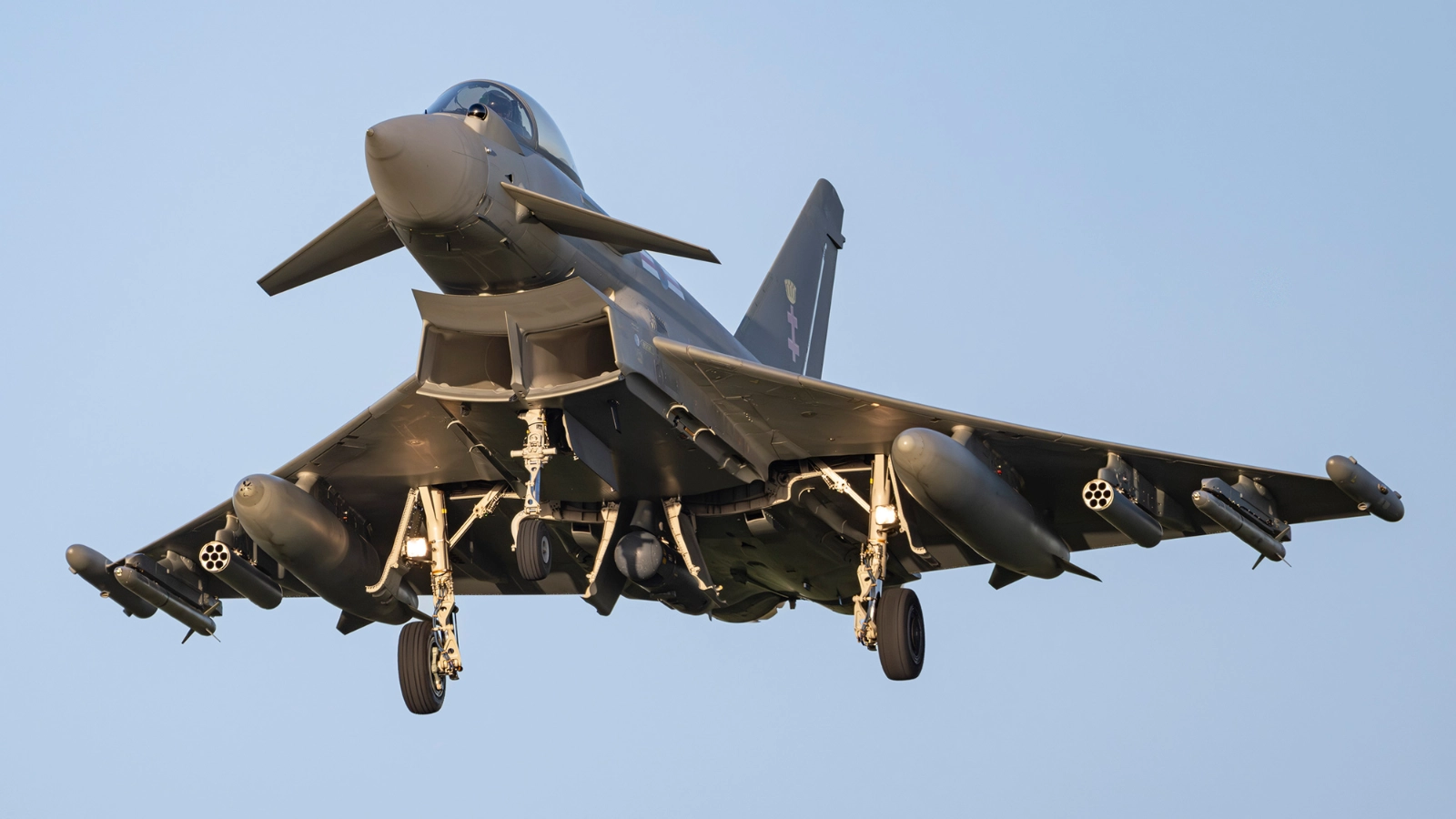
The trial was conducted at BAE Systems’ flight test development center in Warton, Lancashire, using a Royal Air Force Typhoon test and evaluation aircraft. The APKWS rocket was launched against a ground-based target at a UK military testing range, achieving a direct hit. BAE Systems confirmed the result on April 8, following the test carried out in March 2026.
The activity was supported by the UK Ministry of Defence and forms part of ongoing efforts to expand the Typhoon’s role in counter-unmanned aircraft system operations.
Richard Hamilton, Managing Director of Air Operations at BAE Systems’ Air sector, called the trial a demonstration of a “game-changing capability and a cost-effective solution that would enhance Typhoon’s already impressive range of weapons capabilities.”
The cost logic is straightforward: an AIM-120 AMRAAM costs approximately $1 million, and an AIM-9X exceeds $450,000, while the laser guidance section of the APKWS II is estimated at between $15,000 and $20,000 — a significant differential when the threat is a mass-produced one-way attack drone. The massive cost of using ASRAAM in a C-UAS role has already been a point of criticism in the British press, and RAF Typhoons operating from Qatar and Akrotiri have had to rely solely on short-range infrared-guided missiles against drone threats.
The APKWS laser-guidance kit enables both air-to-surface and air-to-air strikes and is already in operational use on the F-16, A-10, and several other fixed-wing and rotary-wing platforms. The operational precedent includes F-15E and F-16C engagements against drones in the Middle East, where APKWS has been employed against Houthi UAVs in real-world conditions.
BAE Systems confirmed the trial was internally funded as part of the company’s commitment to investing in advanced capabilities for its customers. At DSEI 2025 in September, BAE Systems Head of Typhoon Strategy Delivery Paul Smith described APKWS as “a clear driver for that sort of capability — a low-cost kinetic effector,” while noting that integration challenges are as much programmatic as technical, with customer nations determining the level of risk and integration maturity they require.
Next steps will focus on air-to-air testing against airborne targets, the phase expected to assess the system’s suitability for engaging moving aerial threats. Whether the four Eurofighter partner nations — the UK, Germany, Italy, and Spain — ultimately commit to procurement remains an open question. Both UK and German defense officials have said there are no current plans to equip the Typhoon with rockets for the counter-drone mission, while leaving the door open to future development.