
The company built its system for live broadcast reliability. What it is selling to defense users is something different: a portable aerial layer that can go where a tower cannot and stay up longer than a battery-limited drone.
There are a few places where technology does not get much room to fail, and the Super Bowl is one of them. The airspace is watched, the public safety posture is layered, and federal agencies are involved. Broadcasters, security teams and event operators are all working against the same unforgiving clock. There is no useful distinction between “almost worked” and “worked.” The system either performs in real time, under pressure, in front of everyone—or it does not. That is part of what makes ProximaVision interesting.
The company did not come into aerial overwatch from the usual defense-startup path. Its leadership came from broadcast, live production and high-reliability video. Claudio Lisman, one of the founders, is a two-time Emmy Award recipient for science and technology. Proxima’s CTO, Walter Raps, spent almost two decades as CTO of CBS Sports and helped run Super Bowl broadcast operations, among many other mission critical broadcast events. At the Super Bowl that reliability enhanced the broadcast and supported overwatch of one of the most sensitive events in the country. The team brought that background into aerial systems, then proved it in one of the most demanding public-event environments in the United States. At Super Bowl LX, Proxima operated a tethered drone in coordination with federal security and broadcast stakeholders, including FBI and Secret Service. For any company trying to make the case that it can provide reliable aerial overwatch, that is not a minor credential. It is a serious endorsement—and a useful starting point for understanding Proxima’s move into defense.
The company is not merely proposing that tethered drones might someday support military operations. Air Ready already has U.S. defense work underway, and its systems have been used by allied defense users in active, high-intensity conflict environments overseas. For operational and security reasons, Proxima cannot discuss those deployments in detail and is careful not to identify locations, units or mission architecture. What matters for defense readers is that the use cases are not theoretical. They are already in early real-world use.
That puts the Air Ready in a different category than many companies asking military users to imagine an entirely new concept of operations. The U.S. military already understands the need for persistent ISR, counter-UAS awareness, communications relay, force protection and convoy overwatch. Those are established requirements. What Air Ready is trying to change is the speed, cost and locality with which those needs can be met.
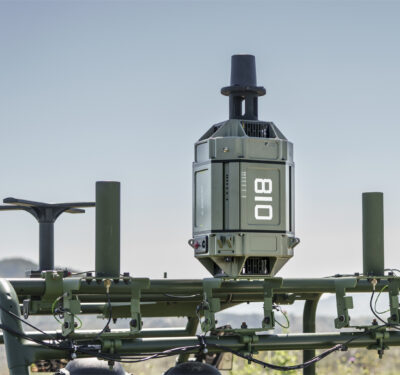
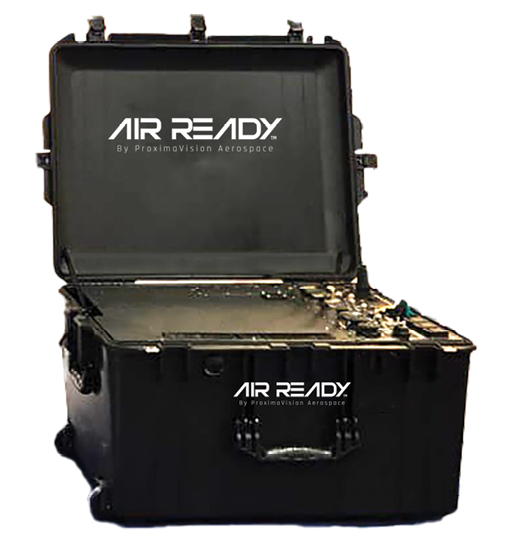
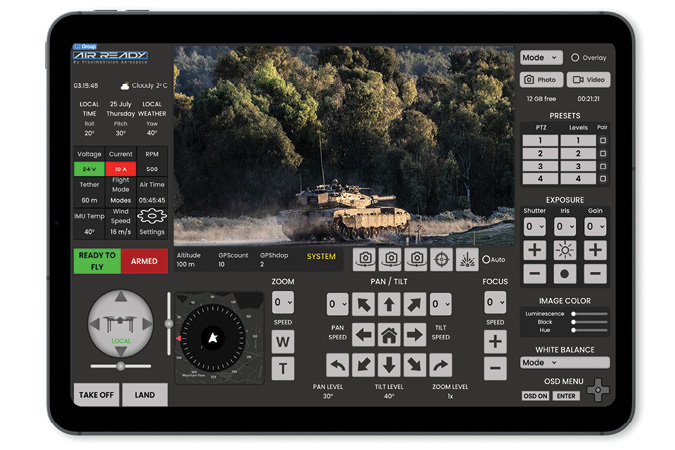
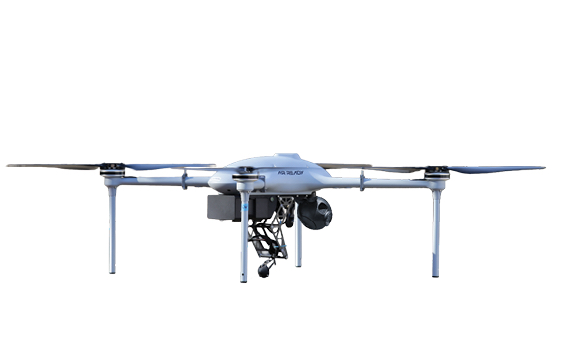
In simple terms, the company has built a portable observation tower—not a metaphorical one, but a real one. An Air Ready tethered drone can rise to roughly 700 feet, remain airborne for long-duration operations, carry multiple payloads and move high-bandwidth data through a fiber-optic tether. The tether provides power, control and a secure data pathway. The aircraft becomes an elevated ISR, communications and sensor node that can be deployed from a fixed site or vehicle, operated locally or remotely, and used to push real-time information to command-and-control users. That sounds straightforward. In practice, it changes the geometry of the problem for units on the ground.
A 60-foot mast can only see so far. A small free-flying quadcopter can look over the next hill, but it has limited endurance, limited payload and a radio-frequency control link that may be vulnerable in contested environments. A larger unmanned aircraft may provide wider-area ISR, but it may be unavailable, expensive or tasked elsewhere. Aerostats provide persistence, but they are large, visible and logistically more complex. Air Ready is aiming squarely at the space between those options. The system is not designed to replace every tactical drone, every tower or every higher-echelon ISR asset. It is designed to give commanders, security teams and operators a fast way to put a persistent sensing and communications node above the fight.
THE TETHER IS THE ARCHITECTURE
Tethered drones are sometimes dismissed because the tether is assumed to be a limitation. For many missions, that is fair: if the requirement is to fly miles away, maneuver freely and return with data, a tether is not the right architecture. Air Ready is focused on a different problem set.
For force protection, base security, convoy overwatch, public safety, border security and counter-UAS support, the requirement is often not to fly far. The requirement is to stay up, see beyond ground sensors, move data quickly and remain resilient in environments where RF and GNSS cannot be assumed. That is where the tether becomes an advantage rather than a constraint.
Air Ready’s system uses fiber optics for data transmission, allowing very high bandwidth and low latency compared with conventional RF links. Lisman describes the throughput as up to 20 gigabits per second, enough headroom to move uncompressed or very high-quality video, radar data, radio communications and other sensor feeds at the same time. ISR is not only about putting a camera in the air. It is about delivering usable information to the people who need it, quickly enough to matter.
Compressed video may look acceptable on a small controller screen but not hold up when expanded on a large display in a command center, zoomed for analysis or fused with other sensor feeds. Air Ready’s broadcast background shows up here. The company thinks about video quality, timing, latency and distribution the way live-event professionals do: the feed has to arrive cleanly, continuously and with enough detail to support decisions.
The system also supports edge AI and local processing. Rather than sending every feed to a cloud service and waiting for analysis to come back, Air Ready’s architecture allows detection, cueing and analytics closer to the point of collection. In tactical use, seconds matter. A system that introduces cloud dependency or long processing delays may not be useful when the target is moving, the convoy is exposed or the drone threat is inbound.
ORGANIC ISR WITHOUT WAITING FOR THE ASSET
One of the most compelling defense applications is also one of the most straightforward: force protection at the tactical edge.
A unit arrives at a position. It needs to understand the surrounding terrain—what is beyond the hill, beyond the tree line, beyond the next block or outside the perimeter. It may need communications reach as much as visual overwatch and may need to share the feed with multiple command nodes. It may be operating in a GNSS-degraded or RF-contested environment.
Traditionally, the unit has a few choices, none of them perfect. It can send personnel forward, which exposes people to risk. It can launch small free-flying drones, which may provide useful short-duration views but require battery cycles, operators and RF links. It can request higher-echelon ISR, but that introduces availability, timing and prioritization problems. It can build or use towers and masts, but those are height-limited, slower to emplace and not always practical.
Air Ready’s answer is to give the unit its own elevated node on demand.
From 700 feet, the line of sight changes. The platform can look across terrain features that block ground-based sensors. It can support EO/IR payloads, radar, communications relay and RF sensing. Its video can be distributed to remote users. Its operation can be local, remote or hybrid, allowing a pilot or payload operator to hand control to another user if the local position becomes unsafe or if the mission outlasts one operator’s duty cycle.
This is not a doctrinal revolution, but it is a practical shift. Air Ready makes overwatch more immediate, more local and less dependent on scarce assets. A tactical commander does not have to wait for a Predator-class platform just to get persistent observation or communications relay. A site security team does not have to build a permanent tower to get a high vantage point. A forward team does not have to keep launching short-endurance systems just to maintain a view. For a military increasingly interested in modular, available, fieldable systems, that is where the value lies.
A HIGHER VANTAGE POINT FOR COUNTER-UAS
The counter-UAS mission is another clear fit, though the role needs to be understood correctly.
Proxima is not presenting its tethered drone as a complete counter-UAS kill chain. It is better understood as an elevated detection, sensing, communications and cueing node that operates inside a broader counter-UAS architecture.
Low-altitude drones exploit terrain, clutter and the limits of ground-based observation. They may appear late, move quickly and disappear behind buildings, trees or ridgelines. Ground-based sensors and operators are constrained by line of sight. Raise the sensors, and the engagement geometry changes.
Air Ready can carry cameras, radar, RF sensors, communications payloads and other mission-specific equipment. From altitude, it can help detect drones earlier, classify activity, identify suspicious RF emissions and provide coordinates or cueing information to other systems responsible for mitigation or defeat. Lisman described the system’s role as providing strategic information to the right users rather than acting as the defeat mechanism itself.
In counter-UAS, no single system solves the problem. More survivable architectures are layered: detection, identification, tracking, classification, cueing, command and control, and mitigation. A persistent tethered node can strengthen several parts of that chain, especially when fixed-site or mobile forces need continuous awareness without relying exclusively on ground sensors.
The modern drone problem is not limited to the air vehicle. It includes the operator, the launch point, the radio link, the targeting process and the follow-on system that may be cued by the first drone. An elevated platform that can sense RF activity, observe the airspace and provide high-quality video into command channels can help expose more of that system. For bases, forward positions, ports, borders and critical infrastructure, that is a serious capability.
CONTESTED LOGISTICS AND CONVOY OVERWATCH
The defense community has spent the last several years talking about contested logistics because the problem is not going away. Moving people, fuel, ammunition, spare parts and other materiel through an active battlespace is one of the hardest things a force has to do. Drones, electronic warfare, ambushes, loitering munitions and surveillance networks all make it harder.
This is where Air Ready’s vehicle-mounted and on-the-move capability becomes especially relevant.
The company has tested the system moving at up to 30 miles per hour. In a convoy scenario, the tethered drone can operate as a mobile observation tower, watching the surrounding area, extending communications and monitoring the environment for unusual activity. That could include visual detection, RF sensing or other payload-driven awareness depending on the mission kit.
The benefit is not that the drone makes the convoy invulnerable. Nothing does that. The benefit is earlier awareness and a wider view of the route and surrounding terrain. A convoy commander who can see farther, detect suspicious activity sooner and maintain better communications has more options. The convoy can slow, stop, reroute, call for support or cue other systems. The platform can provide persistent overwatch without launching and recovering multiple battery-limited drones. It can also serve as an elevated relay in terrain where ground radios struggle.
Contested logistics is not just a supply-chain problem. It is a tactical survival problem. If forces cannot move safely, they cannot sustain the fight.
CRITICAL INFRASTRUCTURE, BASES AND HIGH-VALUE SITES
The same logic applies to fixed and semi-fixed sites.
Air bases, ports, water facilities, fuel depots, ammunition storage areas, border facilities, logistics hubs and temporary command posts are all increasingly exposed to low-cost aerial surveillance, sabotage and drone attack. Many of these facilities were not built around the assumption that small drones would become cheap, available and tactically useful.
Security teams have cameras, fences, patrols and sometimes radar or counter-UAS systems. But those tools still face a geometry problem. Ground-level sensors see what ground-level sensors can see. Permanent towers help but are expensive, visible and fixed. A tethered aerial node can add a deployable layer of awareness without requiring a permanent structure in every vulnerable location.
Here, Super Bowl experience becomes more than a credential. It becomes a model. Large public events and critical infrastructure sites both require layered security, high-confidence video, multi-agency coordination and reliable operation under pressure. The stakes are different, but the operational requirements are similar. A system trusted to provide overwatch in a Super Bowl environment is naturally relevant to facilities where the cost of a blind spot can be measured in lives, mission disruption or national security consequences.
For defense installations and critical infrastructure, Proxima’s value proposition is direct: put a persistent sensor and communications node in the air, move it when the threat changes, integrate it with existing security operations and bring it down when the mission is complete.
TEMPORARY INFRASTRUCTURE FOR SPECIAL OPERATIONS
Special operations users may be another natural fit, though not because they need a new gadget.
They need small-footprint, flexible capabilities that can create options in austere environments. They often operate where communications are difficult, fixed infrastructure is unavailable and dependence on large assets can create delay or compromise. A tethered aerial node gives them a way to create temporary infrastructure—observation, communications relay and sensor reach—from a position they control.
That phrase, “temporary infrastructure,” is useful because it captures what makes the system different. Proxima is not just putting a camera in the air. It is creating a local aerial layer that can support multiple mission functions at once. It can observe, relay, sense and distribute data. It can be operated remotely. It can work alongside free-flying drones, not just instead of them. In that sense, the tethered drone can act like a portable control tower, helping coordinate other systems and providing a persistent vantage point while smaller drones or other assets move through the battlespace.
For units operating in GNSS-denied or RF-contested areas, that combination of persistence, fiber connectivity and elevated reach may matter more than raw aircraft mobility.
NOT A FUTURE CONCEPT
A lot of defense technology is sold in the future tense. Air Ready is trying to avoid that trap.
The company’s message is that its system is ready now, has been demonstrated with military users and is already in early operational defense use. It has responded to user requests for integration, including command-and-control-related requirements. It is working within defense channels while also coming from a commercial and broadcast culture that prizes field performance over long development cycles.
That does not mean every defense application is mature or that every concept of operations is settled. Tethered aerial systems still have to be integrated into unit tactics, counter-UAS architectures, convoy procedures and acquisition pathways. Users will have to decide where the system belongs, how many are needed, who operates them and how payloads should be configured for specific missions. But the capability itself is not hypothetical.
It is a deployable aerial node that can go where a tower cannot, stay up longer than a battery-limited drone, move more data than conventional RF architectures and provide commanders with persistent visibility at the point of need. That is why Proxima’s defense story is best understood less as a drone story and more as an infrastructure story.
The military does not need another platform category for its own sake. It needs ways to see, communicate and act faster in contested environments. It needs tools that give smaller units more awareness without waiting for scarce assets. It needs counter-UAS architectures that improve detection and cueing. It needs convoy protection that can move with the convoy. It needs critical infrastructure security that can adapt faster than the threat.
The Air Ready tethered drone does not solve all of that by itself. But it gives defense users something they increasingly need: a rapidly deployable, high-bandwidth, persistent aerial layer that can be put in place quickly, used immediately and adapted to the mission. At the Super Bowl, that kind of reliability helped support overwatch for one of the most security-sensitive events in the country. At the tactical edge, it may help solve a different problem: giving commanders a 700-foot advantage when they cannot afford to be blind.