
General Atomics Aeronautical Systems Inc. (GA-ASI) and the U.S. Air Force recently conducted a flight demonstration focused on autonomous sensing and targeting capabilities for future Collaborative Combat Aircraft (CCA), using the company’s MQ-20 Avenger unmanned jet as a surrogate platform.
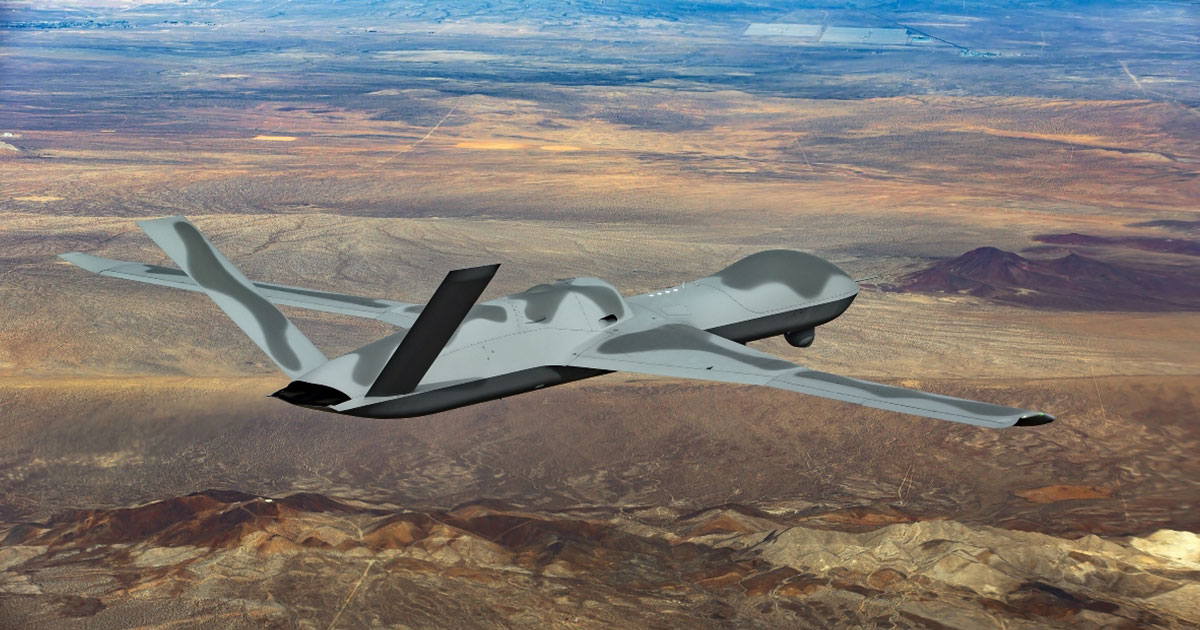
The demonstration, conducted during a large-force exercise on Feb. 24, tested autonomous mission behaviors built around passive infrared sensing and distributed targeting—capabilities intended to support survivable operations in contested electromagnetic environments.
The MQ-20 Avenger aircraft was equipped with the government’s Autonomy Start Kit (ASK) and GA-ASI’s TacACE tactical autonomy ecosystem, which integrates modular autonomy “skills” for mission execution and cooperative targeting. The system was linked through a tactical proliferated low-Earth-orbit communications architecture designed to support coordinated autonomous behaviors across distributed aircraft.
Passive Sensing for Distributed Targeting
A key element of the demonstration was the use of infrared search-and-track (IRST) sensing combined with a technique known as Single Ship Ranging (SSR). This approach allows the aircraft to estimate the range and position of airborne targets using passive infrared observations rather than emitting radar signals.
By avoiding active emissions, the system enables the aircraft to detect, classify and localize threats while remaining electronically quiet—a concept that supports “sensor-to-shooter” kill chains in contested airspace where radar transmissions could expose an aircraft’s position.
During the exercise, the MQ-20 demonstrated passive target localization and engagement logic while operating within a broader autonomy framework designed for future CCA operations. The aircraft also used GA-ASI’s TacPad pilot-vehicle interface to manage autonomous behaviors and mission execution.
Advancing the CCA Autonomy Architecture
The demonstration is part of ongoing U.S. Air Force efforts to develop Collaborative Combat Aircraft—autonomous or semi-autonomous platforms intended to operate alongside crewed fighter aircraft as distributed sensors, decoys, or weapons carriers.
GA-ASI officials said the flight validated integration between the government’s autonomy reference architecture and the company’s TacACE autonomy stack. According to Mike Atwood, vice president of advanced programs at GA-ASI, the modular skills library used in the demonstration supports autonomous mission execution and distributed targeting concepts expected to play a central role in future CCA operations.
The MQ-20 Avenger has been used extensively as a surrogate platform for testing autonomy software and sensor concepts related to the Air Force’s CCA program, allowing developers to evaluate autonomy behaviors, sensing architectures and networking technologies in operationally realistic flight scenarios.
As the Air Force advances the CCA program, demonstrations such as this one are intended to validate how autonomous aircraft can contribute to distributed sensing and targeting networks while operating in environments where active emissions may be restricted or contested.