
Saronic Technologies has closed a $1.75 billion Series D funding round at a $9.25 billion valuation, with the capital directed primarily at accelerating production capacity for autonomous surface vessels rather than technology development alone. The round was led by Kleiner Perkins.
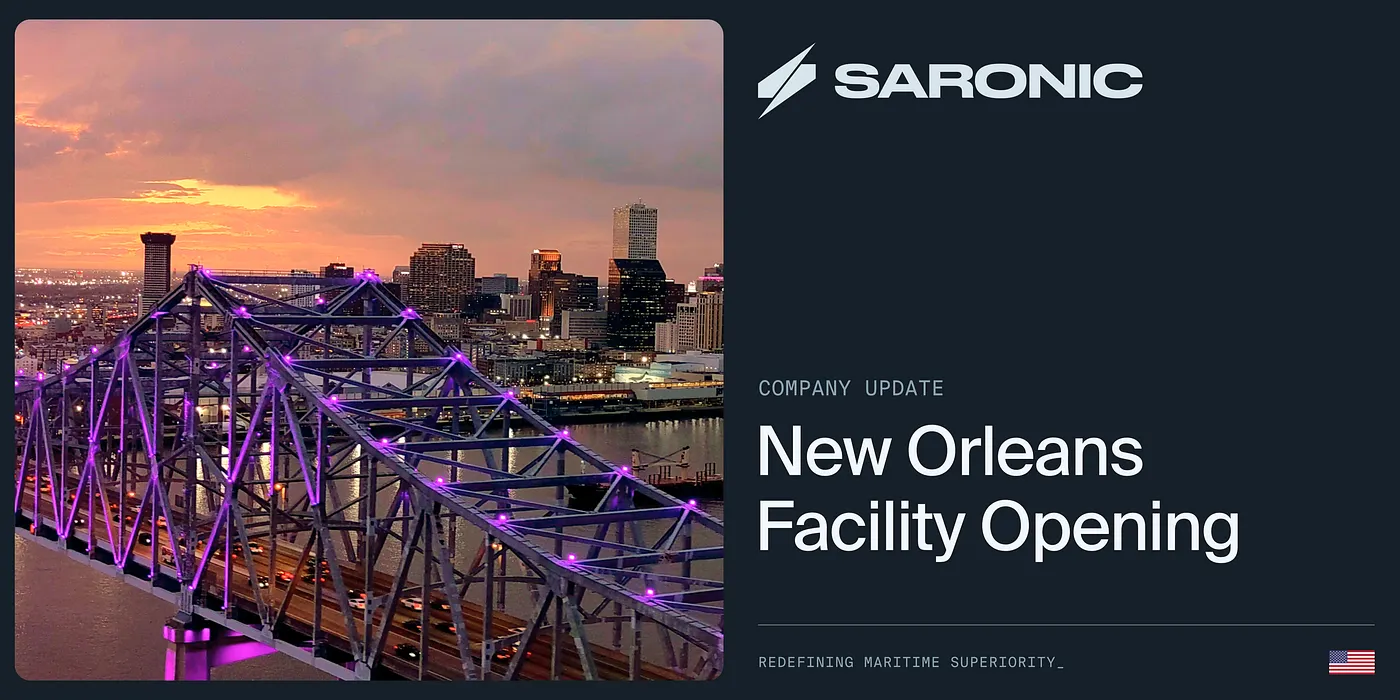
The funding announcement arrived alongside a separate disclosure that Saronic is opening a nearly 15,000 square foot engineering hub in downtown New Orleans — a deliberate pairing that underscores the company’s argument that autonomous shipbuilding requires simultaneous investment in design infrastructure and manufacturing capacity, not just platform capability.
The New Orleans office will house naval architects, hardware engineers, marine engineers, and systems testing personnel focused on the Marauder, Saronic’s 180-foot autonomous surface vessel currently in production at the company’s Franklin, Louisiana shipyard. The facility is intended to provide technical connectivity between design and production functions — the kind of integration that has historically been a weak point in American shipbuilding, where engineering and manufacturing operations have often been geographically and organizationally siloed.
The Franklin shipyard is itself undergoing a $300 million expansion across 300,000 square feet, with Saronic projecting more than 350 new hires across Louisiana operations this year. The company is working with Louisiana Economic Development to build workforce training pipelines in partnership with regional universities and technical institutions, targeting naval architecture, engineering, and marine disciplines.
The broader industrial thesis behind the capital raise is significant for the autonomous maritime sector. Saronic’s CEO Dino Mavrookas framed the Series D explicitly around shipbuilding capacity rather than technology: “We are confronting this challenge with a fundamentally new model of American shipbuilding, one that integrates first-principles engineering, advanced manufacturing, and software-defined production to deliver autonomous vessels with unprecedented speed, precision, and scale.”
That framing directly addresses a structural problem the U.S. defense industrial base has acknowledged — the erosion of domestic shipbuilding capacity over several decades — and positions autonomy-first design as the mechanism for rebuilding it on a compressed timeline. The Marauder’s first hull was completed in under six months from facility acquisition, a production pace Saronic is using as evidence that its manufacturing model can scale.
The company’s existing contract base includes a $392 million production contract with the U.S. Navy. The Series D capital will also fund exploration of capabilities at the surface-subsurface interface — a domain Saronic did not elaborate on but which represents a logical extension of the autonomous maritime platform thesis into undersea applications.
Saronic’s current vessel portfolio ranges from the 24-foot Corsair to the 180-foot Marauder. Production is split between facilities in Louisiana and Texas, with additional offices in San Diego, Washington D.C., the UK, and Australia. The company has surpassed 1,300 employees.