
AeroVironment used the Army Aviation Association of America annual forum in Nashville this week to unveil MAYHEM 10, the first system in a new product line the company is calling its launched effects family.
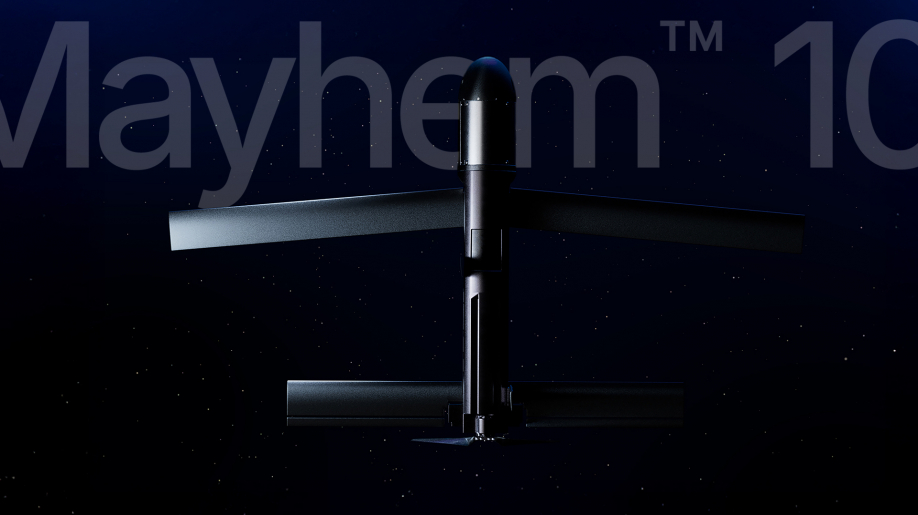
The announcement marks AV’s formal entry into a mission category distinct from its established loitering munitions portfolio — one the U.S. Army has identified as a priority capability for rotary-wing and ground vehicle operations.
Launched effects are designed to be deployed from crewed or uncrewed air platforms, ground vehicles, and maritime assets, extending the sensor and strike reach of host platforms without exposing them to direct threat engagement. The Army’s launched effects program has defined short-, medium-, and long-range tiers within that requirement set; MAYHEM 10 is positioned against the short-range tier, with Brian Young, AV’s senior vice president of loitering munitions, describing it as a natural companion to the Switchblade 400 — the mid-weight loitering munition the company introduced last fall.
Specifications and architecture
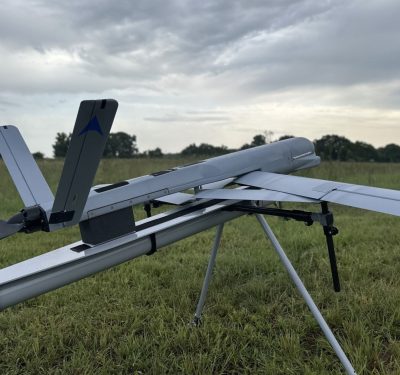
MAYHEM 10 carries a 10-pound (4.5 kg) modular payload, with a stated operational range of 100 km and 50 minutes of endurance. Assembly and launch readiness is specified at under five minutes. The system is designed for air, ground, and maritime deployment and uses a self-contained launcher that supports dismounted, mobile ground, air-mounted, and vehicle-mounted operations.
The payload architecture is the system’s distinguishing design feature. A removable forward modular section accepts interchangeable third-party payloads without requiring changes to launch concepts, allowing a single MAYHEM 10 to be configured for ISR, electronic warfare, communications relay, deception and decoy operations, or precision strike depending on mission requirements. AV has noted that the Javelin Multi-Purpose Warhead — the same munition integrated into the Switchblade 600 — is among the lethal payload options.
Navigation and communications are handled by M-Code GPS with AI-enabled autonomy for degraded and denied environments, a Silvus datalink, and a MANET secure mesh network providing command and control links in the 25 to 40 km range. The system is built on a Modular Open Systems Approach architecture developed with Parry Labs, supporting payload upgrades and third-party integration over time. Control is unified through AV’s Tomahawk Grip controller and AV_Halo command interface.
Swarm and collaborative attack
Young identified collaborative attack — coordinated employment of multiple MAYHEM 10 systems operating simultaneously — as a core intended capability. AV has partnered with Applied Intuition for the swarming software layer. Young acknowledged that swarming functions have not yet been tested in flight, and the company has not provided a timeline for that demonstration. The stated concept is employment of multiple systems to expand sensor coverage, overwhelm or saturate defenses, and execute parallel effects across a battlespace without concentrating crewed platforms.
Production status and market positioning
MAYHEM 10 will enter low-rate initial production this calendar year, with Young estimating approximately 10 units per month initially, scaling toward a full-rate production target of 100 units per month — a ramp he described as potentially years away. AV currently has no active orders for the system. Young expressed confidence in demand from the Army and Marine Corps, particularly in the context of the Army’s Launched Effects Short-Range effort, and noted ongoing conversations with those customers. He also flagged potential entry into the Army’s recently launched drone marketplace if and when that platform expands to include launched effects.
AV is in early discussions about payload sizes for subsequent MAYHEM variants, with the Army’s launched effects program having defined short-, medium-, and long-range capability tiers that the company intends to address across the product line.
Context
The launched effects category has attracted increasing attention as Army aviation planners look for ways to reduce the vulnerability of rotary-wing platforms — which can be targeted by man-portable air defense systems — while maintaining their role in deep reconnaissance and strike. Deploying sensors and munitions from standoff before a helicopter enters a threat envelope is the underlying operational logic. MAYHEM 10 directly addresses that requirement, with its 100 km range designed to push effects well forward of the host platform.
AV’s entry into launched effects follows its established position in man-portable loitering munitions through the Switchblade family, which has seen combat use in Ukraine and fielding across U.S. Army units. Young described MAYHEM 10 as drawing on that Switchblade heritage, with particular reference to the Switchblade 400’s design lineage.
AeroVironment is exhibiting at AAAA 2026 in Nashville, April 14–17.