
Thales, Viasat, and a consortium of European partners have completed flight trials at Cranfield University testing multi-link connectivity architecture for beyond visual line of sight uncrewed aircraft operations, advancing a key prerequisite for scaled BVLOS integration into non-segregated airspace.
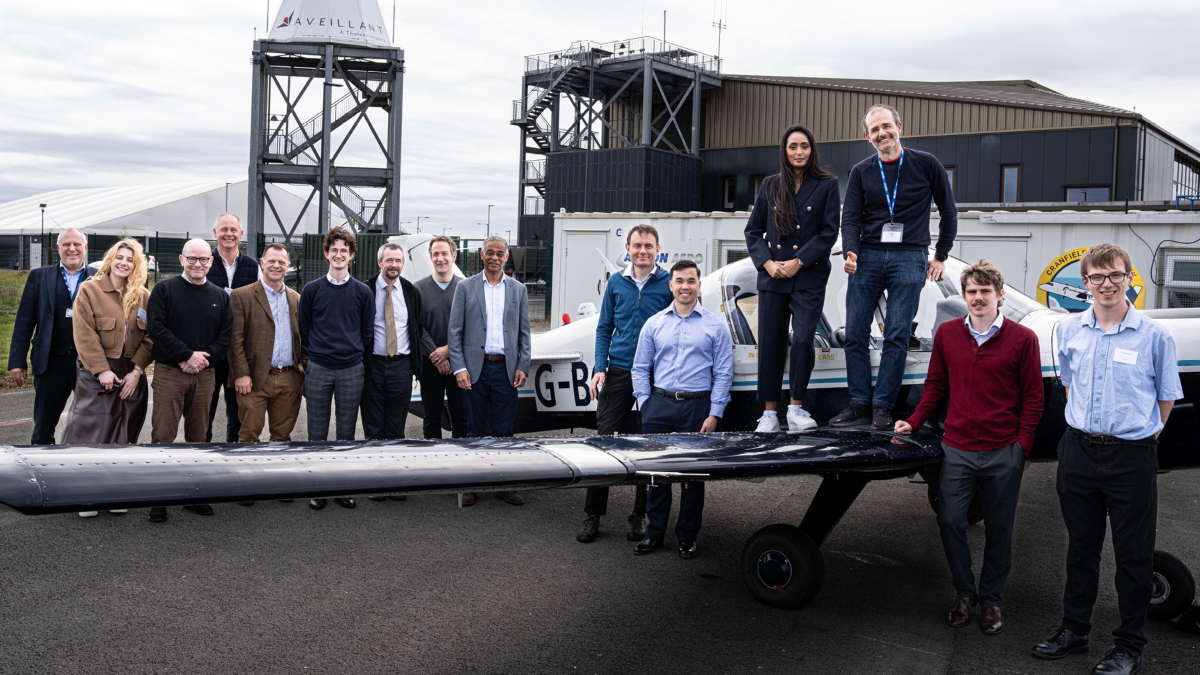
The trials were conducted under the ESA Iris RPAS programme, which is focused on demonstrating how satellite communications, terrestrial networks, and C-band radio links can operate together within a trusted, resilient command-and-control framework. Thales serves as system integrator for Iris; Viasat contributed satellite communications capability; TTP plc developed low-SWaP satcom terminals under its Gotonomi brand for Viasat’s Velaris network; and Dimetor provided real-time airspace connectivity intelligence through its AirborneRF platform. Cranfield University hosted the trials using a Bulldog light aircraft from its National Flying Laboratory Centre.
The programme’s design is explicitly evidence-building — structured to observe multi-link connectivity behavior under representative operational conditions and build a cumulative data set for regulators and airspace stakeholders rather than demonstrate a single capability milestone.
“For BVLOS uncrewed operations, safety depends on having a command-and-control link that can be trusted wherever the aircraft is operating,” said Joel Klooster, SVP Aircraft Operations and Safety at Viasat. “Satellite communications play a critical role in providing that assurance, particularly beyond the reach of terrestrial networks.”
Jim Baddoo, Senior Expert at Thales, noted that the trials validated trusted multi-link connectivity in a live, dynamic environment combining satcom, cellular, and C-band radio — a combination expected to characterize operational BVLOS deployments as the sector scales.
Dimetor CEO Thomas Neubauer emphasized the situational awareness dimension: automated drone operations, he said, are only as reliable as the connectivity data they run on, and knowing where and at what quality terrestrial and non-terrestrial links are available is critical to safe BVLOS scaling.
ESA’s Iris programme is one of several European efforts to build the regulatory evidence base needed to enable routine BVLOS operations and, eventually, urban air mobility at scale.