
Lockheed Martin is advancing the Joint Air-to-Ground Missile as a ground- and maritime-based counter-UAS effector, with a vertical-launch configuration designed to expand defensive coverage beyond the constraints of traditional angled launchers.
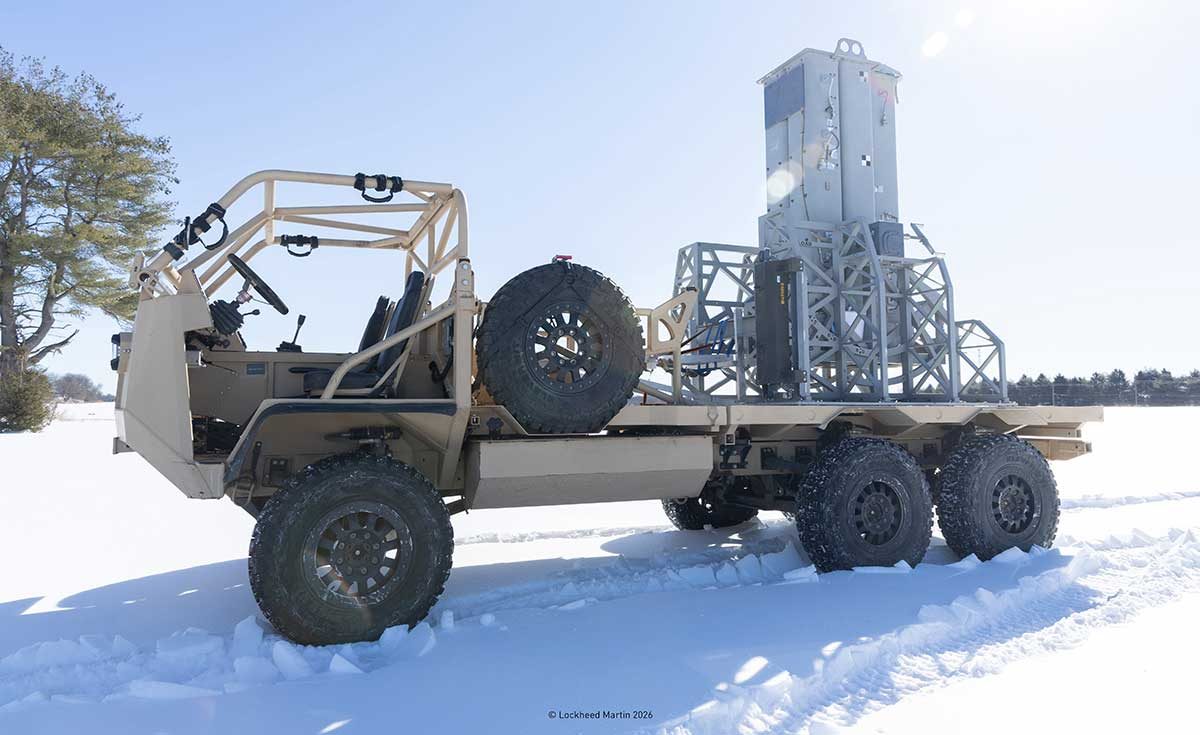
The JAGM Quad Launcher, demonstrated in a 90-degree live-fire exercise in January, allows the missile to be fired from platforms without a clear forward arc — including naval vessels, rooftops, ground vehicles, and forward-deployed bases with limited space.
The C-UAS case for JAGM rests on its dual-mode seeker, which combines semi-active laser and millimeter-wave Doppler radar. That combination allows the missile to detect, classify, and track low-radar-cross-section drones in all weather and lighting conditions — a capability set the company positions as cost-competitive against purpose-built C-UAS interceptors on a per-engagement basis.
The January demonstration used a JQL mounted on Richard Childress Racing’s Mothership 6×6 ground vehicle, a NASCAR supply chain-derived defense platform that RCR has been developing since 2014. Lockheed Martin has also announced a planned live-fire demonstration later this year integrating JAGM with a Saildrone unmanned surface vehicle, extending the vertical-launch C-UAS concept into the maritime autonomous domain.
The JQL uses an open-architecture Launcher Management Assembly compatible with existing ship and vehicle combat systems, and features rapid individual cell reload designed to sustain continuous fire.