
As UAS proliferation accelerates and threat environments evolve, ISR is shifting from standalone sensors to scalable, AI-enabled systems—where performance, integration, and production at volume define operational advantage.
The ISR (intelligence, surveillance, and reconnaissance) market is undergoing a fundamental shift—one defined not just by better sensors, but by the ability to deploy them at scale, integrate them intelligently, and act on their data in real time. What was once the domain of large, exquisite platforms is now diffusing rapidly across unmanned systems, fixed installations, and distributed sensing networks. Small drones, persistent ground systems, and hybrid architectures are reshaping how ISR capabilities are fielded—and how quickly they must evolve. At the center of this transition is a new requirement: performance at scale.
AIRBORNE SCALE VS. PERSISTENT REACH
From a deployment standpoint, the ISR market is increasingly bifurcated. Airborne ISR, driven by the proliferation of UAS platforms, represents the fastest-growing segment. These systems are defined by strict size, weight, and power (SWaP) constraints and are typically built around uncooled thermal cores such as Teledyne FLIR OEM’s Boson. The emphasis is on affordability, flexibility, and high-volume deployment across a widening range of mission sets. As Jared Faraudo, Vice President, Product Management and Programs, OEM Business Unit, Teledyne FLIR OEM, explains, the scale of activity in this segment is accelerating rapidly, with the number of platforms and mission sets expanding at a pace that continues to reshape expectations around ISR deployment.
“That market is just exploding in terms of the number of platforms and mission sets.”
On the other side is persistent, long-range ISR—often ground-based or mounted on larger platforms. These systems are designed for border security, perimeter monitoring, and wide-area surveillance, requiring higher-performance sensing, including cooled mid-wave infrared (MWIR) systems and long-range optics, such as those in FLIR’s Neutrino portfolio. These systems are built to operate at extended standoff distances and across difficult environmental conditions, enabling operators to monitor vast areas over long durations.
Across both domains, another more important shift is underway: the transition from standalone sensors to integrated sensing systems. Thermal cores are increasingly paired with electro-optical cameras, laser range finders, and other sensing modalities to create multi-sensor payloads capable of delivering richer, more reliable data. Faraudo notes that customers are actively integrating thermal camera cores with other sensing technologies to enable lower-cost, more agile platforms that can deliver capabilities once limited to high-end systems. This shift is not only expanding access to ISR but also fundamentally changing how systems are designed and deployed.
FROM SENSORS TO DECISIONS
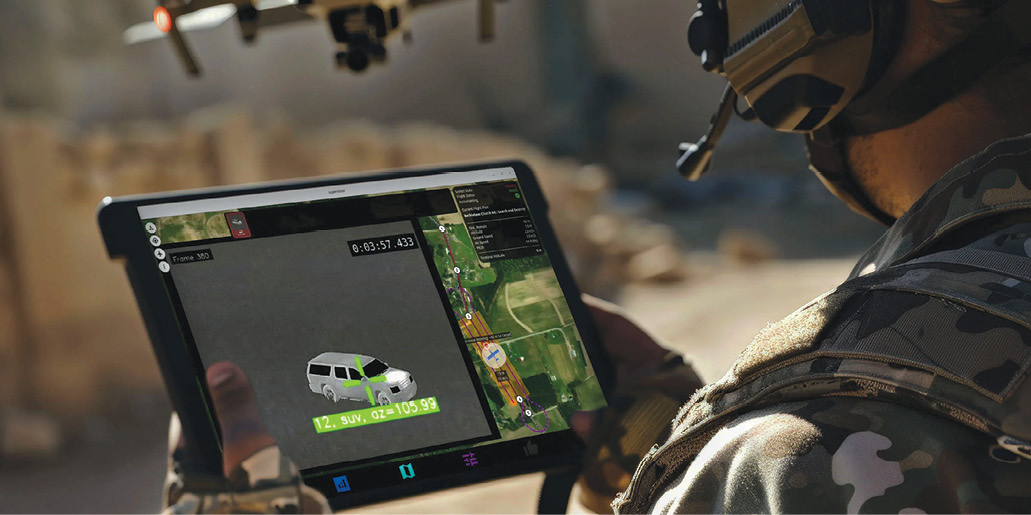
However, greater sensing capability introduces a new challenge—data saturation. The solution is not simply more data, but better filtering and faster interpretation. AI and machine learning are now central to ISR operations, enabling automated detection, tracking, and classification of targets. Increasingly, these capabilities are being deployed at the edge, embedded directly alongside the sensor rather than relying on cloud-based processing. Faraudo emphasizes that the volume of information flowing back to operators is growing significantly, making it essential to extract what is truly relevant while filtering out what is not.
“The key is being able to extract what’s actually important and filter out what isn’t.”
This shift reduces latency, minimizes bandwidth requirements, and allows operators to focus on critical decisions rather than raw data streams. At the same time, it supports a broader move toward autonomy, where systems can make decisions more quickly and operate with less user interaction.
In practice, ISR systems are evolving from passive data collectors into active decision-support tools. Software is becoming as important as hardware in enabling this transformation. Teledyne FLIR OEM’s Prism ecosystem reflects this shift by combining image processing and AI-based perception into a unified, embedded stack. On one side, it enhances imagery through functions such as noise reduction, stabilization, and contrast improvement. On the other, it enables machine vision capabilities including object detection, tracking, and classification. The intent, as Faraudo describes it, is to deliver a fully integrated sensing and perception stack that simplifies integration for developers and accelerates deployment timelines.
This focus on integration aligns with a broader shift in acquisition and deployment models. The demand for rapid fielding is reshaping how ISR systems are procured, with increasing reliance on commercial off-the-shelf (COTS) and modified COTS solutions. Traditional programs measured in years are giving way to approaches that prioritize speed, flexibility, and reduced integration risk. Customers are no longer willing to wait for long development cycles; instead, they are seeking solutions that can be deployed quickly and adapted as requirements evolve.
SCALE AS THE DIFFERENTIATOR
In this environment, one constraint stands above all others: the ability to produce at scale. Many companies can demonstrate advanced ISR capabilities, but far fewer can manufacture and deliver those systems in the volumes required. Faraudo underscores that demonstrating a capability is only part of the equation; the real challenge lies in producing and scaling that capability in a consistent, repeatable way.
“It’s one thing if you can demonstrate something, but if you can’t produce it and scale it, it doesn’t do anybody any good.”
Teledyne FLIR OEM’s vertically integrated manufacturing model is designed to address this gap. By controlling the design and production of key components and maintaining continuous, high-volume output, the company is able to deliver consistent supply across both commercial and defense markets. Unlike traditional program-driven production models, where manufacturing ramps up and down based on specific contracts, this approach ensures steady availability and reduces risk for integrators and end users.
Alongside scale, supply chain integrity has become a central consideration. ITAR-free, NDAA-compliant products with U.S.-aligned sourcing reduce procurement friction and provide confidence for deployment in sensitive environments. As ISR expands across defense and civilian infrastructure, trusted supply is increasingly critical.
At the same time, counter-UAS and infrastructure protection are emerging as key growth areas. Once focused primarily on military applications, these capabilities are now extending to airports, energy facilities, and other civilian environments where monitoring infrastructure remains limited but demand is rising.
Despite rapid innovation, a gap persists between what can be demonstrated and what can be deployed. Many solutions show promise, but far fewer are ready for large-scale implementation. Customers are prioritizing systems that are proven, repeatable, and available now.
ISR is no longer defined solely by sensor performance, but by how effectively sensing, processing, and production come together in a deployable system. The future lies in scalable, intelligent networks capable of delivering actionable insight in real time—meeting the demands of an increasingly dynamic threat environment.