
How Hyfix’s H1 brings the autonomy stack into a single architecture—making autonomous systems more trusted, more scalable, and better suited for real-world deployment across commercial, industrial, public safety and defense applications.
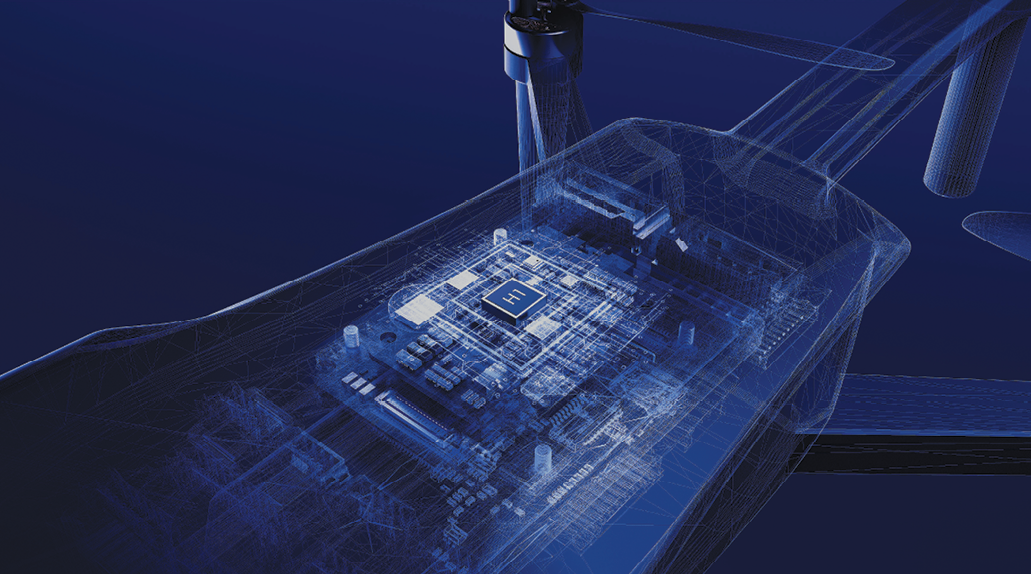
The next phase of drone operations will be won at the tactical edge. That is where autonomy gets hard: smaller form factors, tighter SWaP limits, denser RF conditions, degraded GNSS, faster control loops, and less room for failure. It is also where the limits of today’s hardware model become clear. Most advanced drones still rely on a fragmented stack of positioning, timing, sensing, communications, and compute elements that must be integrated across multiple vendors and multiple assumptions about error. As operations move deeper into inspection, security, logistics, agriculture, and public safety, that fragmented model becomes harder to trust and harder to scale.
Hyfix is responding to that challenge with a more ambitious idea. Its H1 system-on-chip, launching at XPONENTIAL 2026 in Detroit, is designed not as another component in the autonomy stack, but as a way to unify that stack at the source. The company’s view is that autonomy will grow not through increasingly fragile and complex integration, but through architectures that constrain system-level error before it reaches control—before hidden uncertainty turns into bad decisions or unstable behavior in the field. That is what makes scale valuable. It means autonomous systems that are easier to build, easier to trust, easier to certify, and more repeatable as they expand into larger fleets, more environments, and more demanding missions.
The H1 is meant to serve as that enabling foundation, bringing positioning, timing, estimation, compute, and communications into a single, co-designed architecture at a moment when technical integration and trusted domestic sourcing have both become non-negotiable for mission- and safety-critical applications.
WHERE THE CURRENT MODEL BREAKS DOWN
Modern drones are assembled from subsystems that were not originally designed to function as one.
A typical architecture combines a GNSS receiver, an RTK corrections service, an inertial measurement unit, a sensor fusion engine, a flight controller, companion compute, and a radio link. Each element brings its own timing assumptions, error characteristics, and interface requirements. Integration is required at every layer.
That model has supported the rapid rise of drones across commercial and government markets. But as operations move into more demanding environments, the seams between those subsystems become more difficult to manage. Errors propagate across boundaries. Latency accumulates. Behavior under degraded conditions becomes more difficult to predict.
Developers often discover the hardest part of building a reliable system is not achieving nominal performance, but understanding how the system behaves when conditions deteriorate. Multipath—where GNSS signals reflect off buildings, terrain or structures and arrive at the receiver along multiple paths—along with interference or partial signal loss, can produce outputs that appear valid but are not. Hyfix Founder and CEO Mike Horton underscored the core difficulty: A system may be operating under the influence of multipath without any clear indication that its position solution has been compromised. Without a consistent way to detect and manage those conditions, systems can drift or fail in ways that are difficult to anticipate.
The result is a growing integration burden. Every manufacturer is forced to reconcile multiple error models, tune interfaces, and validate performance across a wide range of scenarios. Much of that work is duplicated across the industry, often with uneven results in system behavior, adding weight, higher power consumption, and new sources of error.
SYSTEM-LEVEL DESIGN
The H1 reflects a broader shift from component-centric design to system-level architecture.
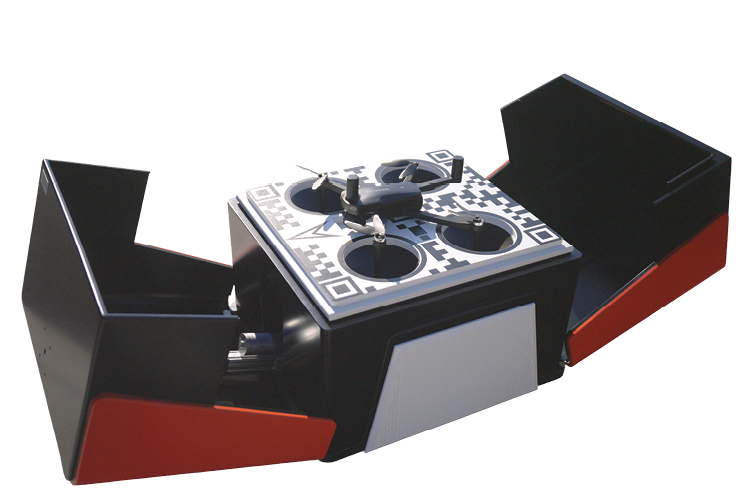
Instead of treating positioning, timing, estimation, and control as separate layers, the H1 brings them into a single pipeline. These functions are not simply co-located. They are co-designed. They share timing, data paths, and assumptions about uncertainty.
That matters because the real challenge in autonomy is no longer just peak sensor accuracy. It is the ability to understand where error comes from, keep it within known limits, and prevent it from turning into unstable behavior under real operating conditions.
By embedding that logic at the silicon level, the H1 is meant to constrain how uncertainty moves through the system. Corrections are treated as native inputs. Timing is consistent across functions. Estimation and control operate on a shared state.
The objective is not to produce a better measurement in isolation. It is to produce a system that behaves more predictably when conditions are less than ideal.
At a technical level, the H1 consolidates capabilities that are typically distributed across multiple boards and components.
It includes a multi-frequency, multi-constellation GNSS SDR baseband, integrated RTK processing, inertial outputs at high update rates, and compute resources that support estimation and peripheral data handling. Communication interfaces are built into the architecture, allowing direct integration with other system elements.
FROM EIGHT LAYERS TO ONE
The most visible change introduced by the H1 is the compression of the traditional autonomy stack.
Today’s systems rely on multiple layers: a receiver, corrections service, inertial sensors, anti-jam functions, fusion software, flight control, companion compute, and communications hardware. Each layer adds complexity and introduces potential points of failure. The H1 collapses those layers into a single architecture.
Instead of coordinating across multiple components, developers work with one integrated system. Instead of aligning different timing assumptions and error behavior across subsystems, they are working within one architecture. Data stays inside the chip rather than moving across separate boards, reducing delay, simplifying integration, and limiting new opportunities for error.
The benefits extend beyond engineering convenience. A system with fewer interfaces is easier to design, easier to validate, and easier to maintain. More importantly, it is easier to understand. When behavior changes, there are fewer variables to isolate. For developers working under time and resource constraints, that reduction in complexity can be as valuable as any improvement in performance.
WHY DUAL ANTENNA MATTERS
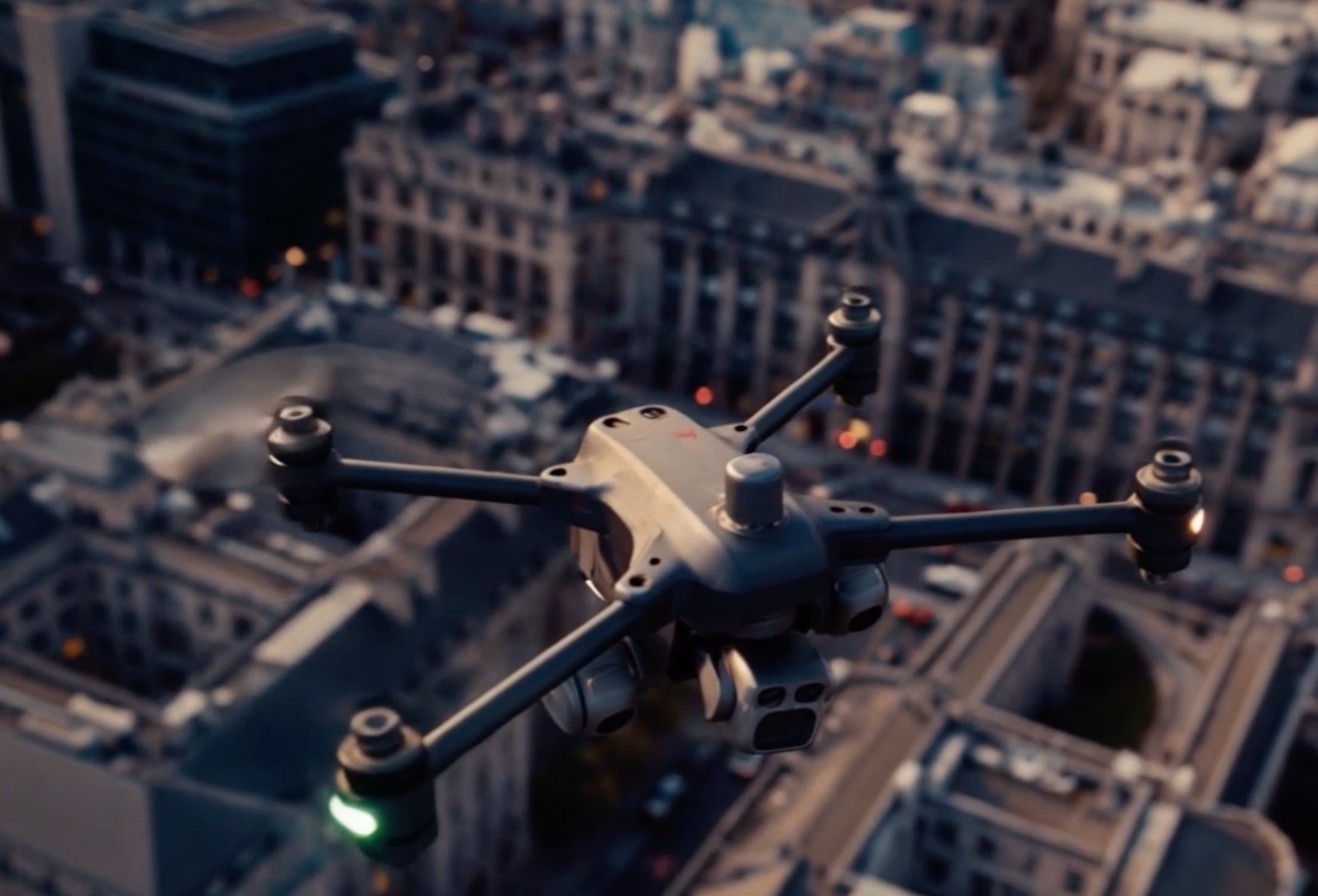
One of the clearest examples of what this integration enables is the H1’s native dual-antenna support.
Dual antennas give the system a direct sense of heading, reducing reliance on a compass that can be unreliable around structures, electrical noise, or other environmental disturbances. They also give the platform a built-in way to check whether the GNSS solution is believable. Because the distance between the antennas is fixed and known, the system can compare that geometry to what the incoming signals imply. If the two do not match, it has a reason to suspect interference, reflected signals, or other positioning errors.
That gives the drone something valuable: a way to recognize when its picture of the world is starting to drift.
Horton explained the practical value in simple terms. “Dual antenna can replace the compass,” he said. Even with a short baseline, he added, it is “going to be better, way better and way more repeatable than a compass.”
THE TACTICAL EDGE
The advantages of integration become most apparent in the environments where autonomy is hardest to sustain.
At the tactical edge—the point of operation where systems are working in the field with limited power, constrained bandwidth, changing conditions, and less room for error—autonomy becomes much harder to maintain. GNSS signals may be degraded or intermittent. RF environments may be congested. Physical conditions may shift quickly. In those settings, the drone has to keep operating with less support, less certainty, and less time to recover from mistakes.
In those settings, the ability to maintain stable control depends on more than accurate measurements. It depends on how well the system can detect and respond to uncertainty.
A unified architecture provides a clearer picture of system state. It allows estimation, corrections, and control to operate within a consistent framework. It reduces the likelihood that conflicting assumptions will produce unstable behavior.
This is where Hyfix makes its strongest case for integration. By constraining error at the source, the system can degrade more predictably. In practice, that means the drone is less likely to move suddenly from stable navigation to unreliable behavior without warning. It has a better chance of detecting when GNSS confidence is slipping, relying more intelligently on inertial, visual, or other supporting inputs, and maintaining controlled flight while conditions change.
Hyfix also points to LEO PNT integration, including XONA, as part of that resilience path. In that context, LEO becomes another input the system can use to strengthen trusted positioning as operating conditions become more demanding.
Horton described that handoff in practical terms. A fixed baseline between two antennas, he said, becomes “another very powerful constraint” that helps the system “switch over your sensor fusion, to use IMU, to use camera, to use whatever.” The operational implication is straightforward. Missions are less likely to end in abrupt aborts, unnecessary reflights, or avoidable instability, especially in cluttered or degraded environments where loosely coupled systems may struggle.

IMPLICATIONS FOR CERTIFICATION AND TRUST
As drone operations expand, certification becomes a central issue.
Regulators are focused on integrity—the ability of a system to demonstrate it knows when its outputs can be trusted. That becomes especially important for BVLOS operations, where human oversight is limited and confidence in system behavior must be higher.
In a multi-vendor architecture, demonstrating that integrity means validating how multiple components interact under stress. Each component has its own failure modes and error characteristics. Building a coherent safety case across those elements can be complex. A unified system changes that dynamic.
When positioning, corrections, inertial data, and control logic are integrated, the error model can be defined and characterized as a whole. The system can provide more consistent outputs about its own confidence.
This does not eliminate the need for testing and validation. But it does simplify the structure of the problem. For developers and regulators alike, a system that can describe its own behavior in a consistent way is easier to evaluate.
EARLY DEVELOPER RESPONSE
Initial feedback from developers highlights the practical value of integration.
Teams working with existing platforms often point to the same challenges: managing multiple boards, balancing power budgets, dealing with antenna constraints, and maintaining reliable heading in complex environments.
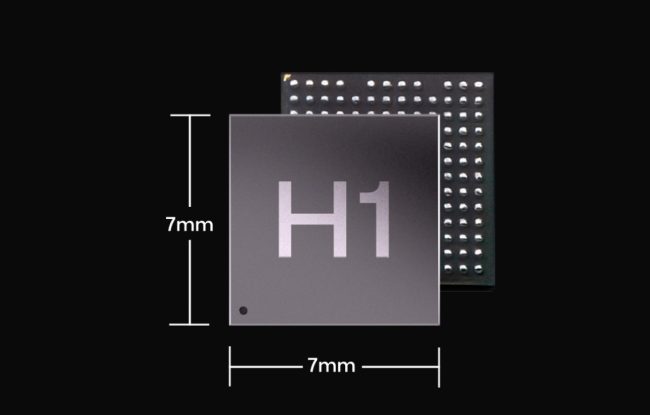
The ability to consolidate functions into a single chip addresses several of these issues at once. Dual-antenna support, when integrated, offers a path to more reliable heading without additional hardware complexity. Embedded corrections reduce dependence on external services. Integrated compute reduces the need for separate processing units.
For developers building on platforms such as PX4, the appeal is straightforward. Less time spent integrating subsystems means more time spent refining system behavior. At the software layer, H1 is built around PX4 as the core flight stack. Hyfix uses a PX4-to-ROS 2 bridge to
tap the ROS 2 ecosystem for more advanced AI functions, while keeping PX4 as the system’s operational foundation. Horton noted one early customer was already “really excited about the integration of PX4,” suggesting the simplification story is resonating not only at the architecture level, but in real workflow decisions.
A FOUNDATION FOR DOMESTIC AUTONOMY
The H1 enters the market at a time when domestic sourcing is becoming more important to autonomy buyers.
Regulatory and procurement requirements are placing greater weight on trusted supply chains, known component origins, and compliance pathways that reduce future risk. For drone makers, especially those serving government and security-sensitive programs, that means the hardware stack is being judged not only on performance, but also on where it is built, how it is sourced, and whether it can support long-term certification and procurement needs.
That changes the meaning of the chip itself. The H1 is not just meant to improve technical integration. It is also meant to give developers a more stable domestic foundation to build on—one that can better align with compliance expectations, reduce supply-chain uncertainty, and support longer-term autonomy programs.
As drones and other autonomous systems become more embedded in operational workflows, the reliability of that foundation becomes more important.
WHY A U.S. CHIP MATTERS
In the United States, the origin of drone components is becoming part of the platform’s viability.
The FCC’s Covered List framework, NDAA-linked procurement restrictions, Blue UAS requirements, and the broader push behind Executive Order 14307 are all moving in the same direction: away from dependence on foreign-controlled drone components and toward trusted domestic alternatives.
That does not make a U.S.-manufactured chip a branding advantage. It makes it a strategic one.
For many programs, “Buy American” is no longer a secondary consideration. It is becoming part of the product requirement itself—especially where secure supply chains, procurement eligibility, and mission assurance all matter at once. A domestically manufactured chip helps reduce the risk that the autonomy stack will be delayed, disqualified, or treated as a long-term liability because of where its most critical components come from.
That is why the H1 matters in more than technical terms. It supports a larger transition already underway: building high-quality, lower-cost autonomous drone systems on a trusted domestic foundation. For a market being pushed toward secure sourcing and mission-critical reliability at the same time, that is not just timely. It is enabling.
REDEFINING THE AUTONOMY STACK
For years, progress in autonomous systems has been driven by improvements in individual components. Better sensors, more capable processors, and more advanced algorithms have expanded what is possible.
The H1 represents a different kind of step. It focuses on how those components work together. It reduces the number of boundaries between functions. It brings key elements of the autonomy stack into a single, coordinated architecture. It is, plainly, an autonomous systems chip.
This does not replace the need for innovation in sensors or software. It changes the context in which those innovations are applied.
As systems become more integrated, the emphasis shifts from assembling parts to designing behavior.
At the tactical edge, that shift matters even more. In controlled environments, loosely coupled systems can still perform well. In the field, where uncertainty is higher and margins are smaller, integration becomes a performance issue, a trust issue, and increasingly a procurement issue as well.
That is why the H1 matters beyond its spec sheet. It arrives at a moment when the industry is asking more of autonomous systems and is less willing to tolerate fragile architectures beneath them. It is a major technical achievement, not simply because it integrates more functions on one chip, but because it does so in service of a larger goal: making autonomous systems more stable, more self-aware, and more trustworthy where it matters most.
The H1 lands at exactly the right time. The operational demands are here. The policy pressures are here. The need for trusted domestic architectures is here. What Hyfix is putting forward is not just a new component, but a stronger foundation for what the next generation of autonomous systems will require.