
Thales Alenia Space France, working with UPT, ABZero and DroneVolt under the European Space Agency (ESA) NAVISP program, has completed the TOPASE (‘Trustworthy PNT for Unmanned Systems’) project, developing and validating positioning, navigation and timing (PNT) architectures for autonomous and safety-critical unmanned aerial systems (UAS).
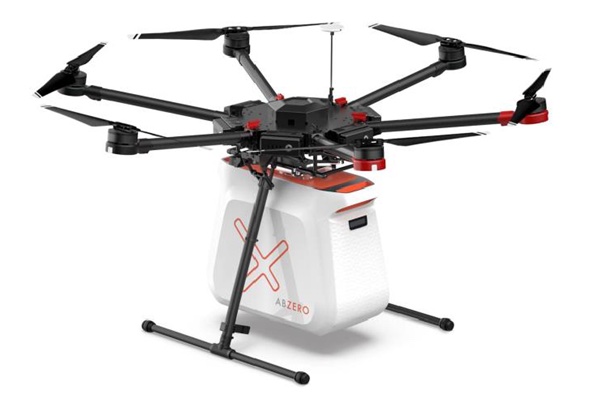
The consortium defined a range of representative operational scenarios, from commercial drone services to future certified eVTOL and urban air mobility platforms. These were then used to derive PNT performance requirements and develop corresponding navigation architectures.
At a recent event hosted by ESA, the TOPASE consortium presented work on a multi-sensor navigation demonstrator that combines GNSS, inertial measurement units (IMUs), barometric sensors and vision-based technologies. The system was designed to provide accurate and resilient positioning while supporting integrity-monitoring functions required for safety-critical applications.
To evaluate candidate solutions, the team developed a simulation and analysis framework capable of combining real and synthetic data. The framework incorporates GNSS measurements, multipath databases, IMU and altimeter models, and vision-sensor measurements, allowing different sensor configurations and navigation algorithms to be assessed under representative operating conditions.
Aerial testing
Flight trials and simulation campaigns covered static, take-off, cruise and landing phases under a variety of operating conditions, generating a substantial dataset for validation. The resulting measurements were processed using multiple navigation approaches, including weighted least-squares, standalone GNSS extended Kalman filtering and hybrid sensor-fusion algorithms combining GNSS, inertial and barometric data.
The project also investigated integrity-monitoring techniques, including carrier-to-noise and elevation-based fault-detection and exclusion methods. Performance was assessed using position and velocity errors together with integrity-event statistics for horizontal and vertical navigation during the different flight phases.
Results showed that cruise-phase performance generally met the requirements of the selected use cases, while take-off and landing remained the most challenging operational phases. Dual-frequency, multi-constellation processing generally improved positioning accuracy, although the impact on integrity performance varied depending on the operational scenario.
The study also examined the contribution of vision sensors. According to the project team, fisheye-camera measurements provided limited benefit in open-sky environments but showed greater potential during take-off and landing.
In all, TOPASE demonstrated how multi-sensor fusion and integrity monitoring can support trustworthy navigation for future autonomous aircraft. The consortium identified opportunities for further work involving additional sensors, improved failure modeling and enhanced simulation capabilities to support the continued development of certifiable UAS navigation systems.
TOPASE is another in an impressive series of PNT projects fully funded by NAVISP Element 1, aimed at building innovation in the European PNT sector.