
The single-rotor helicopter drone posted the competition’s best payload-to-weight ratio at 3.84 to 1, just short of DARPA’s 4-to-1 goal, and Avidrone says it will now develop the design for defense and industrial use.
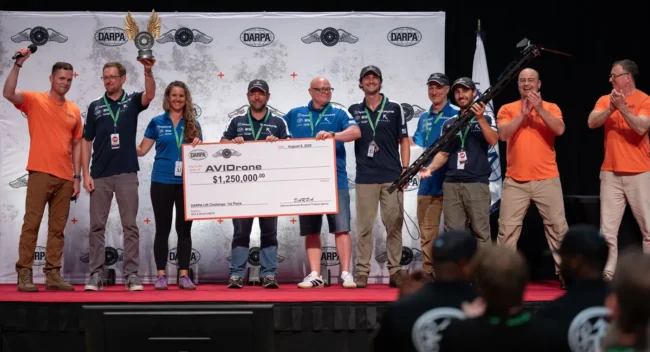
Avidrone Aerospace said this week it will develop a new version of Katana, the single-rotor helicopter drone that won the top prize at DARPA’s Lift Challenge, held Aug. 4-9 at the National Museum of the U.S. Air Force in Dayton, Ohio.
Katana carried a 51-kilogram payload aboard a 13.3-kilogram airframe, producing a payload-to-aircraft-weight ratio of 3.84 to 1, the closest any team came to DARPA’s 4-to-1 target when the agency opened the competition in November 2025. The Lift Challenge drew 124 registered teams, 76 of which reached the flight line, flying a 9.3-kilometer circuit course carrying a loaded payload out, dropping it, and returning empty within a 30-minute window. Katana used a conventional single-main-rotor, tail-boom helicopter layout, a design older than most production drones on the market, while several rival teams built unconventional airframes to chase the same payload target; Avidrone completed its winning run in 19 minutes and 17 seconds.
Because no team reached DARPA’s 4-to-1 goal, the agency halved its prize payouts. Avidrone collected $1.25 million instead of the advertised $2.5 million top prize; MTech Operations LLC placed second at a 3.64-to-1 ratio for $750,000, and Xtreme Aerial Concepts placed third at 3.45 to 1 for $500,000.
A Design Older Than Its Rivals
Avidrone attributed the result to years of in-house experience designing heavy-lift aircraft, with the company’s aircraft platform, propulsion system and flight-control technologies developed entirely in-house. Component suppliers on the winning build included Titan Batteries for battery modules, Scorpion Power System for custom motors and speed controllers, Falcon Propeller for carbon-fiber rotor blades, and Calian for the GNSS/GPS antenna system supporting high-accuracy positioning.
DARPA said it will support further maturation of promising Lift Challenge concepts through multiple Small Business Innovation Research topics and by connecting teams with investors through its Commercial Strategy Office, aimed at exploring transition pathways to national security and commercial applications. Avidrone, which maintains a U.S. office in Columbia, Maryland alongside its Canadian operations, said interest in Katana has grown since the competition. “We are moving forward with continued development of a commercialized version” for defense and industrial applications, the company said.