
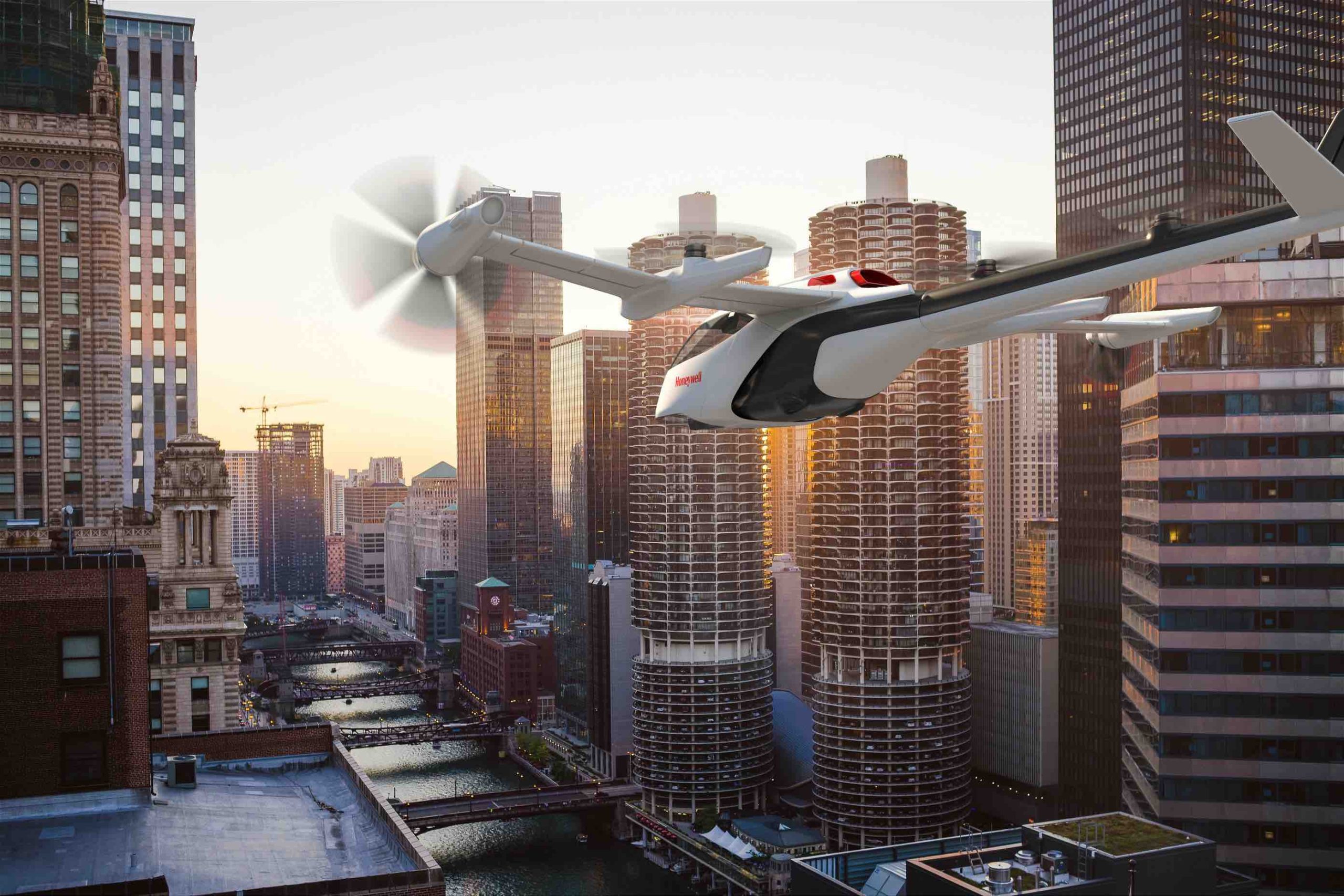
From compact fly-by-wire system to a glass cockpit for the urban sky, Honeywell is translating its avionics legacy into a scalable, always-connected architecture that could define the nerve center of tomorrow’s air taxis.
Reimagining Avionics for the Sky of Tomorrow
For decades, Honeywell’s name has been synonymous with avionics in conventional aircraft—from business jets to airliners and helicopters. Now, as advanced air mobility (AAM) matures into a viable transportation layer, the aerospace giant is reconfiguring its technology stack to meet a new set of demands: smaller aircraft, tighter urban corridors, and software-driven autonomy all with an equivalent level of safety.
At the heart of Honeywell’s avionics AAM initiative is Anthem, a software-defined, distributed avionics suite that rethinks the traditional boundaries between onboard hardware and cloud-enabled functionality. Unlike legacy flight decks, which are typically constrained by fixed-function architectures and tightly coupled displays and processors, Anthem is built on a modular framework that lets pilots customize their displays based on mission. The architecture is designed to be scaled across airframes, and support a broader autonomy tech stack. Designed from the ground up with, Anthem isn’t just a cockpit—it’s a digital ecosystem that can virtually support any type of aircraft, including large passenger and cargo, general aviation, business jets, and advanced air mobility.
“We really approached Anthem from a clean-sheet design perspective,” said Taylor Alberstadt, Accounts and Sales Leader for AAM at Honeywell. “It’s scalable, modular, and built specifically for these next-generation vehicles. The idea is to give aircraft OEMs something that is best-in-class today – but also somehting they can grow into as autonomy and regulatory clarity evolve.”
During our conversation, Alberstadt emphasized, “It’s not just the size—it’s the architecture, integration, and software. You’ve got smaller platforms, tighter spaces, and evolving pilot roles. Our system can scale with the mission.”
Anatomy of the Anthem System
The key components of the Anthem platform includes:
- Primary Flight Display (PFD) and Multi-Function Display (MFD): Designed for reconfigurability, the displays are simple, smart, and intuitive allowing both experienced and new pilots to quickly learn the system.
- Cloud Connectivity and Remote Interface: “It’s got a modern architecture that’s always-connected, modular, easy-to-use and ready for future autonomy applications,” added Sapan Shah, Sr. Product Director for AAM and Autonomy. “We’re building in not just connectivity, but a connected ecosystem that improves experience both in air and on the ground.”
When asked how Anthem compares to legacy avionics, Shah responded, “Think of it as the simple to use glass cockpit meets API-driven development. The HMI [human-machine interface] and the data flow are designed to be as flexible as the use cases demand.”
Anthem is currently flying including on Vertical Aerospace’s VX4, and in development on several other applications.

Compact Fly-By-Wire and Pathways to Autonomy
Honeywell’s Compact Fly-By-Wire system complements Anthem with a compact, triple-redundant digital flight control system that manages critical flight surfaces and propellers through software-defined signals. The system integrates high-integrity inertial sensing, control laws, and real-time feedback loops to continuously adjust flight parameters based on sensor fusion. “Our control laws are designed to adapt in milliseconds,” Alberstadt explained. “The system monitors inputs from inertial measurement units, actuator positions, and air data systems to provide smooth, reliable handling—even in dynamic flight conditions.” Shah added, “From fault detection to mode switching, the architecture includes multiple layers of redundancy, and it’s built to be certifiable under stringent DO-178C, ARP4754B, and DO-254 standards. That’s essential when you’re flying in dense urban airspace or carrying payloads autonomously,” by replacing mechanical control linkages with redundant, software-defined signal paths. “This is a triple-redundant system where each unit is about the size of a paperback book,” Alberstadt said. “It gives you safety-critical control and envelope protection in a very small footprint—ideal for eVTOLs and even larger drones.”
“We have customers integrating this system into air taxi and cargo UAVs,” said Shah. “It’s certifiable, it’s compact, and it’s ready today.”
When asked how the system supports automation, Alberstadt explained, “Every layer of our fly-by-wire is designed to support either a pilot, a remote operator, or an autonomous control layer. We’re not building isolated subsystems—we’re building a continuum.”
Ground Control Station for a Fleet
For early-stage AAM operations, particularly those exploring BVLOS and urban airspace integration, Honeywell is developing a Ground Control Station (GCS) that allows remote operators to manage either a single vehicle or a fleet of autonomous aircraft BVLOS. The GCS is designed to be agnostic to onboard flight computers and communication systems and will interface seamlessly with urban air traffic management (UTM) systems.
“Our certifiable GCS is built to support autonomous UAS operations in both commercial and defense logistics market ,” Shah emphasized. “That means remote pilots, fleet supervisors, and autonomy managers are all working from a common picture, tightly synchronized with the aircraft’s onboard logic.”
The GCS architecture supports secure data uplink/downlink, real-time telemetry, and plug-ins for UTM APIs—enabling integration with geofencing protocols, and traffic deconfliction services. The system is also extensible to multi-aircraft operations, allowing a single ground crew to monitor, re-task, or intervene across a fleet.
This design philosophy—of unified, cloud-connected interfaces—positions Honeywell’s autonomy suite not just as a cockpit replacement, but as an ecosystem enabler, capable of supporting full-stack autonomy across highly regulated and dynamically evolving urban skies.
“We’re seeing interest from customers who want to leverage Honeywell’s deep legacy in building certifiable HMI. That experience is now being brought into the design of an intuitive, easy-to-use, and certifiable GCS,” said Shah. “Whether it’s monitoring a single aircraft or managing an entire fleet, this combination of certification expertise and intuitive design is critical for ensuring safety and enhancing situational awareness.”
The GCS includes data uplink/downlink tools, mission management, and advanced automation to reduce operator workload and training requirement.
Navigating Without GPS
As unmanned aerial systems (UAS) expand across industries, GPS reliability is becoming a concern. Signals are increasingly disrupted, denied, or spoofed, threatening safe operations. Honeywell is tackling this challenge with a multi-layered strategy for alternative navigation, ensuring drones and autonomous aircraft can operate even without GPS.
“Navigation resilience is no longer optional — it’s essential,” said Shah. “We’re building systems that can guide aircraft safely, even when GPS is compromised.”
A key layer to this approach is vision-based navigation, which uses cameras and software to compare live images with maps. Tested on an Embraer E170 and AW139 helicopter, Honeywell’s system delivered GPS-like accuracy and improved performance by 67% over previous trials. It’s passive and non-jammable, making it ideal for contested environments.
In 2022, Honeywell also demonstrated magnetic anomaly navigation, using Earth’s magnetic field as a natural map. In what was the world-first airborne test, the system accurately identified position in real time, proving its reliability in all-weatherconditions.
“Each layer of navigation adds a safety net,” said Alberstadt. “If one system is blocked, another can take over.” Another layer is celestial navigation, which tracks stars and Resident Space Objects (RSOs). This system has achieved 25-meter accuracy and marked the first airborne use of RSO-based navigation, offering a passive, GPS-like alternative.
Honeywell’s modular systems are designed for various aircraft sizes and missions. Building on a legacy dating back to 1914 with the first autopilot developed by Lawrence Sperry, Honeywell continues to lead in guiding aircraft safely — even when GPS isn’t an option. “Whether it’s a drone in a city or a long-range autonomous aircraft, we’re making sure it knows where it is — no matter what,” said Shah.
The Role of AI and Machine Learning
Honeywell’s autonomy systems are primarily designed for deterministic performance, which remains essential for safety, reliability, and certifiability. However, AI and machine learning are being actively evaluated as an option for their potential to enhance and compliment specific capabilities—particularly in perception tasks such as vision-based navigation.
“We’re seeing meaningful benefits from machine learning in how systems interpret complex environments,” said Shah. “But it’s important to recognize that these applications have to be bounded and explainable, especially in aviation where safety, trust, and traceability are non-negotiable.”
Alberstadt added, “AI isn’t controlling flight-critical systems, but it’s helping us understand the world more effectively. It can be another tool for the operator or a pilot. That’s especially true in visual perception, where AI/ML can assist in identifying features and navigating dynamic scenarios.”
The use of machine learning is carefully considered and varies by platform. For example, smaller UAS or middle-mile cargo vehicles may allow for more flexibility in AI/ML integration, while passenger or crewed aircraft require a more conservative approach.
This hybrid strategy—leveraging ML where it adds clear value while anchoring core functions in deterministic code—reflects a broader industry trend toward autonomy that is both intelligent and verifiable.
Built to Scale
What sets Honeywell’s architecture apart, the team emphasized, is that all of these capabilities—Anthem, fly-by-wire, GCS, and GPS-free nav, just a few of the enabling technologies in Honeywell’s broad portfolio —are designed to scale across the lifecycle of AAM operations.
“You might start with a pilot in the loop, but our systems are built to be adaptable and scalable to transition to remote or autonomous ops over time,” said Shah. “You don’t have to reinvent the stack—it’s already extensible.”
“And frankly,” added Alberstadt, “if you’re building for certification, you can’t afford to throw the architecture out midstream. Building upon a well-established, certifiable foundation enables the growth necessary to address future market needs.”
Defense as the frontier of Autonomy
While in the commercial segment autonomy is often associated with advanced air mobility (AAM), Honeywell sees defense as the most immediate and impactful proving ground. The operational demands of contested logistics, ISR, and tactical missions make defense platforms ideal candidates for early autonomy adoption—especially where missions are too risky, too frequent, or too remote for human pilots alone.
“We don’t believe any single player will bring autonomy to aviation on their own,” said Shah. “That’s why Honeywell is partnering—bringing together our certifiable systems with the innovation from our partners such as Near Earth Autonomy (NEA) to deliver real capability to warfighters. Here lies the opportunity for autonomy to handle some of the dirty, dark, dull, or dangerous missions”
Honeywell is actively collaborating on multiple defense programs with NEA, including efforts to make the AW139 and Blackhawk helicopters optionally piloted for a range of mission profiles. These platforms are being adapted for autonomous operations using Honeywell’s certified navigation and avionics systems—combined with NEA’s technologies—to support expeditionary logistics in contested environments.
This approach reflects Honeywell’s broader autonomy strategy: leveraging proven, certifiable systems as a foundation, while integrating advanced autonomy features through collaboration.
Certifying the Future
Honeywell is actively engaging with FAA, EASA, and global regulators to define certifiable pathways for autonomy.
“We know autonomy won’t be certified overnight,” said Shah. “But everything we’re doing—every system, every data pipe—is being built with that eventual cert path in mind.”
That includes DO-178C and DO-254 compliance.
“Our goal,” Alberstadt concluded, “is not just to enable autonomy. It’s to do it in a way that is first and foremost as safe or safer than today’s operations, scalable, and certifiable. That’s what it takes to unlock this next era of aviation.”
Autonomy Tech Stack – Layered Intelligence
Honeywell’s Autonomy Stack Breakdown:
- See: Environmental sensing and navigation
- Vision aided navigation, Magnetic Anomaly aided navigation, Celestial aided navigation, Inertial Navigation Systems
- Think: Situational awareness, decision-making, mission planning
- Anthem and Ground Control Station
- Act: Flight Control and Actuation
- Fly-by-wire and actuators
Modular, Mission-Ready Autonomy: Honeywell’s autonomy stack is built around a layered architecture that mirrors how pilots operate: sensing the environment, interpreting it, and acting decisively. Each layer is modular and certifiable, allowing for tailored integration across platforms—from optionally piloted rotorcraft to tactical UAVs.
Inside Anthem – A Modular Architecture at a Glance
Why It Matters: Anthem’s architecture disaggregates compute, display, and data management—paving the way for scalable autonomy and faster certification cycles.
| Component | Function | Notable Feature |
| Primary Flight Display (PFD) and Multi Function Display (MFD) | Pilot interface, Situational awareness, navigation, mission tools | Intuitive, fully reconfigurable layout, scalable |
| Remote Interface & Cloud Gateway | Cloud connectivity and remote interface | Uplink/downlink, health monitoring, software updates; Edge-cloud orchestration built-in |
How Honeywell Navigates Without GPS
Sensor Modalities and Their Applications:
| Sensor Modality | Operational Environment | Target platforms |
| Vision Aided | Urban canyons, low altitude | Munition, Cargo UAVs |
| Magnetic Anomaly Aided | All weather, Day or Night Solution | Fixed wing aircraft, Large UAVs, Fighters and Munitions |
| Celestial Aided | Long range, high altitude missions | Large UAVs, Fighters, Long Range Missiles |
Navigation Strategy: Honeywell’s autonomy architecture is designed to be modular and resilient—enabling sensor substitution and augmentation based on mission needs.