
The five-year IDIQ splits hardware and services into two tracks, giving Secret Service, CBP, the Coast Guard and other components a common pathway to counter-drone capability as the department works to close gaps in its own defenses.
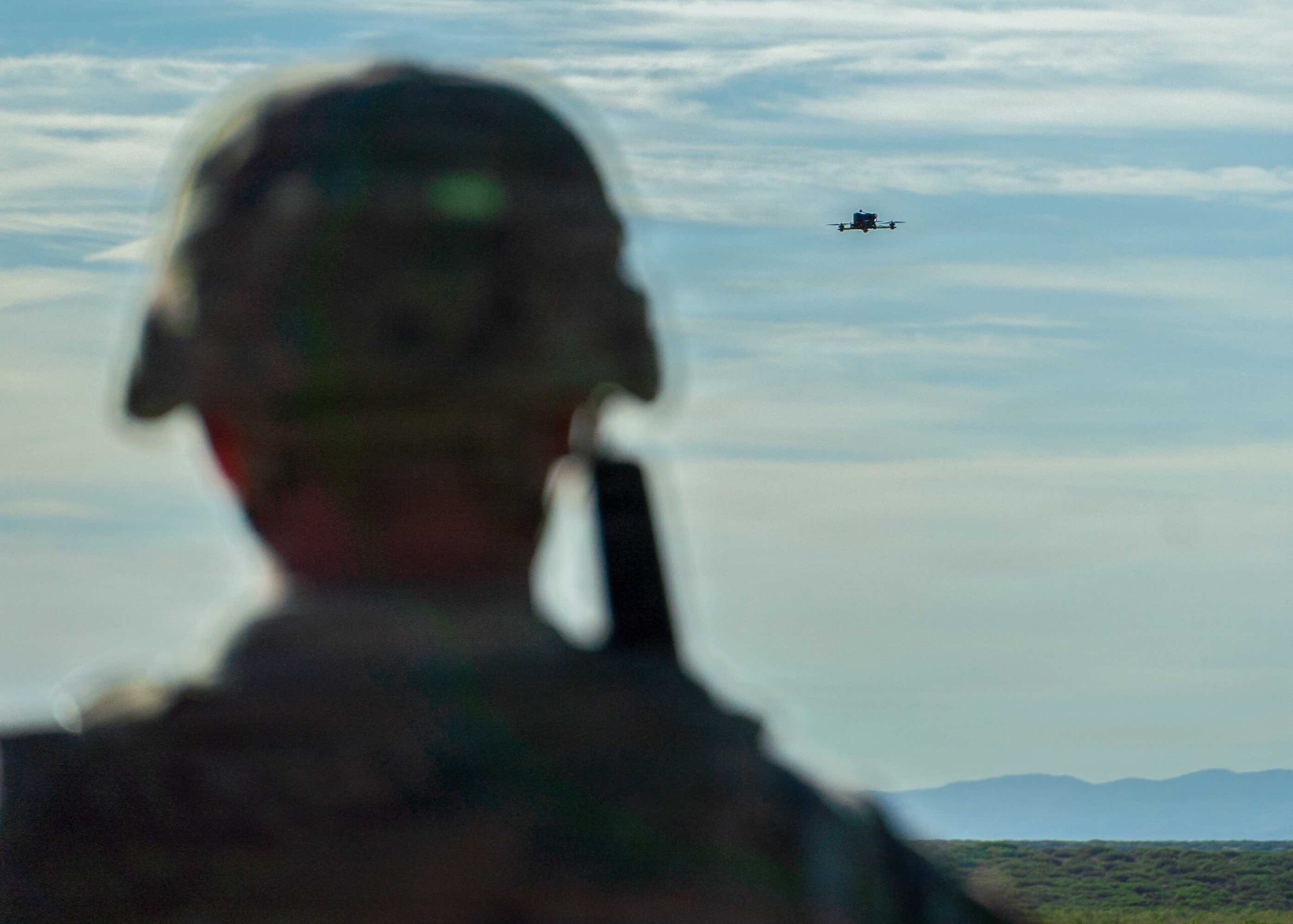
U.S. Army soldiers aim a Wingman/Pitbull C-sUAS system at a drone during joint counter-drone training with CBP at Fort Bliss, Texas, April 9, 2026. (DoD photo by Mass Communication Specialist 1st Class Melvin J. Gonzalvo)
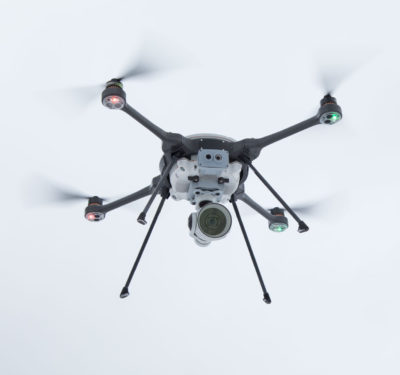
The Department of Homeland Security has awarded a five-year, $1.5 billion indefinite-delivery/indefinite-quantity contract for counter-unmanned aircraft systems, naming 12 companies across two tracks to give DHS components a shared acquisition pathway for detecting, tracking, identifying and mitigating drone threats.
DHS announced the awards August 5, saying the contract vehicle, issued by the department’s Science and Technology Directorate, replaces a patchwork of separate procurement efforts historically run by individual components. Ordering opened August 1 and runs through July 31, 2031.
A Broader Legislative Push
The contract lands amid a broader expansion of DHS’s own legal authority to counter drones. In December 2025, Congress passed the SAFER SKIES Act as part of the fiscal 2026 National Defense Authorization Act, extending and broadening the C-UAS mitigation authorities DHS and the Department of Justice first received under the FAA Reauthorization Act of 2018 — authorities that had briefly lapsed the prior October amid a lawmaking impasse. The new law also opened C-UAS authority to state, local, tribal and territorial law enforcement and correctional agencies for the first time, under an interim final rule that took effect July 1, 2026 covering training, certification, authorized technologies and mitigation reporting.
DHS previewed the contract vehicle in January, when it launched a dedicated Unmanned Aircraft Systems office to speed procurement and deployment of drone and counter-drone technology department-wide. At the time, DHS described the pending $1.5 billion award as a way for components such as CBP and Immigration and Customs Enforcement to quickly and strategically acquire technology needed to protect officers and the public, and credited the December authority expansion alongside FEMA’s rollout of $250 million in counter-drone grants to the 11 states that hosted FIFA World Cup 2026 matches and the National Capital Region.
“These awards mark an important step in strengthening DHS’s ability to respond to unauthorized and malicious unmanned aircraft systems,” said Homeland Security Secretary Markwayne Mullin. “By taking a Department-wide approach, we are improving mission readiness, supporting more consistent capabilities, and helping ensure DHS personnel have access to the right tools for the job.”
Justin Napolitano, chief security officer for the DHS management directorate, said the contract addresses a recurring operational gap between components. “Protecting DHS personnel, facilities, and operations requires capabilities that are reliable, interoperable, and adaptable to different mission environments,” Napolitano said. “This Department-wide approach will help Components access C-UAS solutions that can support fixed-site security, mobile operations, special events, and other mission needs.”
Two Tracks, 12 Companies
The contract splits work between two tracks. Track 1 covers hardware, software and ancillary services, with an estimated ceiling just over $1 billion, and went to seven companies: Dedrone Defense, D-Fend Solutions AD, Leidos, Fortem Technologies, CACI Inc.-Federal, BAE Systems Technology Solutions & Services, and EMS Defense Technologies. Track 2 covers comprehensive services — counter-drone capability delivered as a fully managed service, system integration and support for research, development, testing and evaluation — with a ceiling of roughly $489 million, and went to Booz Allen Hamilton, General Dynamics Information Technology, Parsons Government Services, BAE Systems Technology Solutions & Services, Leidos, Anduril Industries and Astrion Group. Only Leidos and BAE Systems Technology Solutions & Services appear on both award lists; the remaining 10 companies hold a single position apiece. Forty-seven vendors bid on the vehicle.
Fortem, which the company said is the only small business among the Track 1 winners, named Lockheed Martin and Microsoft as subcontractors on its team, adding electro-optical/infrared, radio frequency, passive radar and C4 capabilities to its offering.
Under the statement of work, systems fielded through the contract must be able to detect a drone at a minimum range of 2 kilometers, track at least three UAS simultaneously, and neutralize a threat at a minimum range of 500 meters. Chosen contractors must also deliver detailed testing reports validating system performance and provide training covering setup, operation and maintenance for DHS components.
DHS components expected to draw on the contract include the Secret Service, Coast Guard, Customs and Border Protection, Immigration and Customs Enforcement, Transportation Security Administration, FEMA, Federal Protective Service, Citizenship and Immigration Services, and the Science and Technology Directorate itself.
Closing the Gap
“As unmanned aircraft systems become more capable and more widely available, DHS needs solutions that can adapt,” said Under Secretary for Science and Technology Pedro Allende. “This effort supports a technology refresh model that will help the Department keep pace with changing threats, emerging tools, and evolving operational requirements.”
The award follows months of public acknowledgment from DHS leadership that the department’s own counter-drone defenses lag behind its offensive drone investment. Testifying before the House Appropriations Homeland Security Subcommittee in June, Mullin told lawmakers DHS had invested heavily in offensive drone capability but still needed to strengthen its own defenses against drones. Speaking at a Commercial Drone Alliance event days before the award, Allende said the department was “behind the hook,” adding that no option was off the table — from layered defenses and jamming to takeover systems and kinetic intercept methods.
Allende also pointed to the length of standard federal contracting as a hindrance, telling the same event he was working to secure Other Transactions Authority for DHS S&T to move more quickly. OTAs, which fall outside the Federal Acquisition Regulation, would give the department more flexibility to work with non-traditional contractors, though the authority carries tradeoffs in accountability and transparency. DHS’s prior legislative authorization for OTA use expired in 2024; a bill extending that authority through fiscal 2027 cleared the House but has stalled without further action.
The contract’s timeline slipped from DHS’s original expectations. In a response to a solicitation question in November, the department had projected IDIQ start dates in December — roughly eight months ahead of the actual award — delays the department attributed in part to a funding lapse that affected DHS operations for much of the intervening period.
State Funding and Continued Scrutiny
The awards come as DHS separately moves to strengthen counter-drone capability at the state and local level. A $500 million Counter-Unmanned Aircraft Systems Grant Program, established under the One Big Beautiful Bill Act, distributed its first $250 million tranche in December 2025, with a second $250 million round appropriated for fiscal 2027. Charles Werner, director of the nonprofit DroneResponders, said state and local agencies still lack a clear sense of federal prioritization for that funding and have raised questions about how the various funding streams will work together as awards continue.
The IDIQ award also lands roughly two years after a DHS Office of Inspector General report, released June 30, 2026, faulting an inexperienced counter-UAS operator and delayed technical support for a missed detection opportunity during the July 2024 assassination attempt against then-candidate Donald Trump in Butler, Pennsylvania — an incident that has continued to shape congressional scrutiny of the Secret Service’s drone-defense posture.