
While JIATF 401 invites NATO allies to buy into a U.S.-run counter-drone marketplace, Stockholm’s Nordic Air Defence, Germany’s biggest primes, and Poland’s state-anchored East Shield program are each building their own answer, on their own schedule.
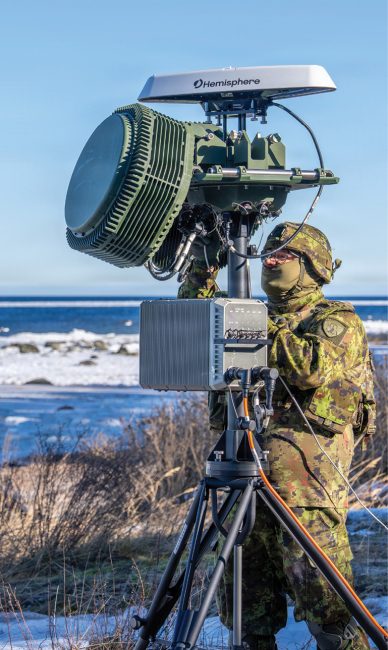
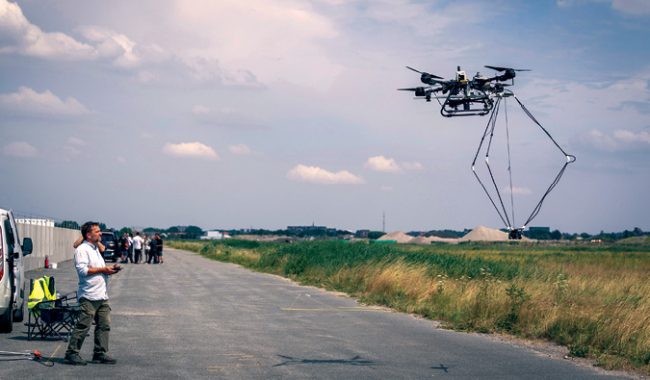
Nordic Air Defence held its first public live demonstration of its K100XR counter-drone interceptor in early July, inviting journalists to Sweden to watch the system detect and engage target drones, tour the command site where operators work, and meet the engineering team behind it. It was the company’s first chance to show the interceptor performing rather than describing it through press materials, technical briefings and renderings, and it arrived at a moment when a growing slice of the European counter-drone conversation is about who builds the answer, and how fast, not just who buys it.
The Stockholm-based company is barely two years old. Founded in March 2024, it has grown to roughly 23 employees on approximately $4.4 million raised across two funding rounds, the second led by Inflection, a fraction of the capital the counter-UAS primes now working with the Pentagon’s Joint Interagency Task Force (JIATF) 401 have committed to Domestic Shield contracts over the same stretch.
What the Kreuger 100 Family Does
The K100XR is a performance variant of Nordic Air Defence’s baseline Kreuger 100 interceptor rather than a separate platform: The baseline tops out around 270 kilometers per hour, while the XR variant exceeds 354 kilometers per hour, or roughly 220 miles per hour. Built from carbon fiber and weighing about half a kilogram, it can loiter over an area for at least 20 minutes waiting for a target, engage threats at altitudes around 3,300 feet and ranges beyond three kilometers, and uses onboard artificial intelligence to detect, classify and track a hostile drone without continuous operator input. An integrated thermal infrared seeker lets it operate at night or through cloud cover, and it can switch into a fully autonomous, radio-silent mode when jamming makes normal ground control unreliable, a feature built specifically for the kind of signal-disrupting warfare that has become routine in Ukraine.
“The drones are designed for detecting and engaging target drones in real time,” said Karl Rosander, Nordic Air Defence’s chief executive and co-founder, describing the system as a faster-maneuvering alternative to missiles and other traditional armaments. On price, a round costs a few thousand dollars, according to the company, putting three K100XR rounds less than a single $480,000 FIM-92 Stinger missile.
Rosander has made the case publicly, and repeatedly, that speed of fielding matters as much as the technology itself. Discussing a wave of drone incursions that shut down European airports last fall, he told The Telegraph that protecting public spaces against drones “needs a more sophisticated solution than just shooting them down.” And writing in Svenska Dagbladet with Moderate Party lawmaker Tobias Billström, Rosander argued that Sweden was still procuring defense capability as though it had unlimited time, calling instead for separate, faster procurement pathways matched to the pace of the threat.
The company plans to run trials in Ukraine against Shahed-type drones, following winter testing that Dominic Surano, Nordic Air Defence’s director of special projects, described in November 2025 as the next step toward validating the system in the same threat environment that inspired it.
Photos courtesy of French OR-9 Arnaud Chamberlin/NATO.
Not Just an Interceptor: Vehicle Protection, Too
Nordic Air Defence has also moved to embed the K100XR into vehicle protection rather than sell it only as a standalone interceptor. In September 2025, the company partnered with Volvo Defense on VIPRO, a compact, vehicle-mounted counter-drone pod built to launch the interceptor directly from military trucks rather than requiring a separate ground battery. “VIPRO combines Volvo’s legacy of engineering excellence with Nordic Air Defence’s cutting-edge defence innovation and agility to deliver a truly European solution to the number one threat in land warfare,” Rosander said of the partnership, which is due to reach the market this year. The logic tracks battlefield data out of Ukraine, where NATO assessments have found cheap first-person-view drones responsible for roughly two-thirds of Russian equipment losses, a toll that has made the logistics trucks and troop carriers military forces still depend on newly exposed. Sweden’s own Defence Materiel Administration underscored the stakes in February 2025, placing an order for 775 trucks from Volvo and Scania to expand the country’s armed forces, a fleet VIPRO is designed to help protect.
Germany Builds Its Own Layered Answer
Germany’s counter-drone buildout looks nothing like Nordic Air Defence’s lean, partnership-driven model, but it shares the same underlying instinct: build domestically rather than import a finished system. Rheinmetall and MBDA Germany plan to form a joint venture in early 2026 to develop naval laser weapons against drones, building on a shipboard demonstrator that ran for a year under real-world conditions. Diehl Defence has relaunched its Garmr mobile counter-drone system, now extending beyond 70 kilometers with its Cicada interceptor drone, an upgrade from the Kinetic Defence Vehicle Diehl already delivered to Ukraine. And Rheinmetall has partnered with Deutsche Telekom on a cellular-based drone detection system, with Telekom stating that the companies are “elevating drone defence to a new level” by combining Rheinmetall’s kinetic and sensor expertise with Telekom’s network and data infrastructure.
That buildout is happening in part because a broader, European Union-level “drone wall” proposal has stalled, blocked by France and Germany themselves over questions of funding and control. Belgium had to ask Berlin directly for help after drone incursions closed Brussels and Liège airports, and Germany sent Bundeswehr counter-drone specialists and equipment in response. Rather than wait for Brussels to resolve that standoff, Germany has kept building its own capability at the national level, backed by an October 2025 law granting police shoot-down authority over rogue drones.
Poland’s Two Tracks
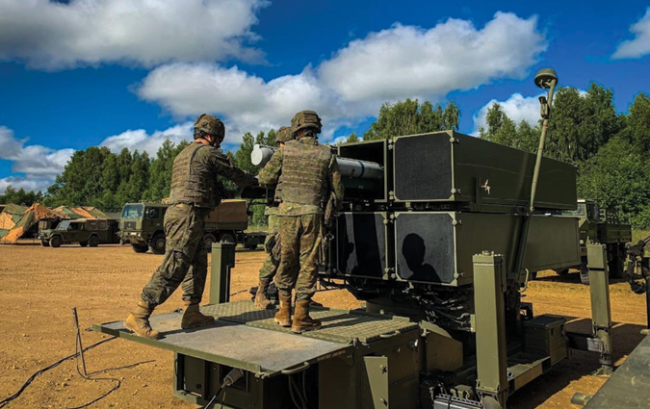
Poland is running two counter-drone efforts at once, at very different scales. The larger is East Shield, the border-hardening and air-defense program Prime Minister Donald Tusk announced in May 2024 and accelerated after more than a dozen suspected Russian drones crossed into Polish airspace last September, forcing airport closures and fighter sorties. Its counter-drone centerpiece is San, a mobile, modular system built around 18 anti-aircraft batteries, 52 firing platoons and roughly 700 vehicles, awarded in a contract signed on January 30 to a consortium led by Polska Grupa Zbrojeniowa with Norway’s Kongsberg Defence and Aerospace. It is valued at roughly 15 billion zloty, or about $4.2 billion, with much of the funding drawn from the European Union’s SAFE loan program. “We will be able to react in an extremely effective way against the threats that originate from the east,” Deputy Prime Minister and Defense Minister Władysław Kosiniak-Kamysz said at the signing.
The second track is smaller and faster-moving: Nordic Air Defence’s own letter of intent with Polish firms WB Group and Tantalit, under which Nordic Air Defence remains design authority and lead developer for the interceptor itself while its Polish partners supply the artificial intelligence software, systems integration and battlefield networking, with local production under feasibility study. “Poland is one of the most important defense markets in Europe today,” Rosander said of the arrangement. Warsaw is, in effect, hedging: building a massive, state-anchored national system for the border as a whole, while leaving room for smaller, more nimble partnerships to move faster on specific pieces of the problem.
Different Speeds, Same Threat
Set against JIATF 401’s marketplace, built to let U.S. and allied buyers shop a shared, vetted American catalogue, the European picture looks less like a single alternative model and more like several different bets running in parallel: Sweden’s small, agile interceptor startup; Germany’s multi-vendor, largely domestic industrial buildout, pursued partly because the EU’s own drone wall stalled in Brussels; and Poland’s split between an enormous state-anchored national system and outside partnerships built for speed. Rosander himself has pointed to the gap between those tracks. Europe, he has said, “is making a lot of noise about its drone wall,” but building it will take time the continent may not have. Whether Nordic Air Defence’s smaller, faster model or Poland’s and Germany’s larger industrial ones close that gap first is likely to be decided less by any single procurement decision than by whichever government’s threat picture forces its hand next.