
On June 29, the Department of War stood up a new office and gave it a mandate few Pentagon organizations ever get: single joint integrator for nearly every uncrewed and autonomous system program in the department, with authority to direct budgets, halt fielding decisions, and cut through the layers that have slowed procurement for a decade. Eleven days later, on the other side of the regulatory ledger, the FAA sent its long-awaited BVLOS rule to the White House’ Office of Information and Regulatory Affairs (OIRA) for final review, the last stop before finalizing a regulation that would finally let BVLOS drone operations run at scale under a standardized framework instead of a patchwork of waivers.
Different agencies, different missions, the same underlying signal. The structures that have kept commercial and defense uncrewed systems on separate tracks are being rebuilt at the same moment. Companies that treated that line as permanent are about to find out it was never as fixed as it looked.
The Industry Made the Same Case in Congress
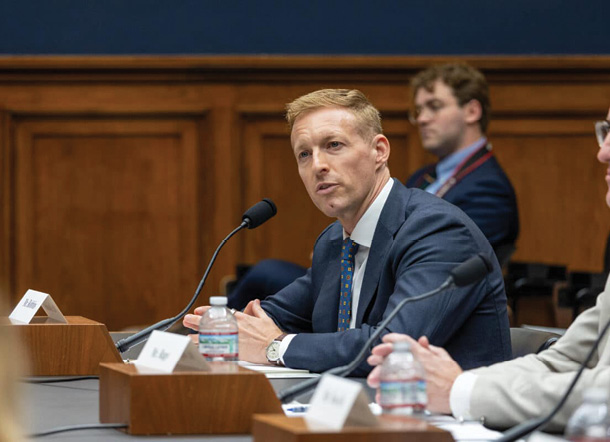
Our own AUVSI members made this exact argument to Congress, five days before that Part 108 submission reached OIRA. At AUVSI’s 2026 Hill Day, more than 100 industry leaders sat down for over 90 meetings on Capitol Hill, and two of the specific asks they carried into those rooms called for increased military UAS procurement funding “directing investments toward dual-use systems to help industry scale production and reduce costs,” and sustained defense industrial base funding
“prioritizing dual-use acquisition to strengthen both defense readiness and commercial industrial capacity.” Alongside those asks sat a third: hold the FAA accountable to finalizing the BVLOS rulemaking. Our members were not treating the regulatory rule and the procurement ask as separate conversations. They were making the same argument in the same room on the same day.
That is the real story behind “commercial goes defense.” It is not just that battlefield success in Ukraine and elsewhere has made small, attritable drones appealing in defense circles, though it has. It is that the regulatory and procurement infrastructure on both sides of the commercial-defense divide is maturing in parallel, and the industry itself is asking Congress to treat that convergence as policy, not coincidence.
Consider what DRPM-UxS will actually do. Beyond centralizing existing defense programs, it creates a single point of contact for industry and chairs the small UAS industrial base working group Congress mandated in last year’s defense authorization act. For a commercial manufacturer that has spent years building the safety case and operational track record BVLOS regulations will require, that is an invitation. The credibility a company builds through operational detect-and-avoid systems and standardized BVLOS flight records is exactly the maturity DRPM-UxS is signaling it wants from suppliers who can scale production.
The Convergence Isn’t Automatic
Like with all things in autonomy, none of this is automatic. None of this is easy. A new Pentagon office with sweeping authority and no director yet named is a structure, not a guarantee. A rule sitting at OIRA can still slip, and this one already has, more than once. The companies that win this moment are building for both customers now, treating certification and compliance work as an asset that pays out on either side of the line rather than a cost specific to one, not waiting for both processes to finish first.
AUVSI’s own membership makes this case every day. We represent nearly 500 organizations and more than 7,000 professionals spanning defense, civil and commercial markets, and the conversations happening inside our industry right now are not about choosing a lane. They are about which companies are structured to move between them. That is what commercial goes defense actually means in 2026: two separate bureaucracies moving at the same speed and an industry built to serve both.