
At SOF Week 2026 in Tampa, the program managers of U.S. Special Operations Command’s Program Executive Office for Tactical Information Systems walked industry through a portfolio that now spans unmanned systems in four domains, next-generation sensing, tactical communications and the data standards meant to hold it all together.
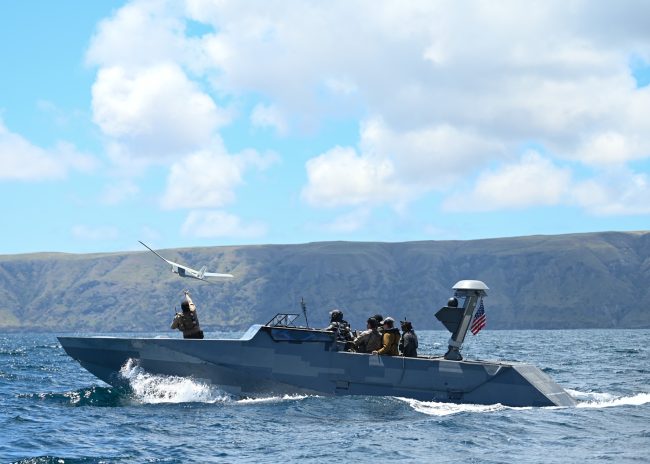
A West Coast-based Naval Special Warfare operator launches a Puma RQ-20, an unmanned, hand-launched, intelligence gathering aircraft system, from a combatant craft (assault) during U.S. Pacific Fleet’s Unmanned System Battle Problem (UxS IBP). UxS IBP 23 is a U.S. Pacific Fleet experiment, executed by U.S. 3rd Fleet, operationalizing multi-domain employment of unmanned systems to create Fleet warfighting advantages. (U.S. Navy Photo by Mass Communication Specialist 1st Class Chelsea D. Meiller)
The message to vendors was consistent: bring mature systems, build to common standards, and use the front doors the command has already opened.
When U.S. Special Operations Command’s acquisition arm briefs industry, the format is familiar: mission statements, portfolio charts, points of contact. What distinguished the “PEO Overview: Tactical Information Systems” session at SOF Week 2026 in Tampa was how plainly the program managers connected those charts to a single architectural argument. The command is buying autonomy and sensing at scale across air, ground, maritime and space, and it intends to knit those acquisitions together through modular payload standards, common data interfaces and edge processing — not through any one platform.
For companies in the autonomous systems sector, the session functioned as both an organizational map and a buying signal. It is worth unpacking in detail.
What PEO-TIS Is
The Program Executive Office for Tactical Information Systems, or PEO-TIS, is a comparatively new construct within Special Operations Forces Acquisition, Technology and Logistics (SOF AT&L), the command’s acquisition enterprise headquartered at MacDill Air Force Base. USSOCOM acquisition executive Jim Smith announced the consolidation at SOF Week 2023: the legacy PEO for Command, Control, Communications and Computers (PEO C4) and the PEO for Special Reconnaissance (PEO SR) would merge into a single office aligned, in the command’s framing, with the National Defense Strategy and with USSOCOM’s pursuit of collaborative autonomy across unmanned systems on land, in the air and at sea. The merger was complete by October of that year.
The resulting portfolio is large. According to SOF AT&L’s published program descriptions, PEO-TIS is responsible for the acquisition, fielding and sustainment of intelligence and tactical communication systems for SOF, with modernization strategies that emphasize intelligence, surveillance and reconnaissance; resilient communications; and collaborative and autonomous unmanned systems. Notably, the command’s garrison enterprise networks did not move into the new PEO; those remained under a separate Director for Enterprise Information Systems. PEO-TIS is the tactical edge.
The SOF Week session presented that portfolio through several program-office lenses, three of which of particular significance being: Remote Capabilities, Technical Collection and Communications, and Tactical Communications.
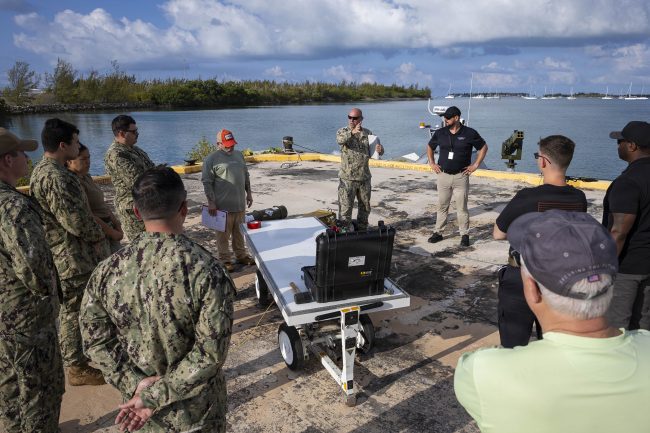
Remote Capabilities: The Autonomy Portfolio
The Remote Capabilities (RC) office carries the autonomous systems mandate in the most literal sense. Its mission statement, as briefed, is to develop, field and sustain unmanned systems across space, air, ground and maritime domains, and to enable autonomous collection and exploitation of ISR sensor capabilities in support of SOF operations in permissive and contested environments.
The office presented four lines of effort. Small Unmanned Multi-Domain Systems (sUMS) covers Group 1 and 2 unmanned aerial systems and unmanned ground systems, fielding what the slide called tactical organic robotic and modular payload solutions for the SOF operator. Tactical Unmanned Aerial Systems (TUAS) acquires the Group 3 UAS materiel solution against USSOCOM’s requirements for organic, tactical, runway-independent launch and recovery. A third element, National System Support to SOF / Tactical Exploitation of National Capability (NSSS/TENCAP), is a Military Intelligence Program-funded research and development effort to pull Intelligence Community capabilities down to the tactical SOF warfighter through rapid prototyping and transition to programs of record. The fourth, Space-Based Capabilities, provides rapid prototyping and demonstration of SOF-relevant space technologies in support of acquisition requirements.
The capability development areas the office listed read as a statement of where SOF autonomy is headed: swarm technology, decentralized control and collective intelligence, environment-agnostic traversability, and what the slide called value-driven multi-purpose solutions. The office is looking for high technology readiness level systems that are flight-demonstration ready, with autonomy, long-endurance ISR, the ability to operate in contested and denied environments, 24/7 organic operations, and safe land and sea launch and recovery. It also flagged modular payload development as a means of informing future program-of-record requirements, fielding decisions, tactics and concepts of operation, and identified the transition of developed technologies into proliferated satellite constellations — defense or national — to address SOF-peculiar operational needs.
Two concrete industry opportunities were posted on the Remote Capabilities slide: a Ground Robotics Element and Team Man Portable Systems capability assessment event via SOFWERX in the third quarter of fiscal 2026, and a small UAS capability assessment event, focus area to be determined, via SOFWERX in the first quarter of fiscal 2027.
The portfolio lead told the audience that the command’s ground robotics requirements “were just validated in March of this year,” opening the door to solicitations across the different categories of ground robotic products that will flow through in the coming cycle. He also described the office’s responsiveness when fielded systems hit problems: in one recent case involving a long-endurance Group 2 UAS, “there was a RFI that was put on the street last week,” turned around within roughly a week of the issue surfacing, to scout new systems in that category. As a baseline, he said, the office typically looks at “three-ish RFIs per year per system,” but the team moves dynamically when the operational environment changes.
His advice to vendors answering those RFIs was unambiguous about maturity. The office is looking to field what it selects, and “if I need to do development work, that development work is probably going to be after I fielded it” — typically software modification or SOF-peculiar adaptation, such as marinizing a system for Naval Special Warfare operators who need to run equipment never designed for small boats. The standing guidance: “look for those mature items that are tested, look for those things that can be produced and scaled, look for those things that operate in contested environments.” Systems that are finicky at the edge need not apply.
Technical Collection and Communications: Sensors at the Edge
The Technical Collection and Communications (TCC) office briefed a sensing portfolio that overlaps heavily with the autonomy enterprise even though it owns relatively few platforms. Its capability development areas, per the slide, include next-generation sensors — maritime sensors, remote triggering sensors, semi-attended remote cameras and multi-modal unattended sensors — alongside reconnaissance, surveillance and target acquisition (RSTA); maritime, aircraft and ground-based blue force tracking and personnel recovery variants; low-cost mobile ad hoc networking (MANET) capability; ATAK tracking over high frequency; high-bandwidth global SATCOM options in handheld form; denied environment operations; and non-RF alternative positioning, navigation and timing solutions.
The inclusion of non-RF alternative PNT as a named capability development area in a SOF sensing portfolio reflects the same operational reality driving alternative-PNT investment across the Defense Department: GPS cannot be assumed in the environments where SOF expects to operate, and sensors and unmanned systems that depend on it inherit its fragility.
The TCC presenter described a portfolio of camera and sensor systems that capture high-fidelity imagery and feed it back to operators, plus a partner-force mission planning and command-and-control capability that allows SOF to plan with partner forces and share access to real-time information. The office’s appetites, the presenter said, run continuously toward next-generation sensors — maritime, remote triggering, low-power ground sensors — and the networking capabilities that connect them.
The office also posted the session’s nearest-term solicitations. Two requests for information were planned for release shortly after SOF Week: one for a low-cost MANET, tied on the slide to a third-quarter fiscal 2026 release, and an other transaction agreement for an RSTA family of systems, which the presenter said the office hoped to release in June. Since the session, PEO-TIS has also posted a notice for UxV Payloads Against Modern Signals — a capability demonstration effort seeking small-form-factor ELINT sensors mountable on UAS, unmanned surface vessels and unmanned underwater vehicles, with submissions due July 1, 2026 — illustrating the pace of market engagement the office described. Vendors tracking PEO-TIS opportunities should monitor both sam.gov and the SOFWERX events calendar.
One requirements note from the session bears on the sensing industrial base specifically: the command’s tactical advanced sensors requirement was recently updated, refreshing a legacy requirements document associated with the hostile forces tagging, tracking and locating mission area. A remote sensors annex was also approved under the command’s SIGINT family of systems, opening, in the presenter’s words, the aperture of that portfolio to anything remotely operated within it. The air requirement was likewise expanded with additional annexes to cover a portfolio running from nano-class UAS up to long-range, long-endurance aircraft, with provisions for emergent, one-off special mission needs.
Tactical Communications: The Connective Tissue
The Tactical Communications (TC) office rounds out the triad. Its briefed mission is to develop, field and sustain advanced tactical communication systems providing real-time hostile and friendly force information, line-of-sight and beyond-line-of-sight communications, close air support and broadcast capabilities, in permissive and contested environments.
The office organizes around four families of systems. SOF Tactical Communications covers the handheld and manpack tactical radios fielded to operators — the slide listed the PRC-163 handheld, PRC-167 manpack and PRC-161 Link 16 radios along with high-frequency sets — plus tactical end user devices. The Radio Integration Systems family provides specialized mobile radio transit systems in amplifier, base station and command-and-control variants, paired with the Digitally Aided Close Air Support Gateway-SOF (DACAS-G-S), which translates data across disparate message formats to provide tactical command-and-control communications for deployed and forward SOF units. The Flyaway Broadcast Systems / Battlefield Dissemination Platform family gives SOF a deployable light, medium and heavy broadcast capability for disseminating high-quality audio and visuals in support of psychological operations in austere environments — and, the presenter noted, for humanitarian assistance and disaster relief broadcast. The Family of Loudspeakers / Next Generation Loudspeaker provides transportable audio broadcast for PSYOP forces reaching target audiences in friendly, denied, hostile or deep territory.
The office’s standing technical interests track the contested-spectrum problem: low probability of intercept, low probability of detection, and anti-jam waveforms. And here the presenter surfaced one of the session’s more consequential disclosures for the autonomy and communications industrial base. The recurring industry feedback, the presenter said, has been: “when you have these great waveforms, you can’t put it on my radio.” The office’s answer is a new radio now in development — described in the session as a SOCOM modular payload standard radio — built so that third-party waveforms have a government-defined, standards-compliant home. That effort is consistent with publicly posted activity: SOFWERX, in collaboration with PEO-TIS, hosted an assessment event in October 2025 to identify a modular payload standard version 5.1-compliant software-defined radio for UAS, manned aircraft and small maritime vessels, with an open architecture enabling third-party waveform development and ports.
The Standards Argument
If the session had a center of gravity, it was standards — specifically, the USSOCOM Modular Payload Standard and the data architecture behind it.
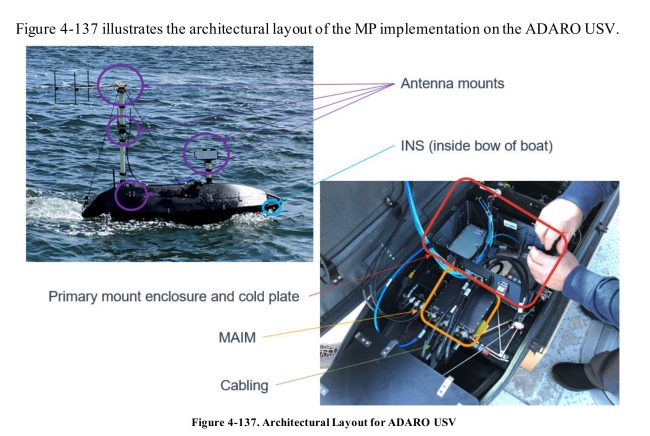
The Modular Payload Standard, frequently shortened to Mod Payload, is managed for the command by the Johns Hopkins University Applied Physics Laboratory. Per APL’s published description, the standard defines common interfaces and attributes for electronic warfare, SIGINT and communications payloads and for the platforms that host them. Originally developed to promote modularity across the Defense Department’s Group 2 UAS fleet, it has since expanded to Groups 1 and 3, unmanned surface vessels and dismounted applications, with an expanded-capability variant developed under the command’s SIGINT family of systems for manned aircraft and maritime platforms, and a micro variant for smaller UAS and dismounts. Industry has been building to it for years; AeroVironment, for one, introduced Mod Payload-standard interface kits for the RQ-20B Puma under USSOCOM order in 2021.
The presenter explained why the standard is integral to the portfolio: it allows payloads to be changed out rapidly to support multi-mission environments, so that, in the presenter’s words, “we can go from … using an acoustic sensor over to a data relay over to a [SIGINT] sensor, all in the same platform, and the operators can do it at their level” — without sending the system back to the original equipment manufacturer or up to a higher integration echelon.
The data side of the argument came out most clearly in the question-and-answer period, when the office’s chief systems engineer for Tactical Information Systems fielded an audience question about what gaps must close to keep sensor data trusted, prioritized and usable without overwhelming users or networks. His answer pointed to the command’s common data architecture: “The ultimate goal for the sensors is to do edge processing and not have everything come back to a centralized point,” he said, with the objective of “having the least amount of data required to make a decision come forward” to the decision point. The corollary for vendors was explicit: adopt common standards, and do not arrive with a proprietary standard that locks the government out of the interface.
For an industry audience, the combined message of the Mod Payload discussion, the standards-compliant radio development and the edge-processing answer is straightforward. PEO-TIS is positioning itself to buy sensors, payloads, radios and autonomy as interchangeable elements of an architecture, and conformance to the published standards is becoming the price of admission.
Seams and Adjacencies: Who Owns the Platform
One structural point from the session deserves attention from any company deciding where to pitch. PEO-TIS does not own most of the platforms its sensors ride on. With the exception of the ground robotics portfolio — where the office does provide the platform — the briefers described a deliberate cross-PEO division of labor. For maritime applications such as unmanned underwater and surface vessels, and for fixed-wing applications, PEO-TIS works with the other program executive offices that own those platforms to ensure the sensors it develops integrate seamlessly. And on the data side, the office works closely with PEO SOF Digital Applications — the command’s software-focused PEO — to ensure that data collected from TIS sensors flows into SDA’s applications and reaches users.
The same theme anchored the session’s partnerships slide, which invoked the SOF truth that most special operations require non-SOF support. The slide arrayed the office’s partner ecosystem across the Defense Department — the Defense Innovation Unit, DARPA, the Space Development Agency and the military services — other government agencies including the national laboratories at Los Alamos and Sandia, and academia, including the Naval Postgraduate School, the University of South Florida, Johns Hopkins APL and the university-affiliated research centers. The briefers noted that the command’s service partners do real acquisition work on its behalf: Navy laboratories, in particular, release RFIs, requests for proposals and related solicitations for SOCOM’s maritime pursuits, which means companies tracking only sam.gov postings under USSOCOM’s own banner are watching an incomplete picture.
How to Get In
The session closed with mechanics—the briefers were specific about which channels matter.
The presenter described the program teams as being “in a constant state of market research,” conducted through a layered set of mechanisms. The traditional channels remain: SOFWERX events, the USSOCOM Broad Agency Announcement, and RFIs posted to sam.gov. Beyond those, the command maintains technical liaison officers in the Washington, D.C. area working with DARPA and other agencies, and tech-scouting personnel in Northern California connecting the commercial technology base back to the program offices, the science and technology directorate and the components.
The official interface between industry, academia and the headquarters is Engage SOF (eSOF) on the Vulcan platform — the command’s self-described digital front door. Vendors register, post capabilities, and submit white papers and scout cards that government users across the SOF enterprise can assess. The briefers strongly encouraged companies that have not yet set up Vulcan accounts to do so and to complete their submissions. The scale of the ecosystem suggests why: command officials have publicly cited more than 22,000 submissions through Vulcan and over a thousand through eSOF, with assessments conducted by thousands of registered government users.
Beyond the portals, the office emphasized in-person pathways. Industry days are structured around the SOF warfighter — operators participate directly, and vendors can expect to engage them. Technical experimentation events, led by the command’s science and technology directorate, run on a white-paper submission and review cycle involving the components and theater special operations commands, culminating in live assessment with operators in the loop. Teams also attend external events in the United States and with Five Eyes partners. And the briefers repeatedly urged vendors to partner with one another — the modular, standards-based architecture the command is building rewards teams that show up with integrated, compliant solutions rather than isolated components.
The closing pitch from the Remote Capabilities lead distilled the office’s buying posture better than any slide: bring capability that is available now, demonstrate it, and expect SOF-peculiar refinement to happen after fielding, not before. For an autonomous systems industry accustomed to long development partnerships, that is a different tempo. It is also, on the evidence of this session, the tempo PEO-TIS intends to keep.