
The Lamprey MMAUV is designed to latch onto ships and submarines, recharge in transit, and arrive on station as a modular undersea “weapons and effects rack” for sea-denial and ISR missions.
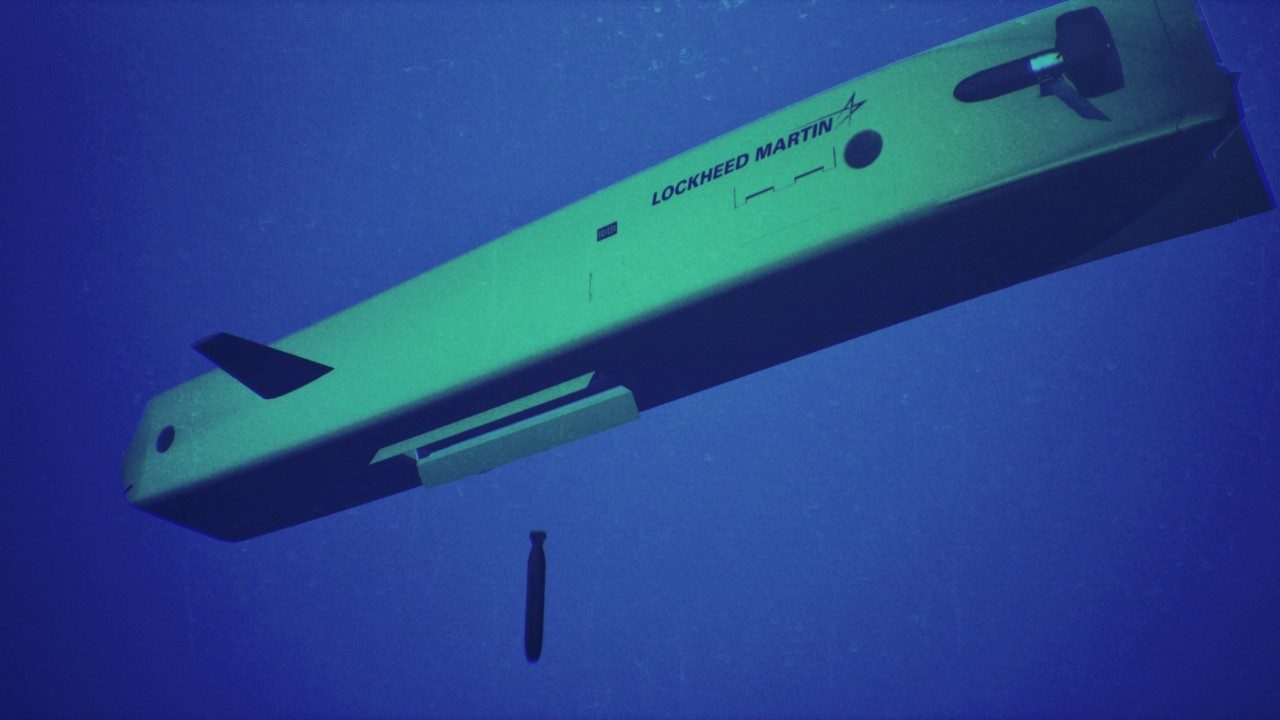
Lockheed Martin has taken the wraps off a new class of autonomous undersea vehicle that is meant to ride into theater on the hulls of ships and submarines, then detach to launch torpedoes, deploy decoys and even fire unmanned aerial vehicles.
Unveiled February 9 as the Lamprey Multi-Mission Autonomous Undersea Vehicle (MMAUV), the system is pitched as a “plug-and-play” unmanned submersible for covert access and sea-denial missions in contested waters. Built with internal research and development funding, Lamprey is aimed squarely at U.S. Navy and allied requirements for more persistent, distributed undersea combat power.
Lockheed says Lamprey can arrive in theater with a fully charged battery, then latch onto a host surface ship or submarine—without requiring modifications to the host hull—and recharge using integrated hydrogenerators while underway. The concept is explicitly modeled on parasitic fish such as lampreys and remoras that hitch rides on larger animals.
Modular payload bay for “deploy, deny, disrupt” missions
At the heart of the design is an open-architecture payload bay with roughly 24 cubic feet of internal volume, large enough to host multiple effectors rather than just sensors. Across Lockheed’s materials, the company emphasizes three broad mission categories:
- Undersea strike and ASW. Lamprey can carry lightweight antisubmarine torpedoes and acoustic decoys, giving it the ability to prosecute or distract submarines below the surface.
- Cross-domain effects. Renderings show retractable twin-tube launchers for small unmanned aerial systems. These can be used for over-the-horizon reconnaissance or kinetic strike once the vehicle surfaces, effectively turning Lamprey into a mobile magazine that bridges undersea and air domains.
- ISR and seabed operations. The vehicle is intended to conduct intelligence, surveillance and reconnaissance, multi-INT collection, and the deployment of seafloor sensors or other equipment. It can loiter quietly on the seabed, then reposition or upload data when cued.
Lockheed characterizes Lamprey as operating in two primary modes: an “assured access” mode focused on stealthy intelligence, persistent surveillance and precision strikes, and a “sea denial” mode emphasizing electronic disruption, decoy deployment and kinetic attack.
Paul Lemmo, Lockheed Martin vice president and general manager for Sensors, Effectors & Mission Systems, said in the company announcement that the “modern battlespace demands platforms that hide, adapt and dominate,” adding that internal funding allowed the firm to move “at lightning speed” and hand the Navy a multi-mission weapon that can detect, disrupt, decoy and engage autonomously.
Hitchhiking concept tackles endurance problem
Technically, Lamprey is an electrically powered UUV with a quad-thruster arrangement—two stern propulsors and two lateral thrusters—alongside a communications mast for surface and subsurface links. But the engineering idea that makes it stand out in a crowded UUV space is the hitchhike-and-recharge concept.
Instead of dedicating internal volume to large energy stores for transit, Lamprey is designed to:
- Attach to a host ship or submarine’s hull using a docking mechanism or suction system.
- Harvest energy in transit via hydrogenerators as the host vessel moves through the water, recharging its onboard batteries.
- Detach in-theater with full or near-full charge to conduct missions at stand-off ranges from manned platforms.
That architecture is meant to sidestep the classic UUV trade between payload and endurance, and to turn fleet units into carriers for small, forward-deployed undersea magazines. The company also notes that Lamprey can be deployed in swarms and network with other unmanned systems, aligning it with broader Navy and DoD concepts for distributed maritime operations.
Open questions and program status
So far Lockheed has not publicly disclosed Lamprey’s range, speed, depth rating or acoustic signature, and there is no announced U.S. Navy program of record tied to the vehicle.
What is clear from Lockheed’s messaging is that Lamprey is being framed less as a survey AUV and more as an unmanned, reloadable effects platform that can extend the reach of manned ships and submarines without exposing crews. That positions it alongside other large and extra-large UUV efforts aimed at giving navies more persistent presence, magazine depth and seabed access at lower cost and risk than manned submarines.
Lamprey’s debut is another data point in a clear trend: undersea autonomy is moving beyond stand-alone vehicles toward modular, networked systems that can cling to, plug into and extend existing platforms—while carrying a growing mix of kinetic, non-kinetic and sensing payloads.