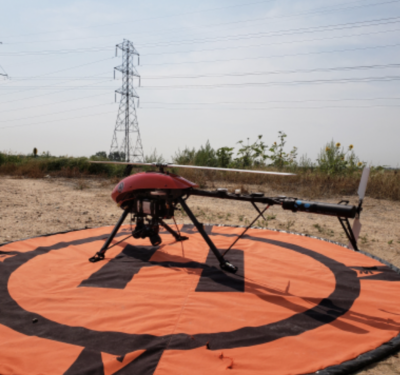

NATO Allied Air Command has highlighted a new “Safe Skies” training mission that brings drones directly into the day-to-day work of guarding the Alliance’s eastern flank, underscoring how small uncrewed aircraft are now treated as a routine air-defense problem, not a niche threat.
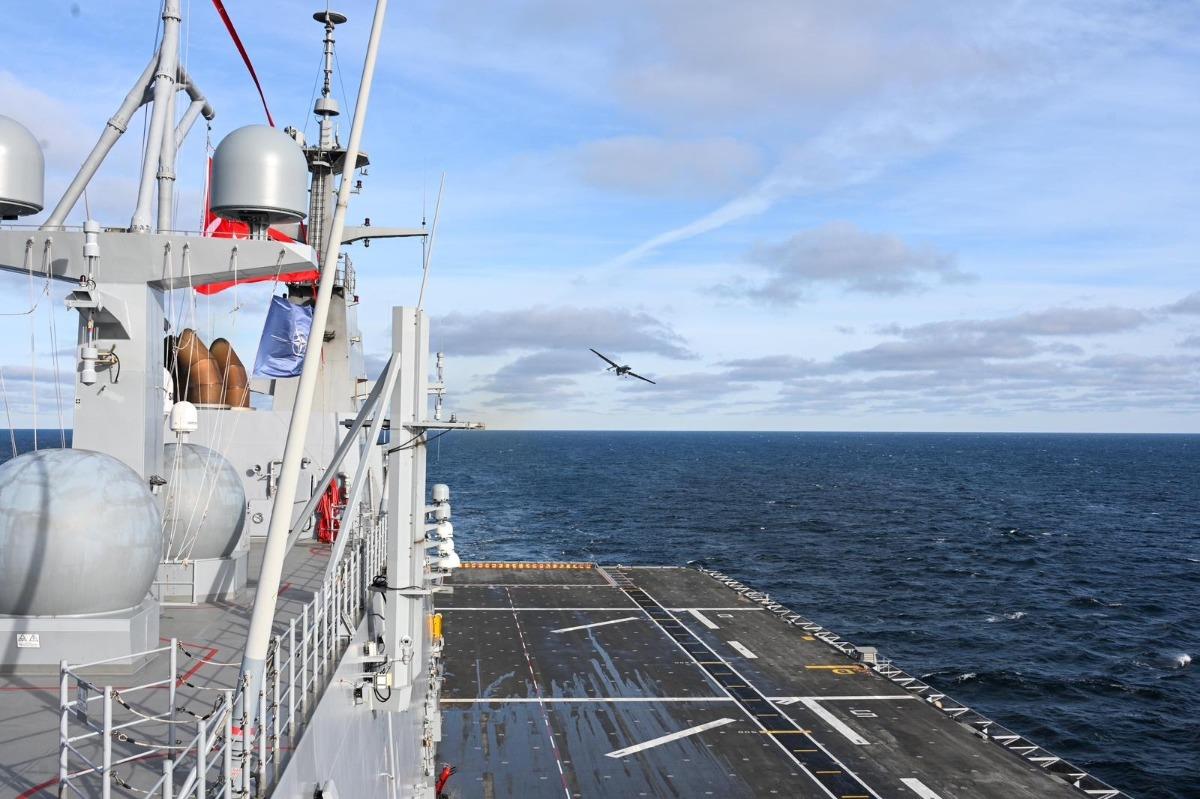
According to Allied Air Command, the mission ran on 20 February 2026 under the “NATO’s safe skies” banner and involved Allies conducting a drone-focused training event over the eastern flank, coordinated from Ramstein Air Base in Germany. While details of participating nations and platforms are limited in public releases, NATO has stressed that the goal is to improve how fighter aircraft and air-defence units detect, track and respond to drone activity in and around Alliance airspace.
A related Allied Air Command social media post describes “counter-drone training over the Baltics,” with Allied fighter aircraft practicing procedures against drone targets. That framing places the event squarely inside the Baltic and eastern-front air-policing mission, where NATO aircraft already stand 24/7 quick-reaction alert to intercept unknown or hostile tracks along the Alliance’s northeastern border.
The significance is less about the specific drones used and more about how they are being normalized inside NATO’s Integrated Air and Missile Defence System. Since 2004, Baltic Air Policing has relied on a layered network of ground-based radar, control and reporting centres, and quick-reaction fighter detachments deployed on rotation to Estonia, Latvia and Lithuania. The “Safe Skies” drills suggest that small UAS are now being threaded into that architecture as routine training targets, giving pilots, controllers and air-defence operators more realistic practice against low, slow and small tracks that often behave very differently from conventional aircraft.
The timing also reflects the operational lessons from Ukraine, where both cheap one-way attack drones and small ISR platforms have become a daily feature of the battlespace. For eastern-flank Allies, the challenge is not only to spot and classify these targets but to do so inside a congested air picture that may already include manned fighters, tankers and ISR platforms supporting NATO reassurance missions.
NATO officials have consistently stressed that air policing is a defensive mission designed to preserve the integrity of Allied airspace. By incorporating drones into that mission set, the Alliance is effectively acknowledging that safe skies now mean more than intercepting an occasional unidentified jet: they also mean understanding, rehearsing and, if necessary, neutralizing a wide spectrum of uncrewed systems that can range from hobbyist-scale quadcopters to long-range, weaponized UAVs probing air defences.
For industry, “Safe Skies” is another data point in a wider pattern. As NATO invests in counter-UAS sensors, effectors and command-and-control, the training environment becomes a proving ground for radar modes tuned to small targets, passive detection techniques, AI-enabled classification tools and low-collateral interceptors. Exercises that deliberately script drone incursions into the air picture give Allies a venue to validate how those technologies perform in mixed manned/unmanned scenarios and how quickly tactics, techniques and procedures can adapt.
The eastern flank focus is also notable. From the Baltics to the Black Sea, Allies have boosted air-defence presence since 2022, with a mix of fighter rotations, ground-based air defence and surveillance assets. Embedding drone training into that posture signals that NATO expects uncrewed systems to remain a persistent feature of the security environment along its borders—and that any credible reassurance and deterrence posture must be able to cope with them.