
The Under Secretary of Defense for Research and Engineering described a three-layer approach to embedding AI into warfighting — and argued the department is in the early innings of a transformation that is compressing years of advancement into months.
When Emil Michael, Under Secretary of Defense for Research and Engineering and the department’s Chief Technology Officer, took the stage at SOF Week 2026, he opened not with a program announcement but with an architecture — a layered framework for how artificial intelligence is being embedded into the force at every level from enterprise logistics to kill chain execution.
The three layers, as Michael described them, run from a sensing and data aggregation foundation, through an intelligence workflow layer designed to surface the right information to the right analyst at the right moment, down to what he called the warfighting layer — the most important tier, where AI-enabled decision tools reach operators directly. “We’re not trying to remove human analysts,” he said. “We’re trying to make the analysts do more, get prompted with things they should look at that have a higher likelihood of being interesting.” The warfighting layer, in his framing, is where the system shortens the time to decision, protects the warfighter, and enables the lethality that “our warfighters want to deliver.”
The session — titled “The Asymmetric Edge: Lethal AI and Autonomy in Special Operations” — was moderated by Lauren Bedula, managing director of Beacon Global Strategies, and included Tara Murphy Dougherty, CEO of defense software company Govini, and Peter Tague, managing partner of US Innovative Technology. The exchange covered Drone Dominance, private capital dynamics, supply chain as a warfighting enabler, directed energy, and the personnel pipeline feeding this transformation.

Drone Dominance: The Philosophy Behind the Program
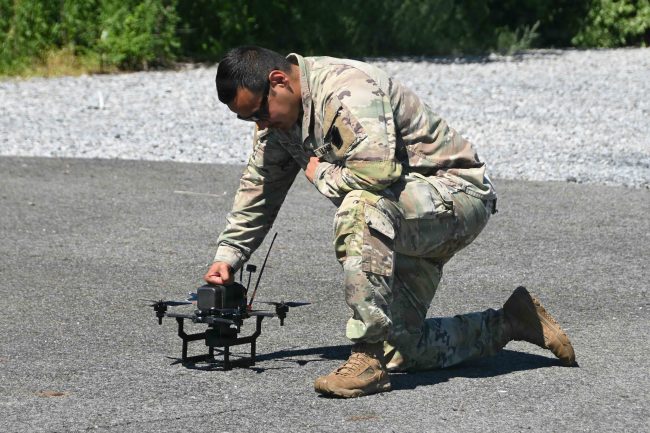
Michael offered the most direct account of what motivated the Drone Dominance Program’s design that the SOF Week audience had heard from a senior official. The previous model, he said, was broken at its foundation. Drone purchasing was “highly distributed” across the department, happening in small blocks without coordination or sustained demand signal. The blue list that governed procurement was difficult to enter, and once a company was on it, the incentive structure inverted: vendors had little reason to improve their products because improvement risked triggering recertification and losing list status.
“We kind of blew all that up,” Michael said. The replacement concept is structured around giving every viable vendor a shot at becoming a prime supplier, then progressively raising requirements — more capability, better supply chain compliance, higher scale — with more money attached at each rung. The services can then evaluate a set of companies that have demonstrated both innovation and production capability, and the department can deploy strategic capital to fill in the domestically-sourced components that no single manufacturer can onshore on its own. “That’s sort of the vision that we hope to get to as quickly as possible.”
He was blunt about the adversary context driving the urgency. “The number of casualties resulting from these drones is sort of staggering relative to any other conflict the world’s ever experienced,” he said of the Russia-Ukraine battlefield. He described watching video of drone swarms performing coordinated formations at concerts and finding it clarifying: “If they’re doing collaborative — we better be doing it better than them.”

Private Capital and the Demand Signal
Peter Tague’s investment thesis for the defense tech space traces to 2022, when converging improvements in autonomy software, edge compute, battery technology, additive manufacturing, and sensor cost-performance created what his firm recognized as an inflection point. The technology had crossed a threshold that would allow it to be fielded at scale — and the capital, in his view, needed to follow.
What translates that thesis into deployable investment, he argued, is the clarity and durability of the government demand signal. “The clarity of the signal is vital. If that signal is short-term, it’s mercurial, if it changes direction at the drop of a hat, you can’t build against it.” The Drone Dominance Program, in his reading, represents precisely the kind of sustained and legible signal that allows companies to commit capital, hire talent, and build production infrastructure against a real plan.
He was also candid about the risk that the current environment creates its own problems. Defense tech is experiencing what he called a hype cycle, and if capital is deployed at a scale that outpaces actual government purchasing, the consequences for the innovation ecosystem would be severe. “If we find ourselves in a spot where there are large numbers of losers in this space, you’re going to find the capital dry up — and the capital drives the innovation.” The connection between the warfighter’s operational feedback and the companies building for that warfighter is, in his view, the circuit that has to close for the investment cycle to remain productive.
Supply Chain as a Warfighting Enabler
Tara Murphy Dougherty grounded the supply chain discussion in a case study that illustrated what getting it right looks like in practice. Govini had mapped the supply chain for a small UAS platform in the period before Operation Epic Fury created sudden demand for accelerated production. Because the supply chain work had been done upstream — before the urgency materialized — production held when it mattered.
The anecdote she offered to illustrate the depth of the problem involved a wooden propeller on a small UAS — a key weight-reduction element that left the program exposed to a supplier concentration risk. That vulnerability had been mapped in advance, with alternative suppliers identified before the demand spike. “Seven months from concept to delivery” was the turnaround she described for the platform’s path to the battlefield.
Her argument was that this kind of speed is only achievable when supply chain management, production management, and sustainment planning are treated as warfighting functions rather than administrative overhead. “There is not an entity in the world today that operates in total isolation. All of the data you can collect is really valuable intelligence to the prospects of mission success.” She credited AI with having fundamentally changed what is possible in this space, arguing that tasks that previously required armies of consultants or years of enterprise software implementation can now be accomplished with commercial AI-enabled platforms operating against real program data.
Interoperability: Platform Versus Payload
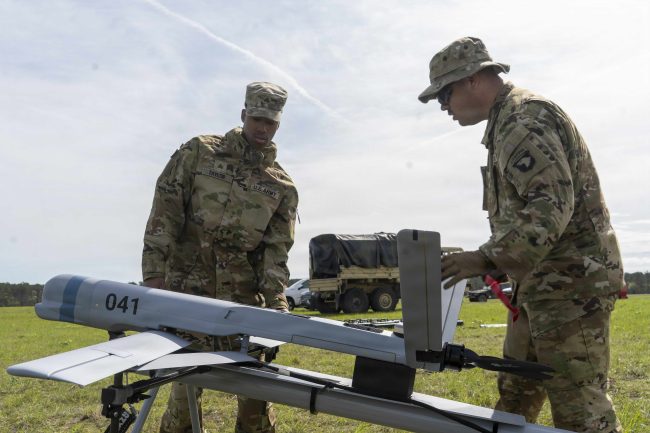
Michael argued that open architecture interoperability is not optional when the mission involves heterogeneous drone swarms. The combat power multiplier from coordinated mixed-vendor formations — where no single supplier’s software controls the entire formation — far exceeds what any single-vendor lock-in can deliver. “It’s 10 to 100x,” he said. The department is requiring open architecture for new systems and attempting to retrofit API interfaces onto legacy platforms, using modern code generation tools to re-engineer communication protocols for older systems that were never designed to interoperate.
Tague offered a framework for thinking about this from an investment perspective: the distinction between the platform and the payload. The platform — the structural and propulsion layer, whether software or hardware — should be as open and standardized as possible, with the community defining a small number of real standards rather than proliferating incompatible ones. The payload — sensors, kinetics, electronic warfare, autonomy software — is where innovation lives and where differentiation is legitimate. “I should be able to plug in a new payload very easily” on a standardized platform that survives over years, he said, because cost reduction requires manufacturing at scale, and scale requires stability. IP protection, in this framework, belongs on the payload, not the platform.
Lasers, AI, and the Policy Behind Autonomous Lethality
Michael identified directed energy as one of his six critical technology areas — elevated to that status specifically because of what he is seeing happen with UAS in current operational environments. The science, in his assessment, is ready. The remaining engineering challenges are cost reduction, form factor miniaturization, durability, and range in the scenarios that require it. “I made scale directed energy one of my top priorities, one of my six critical technology areas,” he said. The department is working through spectrum deconfliction with the FAA and FCC to enable employment in environments — border operations among them — where it has previously been constrained by regulatory considerations that the underlying technology has now outrun.
On AI in the targeting and lethality domain, Michael’s framing was structural rather than system-specific. The capability he described — aggregating intelligence, moving it rapidly into decision tools, deconflicting with allies and partners, and compressing the targeting timeline — was illustrated by the operational tempo of Epic Fury. “We compressed years’ worth of advancement into two months” during that operational period, he said, and projected similar compression continuing in the period ahead.
On autonomous weapons policy, Michael was pragmatic rather than ideological. There are situations where a human on the loop for final decisions is essential; there are others — autonomous mine-sweeping, space-based missile interception, laser engagement of drone swarms — where removing the human from the decision cycle is not a values compromise but an operational necessity. “The debate is a little ideological,” he said. “It should be more practical.”
Talent, Clearances, and the Revolving Door
Michael described an initiative to recruit engineering-profile personnel into a government Tech Force program, with a current goal of several thousand by end of calendar year, targeting professionals who want to work on consequential technical problems before returning to the private sector. The value proposition is not financial — competing with private sector compensation at scale is not realistic — but experiential: the hardest problems, the most operationally relevant environments, and a career trajectory enhanced rather than interrupted by a government tour.
Tague flagged the clearance timeline as a structural impediment to the talent rotation model the panel was describing. His own clearance took two and a half years. The model where technical talent rotates between industry and government, taking institutional knowledge in both directions, requires that friction to come down substantially. Michael said the department is actively reviewing both the clearance and the accreditation processes, describing the accumulated bureaucratic complexity as “somewhat wondrous” and expressing optimism that significant compression — he suggested 90 percent — is achievable.
Murphy Dougherty closed on the talent theme with a note about company identity. Govini’s orientation toward the defense mission preceded the current moment of financial and cultural enthusiasm for defense tech. “We were into defense before it was cool,” she said, and the organizational clarity that comes from defining the company’s purpose around warfighter outcomes — not around capital returns as the primary framing — has proven valuable both for retention and for the difficult decisions that come with operating in a national security context. The company celebrates one circumstance in which it encourages employees to leave: when they go into public service. “That is the kind of revolving door that is very positive, that is very productive, and that creates lasting effects.”