
The Pentagon has conducted its first operational combat use of a low-cost, long-range one-way attack drone, signaling a shift from counter-UAS defense to attritable strike doctrine informed by years of conflict observation in Ukraine and the Middle East.
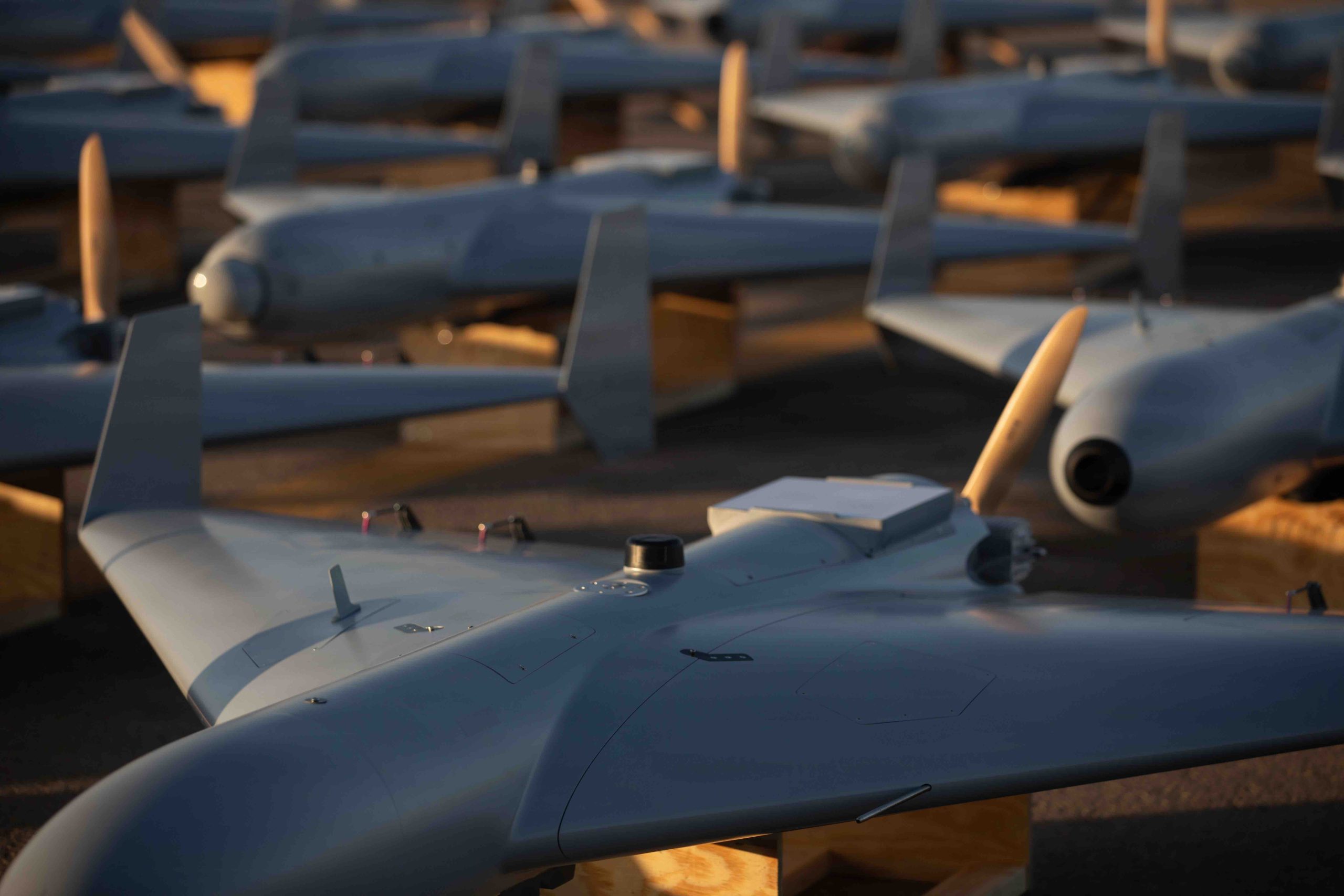
Since 2022, Iran’s Shahed-136 strike drone and its many derivatives have injected themselves into the global consciousness through large-scale deployment in destructive strategic raids affecting cities and military bases across the Middle East and Ukraine.
Now, in the opening phase of a U.S. air campaign targeting Iran, a Group 3 drone design derived from that same lineage — an American system known as the Low-Cost Unmanned Combat Aerial System (LUCAS) — has been employed operationally against the very country that pioneered its combat use, according to U.S. Central Command.
While LUCAS is not the first loitering munition fielded by U.S. forces, its use marks the Pentagon’s first modern operational deployment of low-cost, long-range one-way attack drones as a strike instrument — a mission set the U.S. has historically executed with manned aircraft and cruise missiles.
Iran has responded with renewed Shahed-136 attacks across the region, reinforcing a lesson observed repeatedly in Ukraine and the Red Sea: even extensive, layered air defenses struggle to prevent some strike drones from leaking through when employed at scale.
CENTCOM has released few details on how LUCAS has been employed tactically, suggesting the system represents only a small fraction of the strike capacity being applied. What is notable is timing. The Pentagon activated its kamikaze drone capability on December 3 — just six months after LUCAS was publicly unveiled — a compressed transition timeline that underscores how rapidly unmanned systems can move from concept to combat employment when acquisition constraints are relaxed.
Return to Sender: America’s Shahed-Class Strike Drone Debuts in Combat
Until recently, U.S. military interest in Shahed-class weapons appeared limited. Early efforts focused primarily on reverse-engineering recovered Iranian drones to improve counter-UAS defenses. That work produced the FLM-136 target drone, developed by Arizona-based SpektreWorks, with reduced range and payload compared to the Shahed-136.
However, SpektreWorks also revealed an offensive variant — LUCAS — which CENTCOM operationalized through the creation of Task Force Scorpion Strike, nested under U.S. Special Operations Command Central. The unit reportedly consists of roughly two dozen personnel operating an inventory of one-way attack drones costing approximately $35,000 per unit, placing LUCAS squarely in the Shahed-136 cost class.
The program appears to be supported primarily by the Marine Corps, with Army participation. In January, Task Force Scorpion Strike launched LUCAS from the flight deck of the Independence-class littoral combat ship USS Santa Barbara using a jettisonable rocket booster — a demonstration of how attritable strike drones can be deployed from small, distributed maritime platforms.
Officials describe LUCAS as having modular hardware and open-architecture software, with configurations tested for maritime strike, ISR, and one-way attack missions. Some variants appear equipped with nose-mounted electro-optical sensors and satellite uplinks, suggesting roles beyond simple pre-programmed strikes.
At $35,000 per unit, LUCAS is well suited for cost-exchange strategies intended to saturate air defenses and exhaust interceptor inventories. Downing such systems with surface-to-air missiles costing hundreds of thousands — or millions — of dollars per shot is not sustainable over time.
There are also indications the U.S. military is pursuing more sophisticated employment concepts. Sources have suggested LUCAS supports autonomous coordination, enabling networked or swarm-style operations. A satellite-connected variant could serve as an airborne relay node, extending command-and-control beyond line-of-sight and potentially coordinating subordinate drones deeper into defended airspace.
Such architectures introduce vulnerabilities of their own. Reliance on airborne command nodes creates high-value targets, requiring redundancy and autonomous mission fallback behaviors if C2 assets are disrupted. These tradeoffs mirror those already observed in Russian and Iranian strike drone campaigns.
The U.S. military has employed kamikaze drones before, from radio-controlled systems in World War II to tactical loitering munitions such as Switchblade in Afghanistan. What differentiates LUCAS is its role: a long-range, low-cost strike system intended to impose mass, persistence, and economic pressure on modern air defenses.
Strike drones occupy an increasingly central niche in high-intensity conflict. They can follow pre-programmed waypoint routes with minimal susceptibility to jamming, engage moving targets when remotely piloted in terminal phases, or loiter with onboard sensors awaiting targets of opportunity. When used in large numbers, even imperfect systems can hold a wide target set at risk simultaneously.
As high-intensity conflict expands in the Middle East, the current campaign represents the first real-world test of U.S.-fielded attritable strike drones operating against a peer adversary’s layered air defenses — marking the first instance in which U.S. forces are employing low-cost, long-range one-way attack drones as a primary strike instrument rather than solely as a defensive concern.
After years of analysis, modeling, and observation abroad, the United States has now crossed a doctrinal threshold: attritable strike drones are no longer a lesson learned from others — they are a capability being exercised, refined, and scaled in combat.