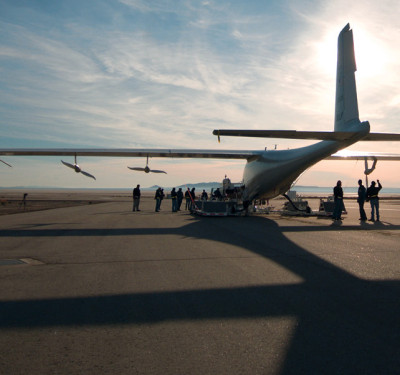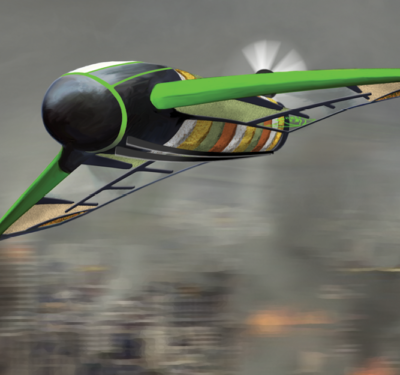

In February, the Drone Dominance Program (DDP) invited 25 vendors to a “Gauntlet” fly-off at Fort Benning, part of a four-phase, $1.1 billion framework, and an ambition to field “hundreds of thousands” of low-cost, one-way attack drones in the 2027 timeframe. The Senate Armed Services Committee’s March 5 hearing on “The American Small Drone Industrial Base” put more flesh on those bones.
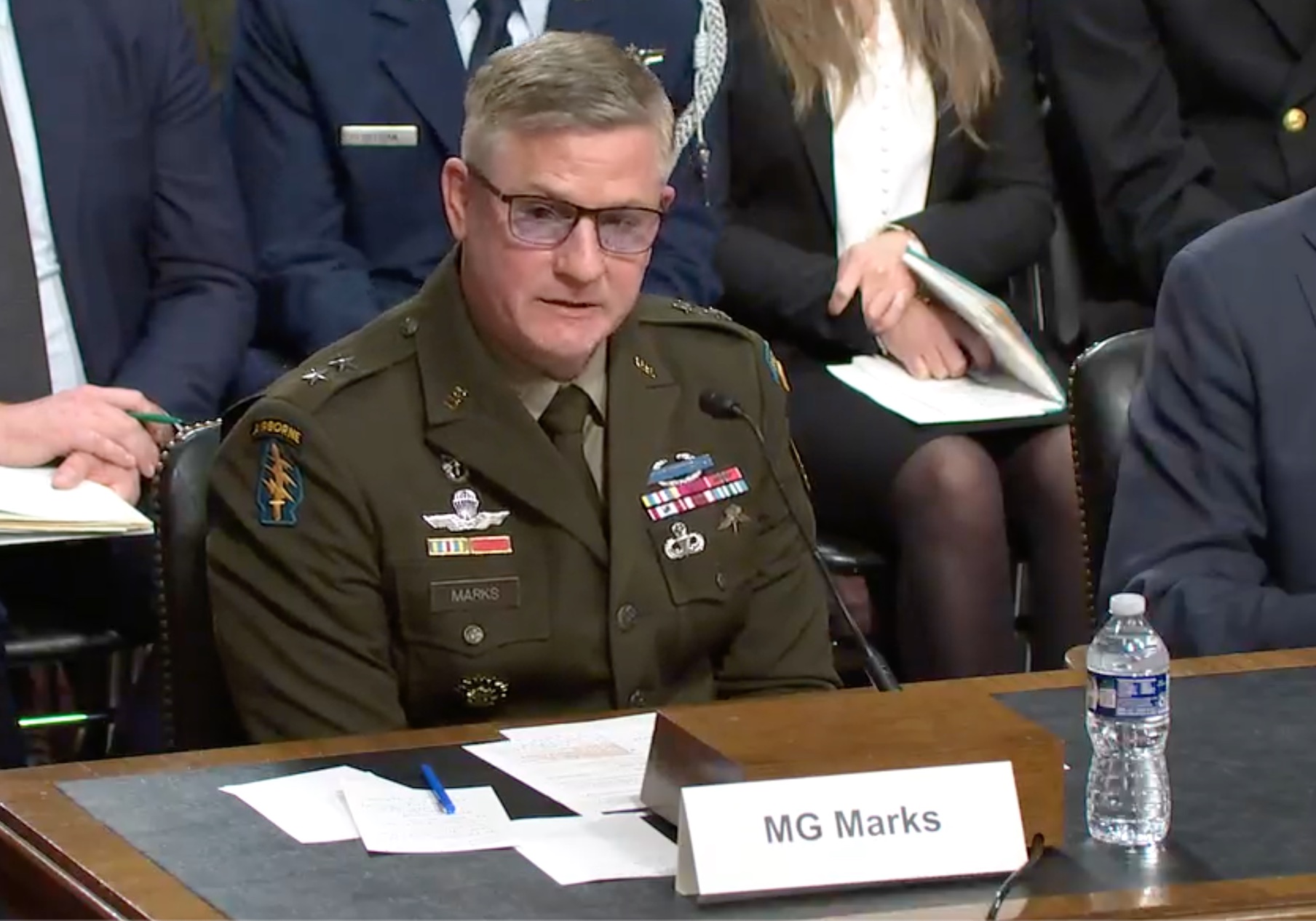
Prepared testimony from Owen West, Senior Advisor for Drone Dominance; program manager Travis Metz; and Major General Steven Marks, Director of the Defense Autonomous Warfare Group (DAWG), showed that DDP is not simply a rapid-fielding initiative, but an instrument of industrial policy and organizational change aimed at autonomous warfare at scale.
From Gauntlet line-up to strategic demand signal
West’s testimony confirms the previously announced structure but adds a sharper demand signal and end-state. DDP is now explicitly scoped as:
- Roughly $1.1 billion in demand over the next 18 months.
- Four open competitions judged by military experts rather than traditional paper-based reviews.
- A deliberate glidepath where unit prices fall, volumes climb, and operational complexity rises across the phases.
- A target of more than 200,000 one-way attack drones in the field by January 2028.
In other words, the Gauntlet is Phase I of a much larger, time-bound industrialization push. The hearing also confirmed that the first phase is already translating into firm orders: the Gauntlet ran from February 18 into early March at Fort Benning, with about $150 million in prototype delivery orders expected among roughly a dozen winners and an initial tranche of 30,000 drones flowing quickly to units.
UPDATE: GAUNTLET R1 WINNERS ANNOUNCED BY PENTAGON
For vendors on that 25-company list, the testimony underscores that the program is designed as a ladder, not a single contract opportunity. Each Gauntlet and follow-on phase offers another shot at entry or expansion, with quantities and expectations ratcheting up at every step.
DDP as an industrial-policy lever, not just a buying sprint
West ties Drone Dominance directly to Executive Order 14307, “Unleashing American Drone Dominance,” and a follow-on memorandum from the Secretary of Defense, which together set three priorities: bolster a nascent U.S. drone manufacturing base, field a variety of low-cost drones to the force, and integrate drones into all relevant combat training.
In practice, that means DDP is structured to do two things at once:
- Aggregate demand for U.S.-made drones and components through large, phased buys.
- Expose—and then deliberately fix—supply-chain chokepoints wherever they appear in motors, batteries, radios or sub-tier suppliers.
West notes that the first 30,000-drone order will create “expansive opportunities” for American manufacturers, but will also likely strain certain component lines. Those constraints, once illuminated by DDP’s volume, are meant to be addressed using the Department’s Industrial Base Policy office and the Office of Strategic Capital, backed by reconciliation funding and new authorities.
That is a critical nuance for industry. Drone Dominance is not just buying around weaknesses in the current small-UAS ecosystem. It is designed to surface those weaknesses and then channel money, policy and capital toward closing them.
A progressively tighter “trusted autonomy” funnel
According to West, even in Phase I new entrants are being inspected for NDAA compliance. Starting in Phase II, the Department “expects to preclude buying any systems that utilize motors or battery systems from covered countries.” The evaluation focus will extend from bills of materials down through capitalization stacks and physical components, with the goal of a “healthier domestic market.”
For vendors, that means Drone Dominance will act as a progressively narrowing funnel. Phase I is a proving ground for performance and basic compliance. In later phases, detailed scrutiny of component provenance and ownership will become gating criteria, not just paperwork.
Coupled with the volume targets, this suggests a future small-UAS industrial base where a relatively small number of firms emerge from Phase IV with both field-tested systems and fully vetted supply chains—a de facto “trusted autonomy” tier that will likely be well-positioned for follow-on programs beyond DDP.
DAWG and the organizational side of autonomous warfare
Marks describes autonomy as having moved past experimental status; adversaries are already shortening development cycles and integrating autonomous capabilities directly into formations. He points to Russia’s Rubicon unit—a specialized command structured around drones and other autonomous systems—as an example of how new organizations, not just new hardware, are changing the kill chain.
The Defense Autonomous Warfare Group (DAWG) was created to unify this response. Its mission is to synchronize operational demand, technical innovation and industrial capacity across service boundaries, and to integrate operators, engineers and acquisition professionals “side-by-side at the tactical edge” so that development is driven by real battlefield needs.
Crucially for DDP vendors, Marks makes clear that Drone Dominance is one of DAWG’s core proving grounds. Under the framework he describes, West and Metz ensure that systems procured through DDP meet frontline requirements, while DAWG connects those systems into service-level modernization plans so that each acquisition “sharpens the tip of the Joint Force spear” rather than proliferating one-off programs.
For industry, that suggests success in DDP will be measured not only in units delivered, but in how well systems slot into emerging concepts of employment for autonomous and attritable capabilities across domains.
Design targets: denied environments and cognitive load
Future phases will:
- Increase operating-environment complexity.
- Layer in more sophisticated counter-UAS threats.
- Force solutions that can operate under denied communications and denied navigation conditions.
- Reward features that reduce the cognitive load on soldiers controlling swarms of small systems.
Marks connects this to DAWG’s process: hand-selected experts with deep operational experience stress-test capabilities, define their limits and then “lock in” the most effective systems with trained operators, with an emphasis on disciplined use of reconciliation funding and stewardship of taxpayer dollars.
Taken together, that gives vendors a clearer brief than existed when the 25-company list was first published. Drone Dominance is not just a capacity play; it is explicitly seeking software-defined, resilient, operator-intuitive systems built for contested airspace and high-tempo human–machine teaming.
What this means for the emerging small-drone industrial base
Key takeaways from the testimony:
- DDP is the concrete implementation vehicle for a White House-level drone strategy, backed by new acquisition authorities and reconciliation funding.
- The program is designed to surface and then fix U.S. supply-chain gaps, not work around them.
- Supply-chain and ownership scrutiny will become progressively stricter in later phases, making “trusted” components and capital structures a competitive differentiator.
- DAWG is using Drone Dominance to build institutional “muscle memory” for autonomous warfare—organizational changes that may be as important as any particular airframe or payload.
That suggests Drone Dominance is best understood as both a market and a forcing function. It offers near-term revenue and long-term positioning for the 25 vendors already in the Gauntlet and for future entrants. At the same time, it is being used to standardize what “trusted,” scalable, combat-ready small UAS look like in a world where attritable drones are central to how wars are fought and how industrial bases are judged.