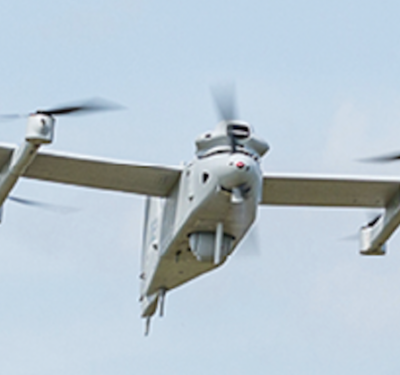

Joint Interagency Task Force 401 and Joint Task Force-National Capital Region conducted a counter-UAS training exercise at Fort Belvoir, Virginia, as part of an ongoing effort to expand layered drone defenses across the National Capital Region.
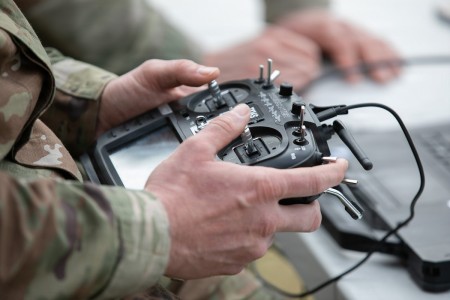
Soldiers from the 3d U.S. Infantry Regiment — The Old Guard — are receiving training on the Bumblebee V1 counter-UAS system, a small drone being operationally assessed for dual use as both a reconnaissance asset and a kinetic interceptor. The system is designed to allow operators to either follow a hostile drone back to its launch point to identify the operator, or destroy it in the air with minimal collateral risk to personnel and facilities on the ground.
“We want to train our warfighters in the National Capital Region on how best to employ low cost, low collateral kinetic effectors,” said Lt. Col. Alex Morse, JIATF-401 acquisition lead. “The training at Ft. Belvoir adds to the layered defense systems that are set up here in the NCR.”
The exercise reflects a deliberate shift in JIATF-401’s approach to homeland counter-UAS. Brig. Gen. Matt Ross, JIATF-401 director, signaled that the command is moving beyond radio frequency defeat systems as its primary tool. “We must be proactive with a layered defense, including kinetic defeat options at every War Department base or facility,” Ross said.
JIATF-401 is coordinating a whole-of-government approach that integrates interagency and law enforcement partners alongside the joint force. The Bumblebee assessment at Fort Belvoir represents one element of that broader effort to expand the tools available for countering the persistent unmanned threat in one of the most protected airspaces in the country.