
Teledyne FLIR unveiled a new vehicle-borne multi-role UAS called Black Recon at this June’s Eurosatory arms expo—one evolved from its popular palm-sized Black Hornet nanodrone proliferated across infantry in NATO armies.
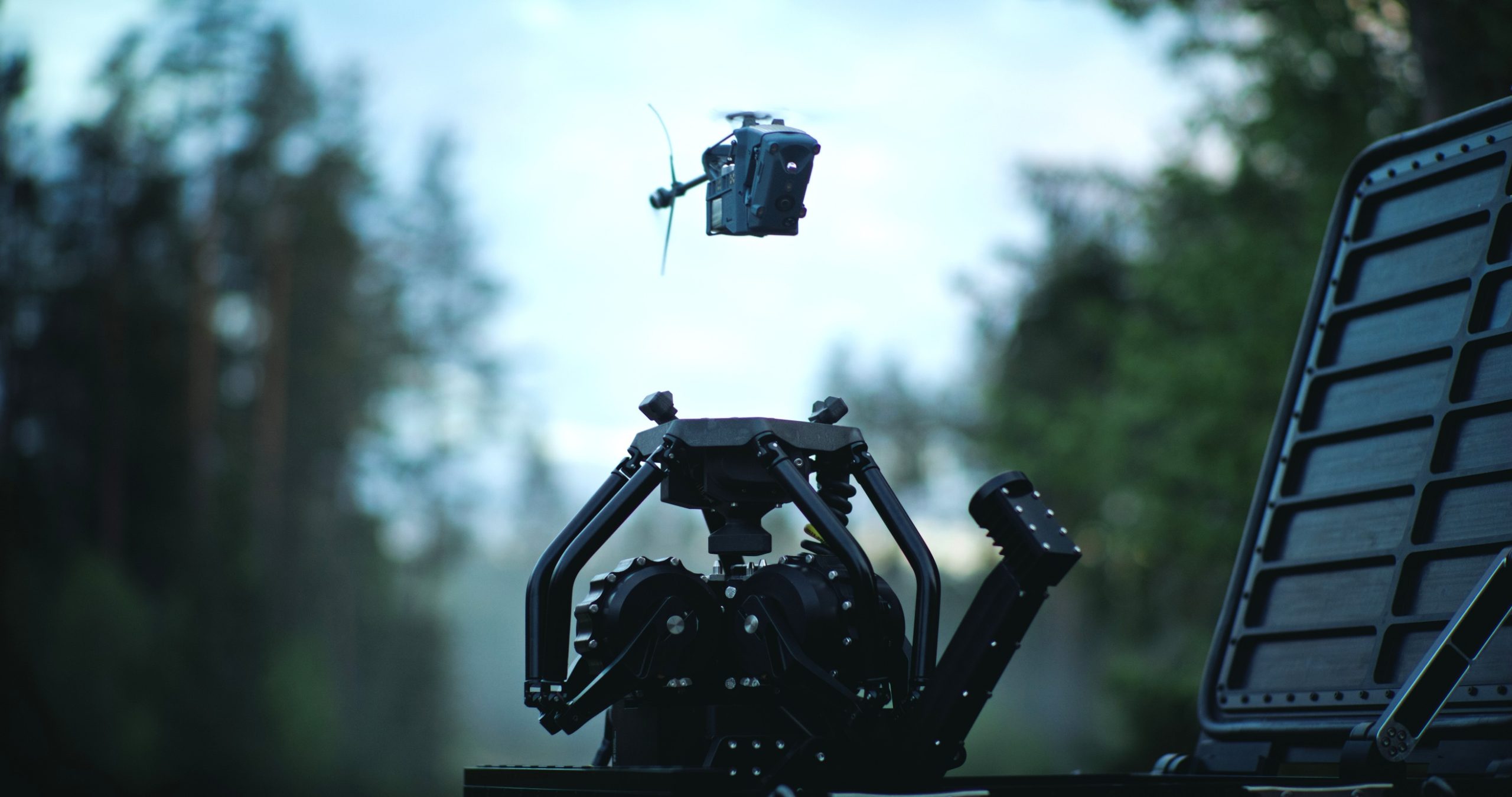
The similar-profile but enlarged Black Recon microdrone boasts greater range, endurance and payload than its dismounted forebear, and can perform reconnaissance missions, provide persistent overhead surveillance, or even execute kinetic strikes. Furthermore, the double-rotor UAV can launch, recover and recharge itself autonomously from a box-launcher accommodating three drones. By rotating drones for recharging, a vehicle crew can ensure “near continuous overwatch” according to Teledyne.
Black Recon is debuting at a time where there is now more widespread proliferation of small UASs amongst dismounted forces than integrated into manned vehicles—despite the latter’s potential to carry heavier UASs and recharge them using onboard electrical power. To be sure, there have been industry proposals and experimentation integrating drones into everything from tanks to Humvee-style vehicles, but operational fielding remains comparatively rare.
In that context Teledyne FLIR likely hopes a turnkey solution spun off from—and compatible with—its by now mature Black Hornet ecosystem (recently further expanded to its new FirstLook 125 UGV) might appeal to both military operators and vehicle manufacturers.
Widar Halvorsen, Teledyne’s director of UAS products in Norway, told IUS “We think wheeled and tracked vehicles 5-60 tons and typically Recce units will see good use of the system.” That weight range encompasses everything from MTV and JLTV tactical trucks to main battle tanks and heavy self-propelled artillery systems.
Teledyne FLIR’s public relations director Joe Ailinger told IUS that Black Recon made its first flight last winter in Norway, and had been internally tested on a Ford Raptor SUV. Ailinger confirmed Teledyne FLIR signed contracts with two European customers for Black Recon—first deliveries are expected by 2027—and that it expects to trial the UAV later this year with the U.S. Army.
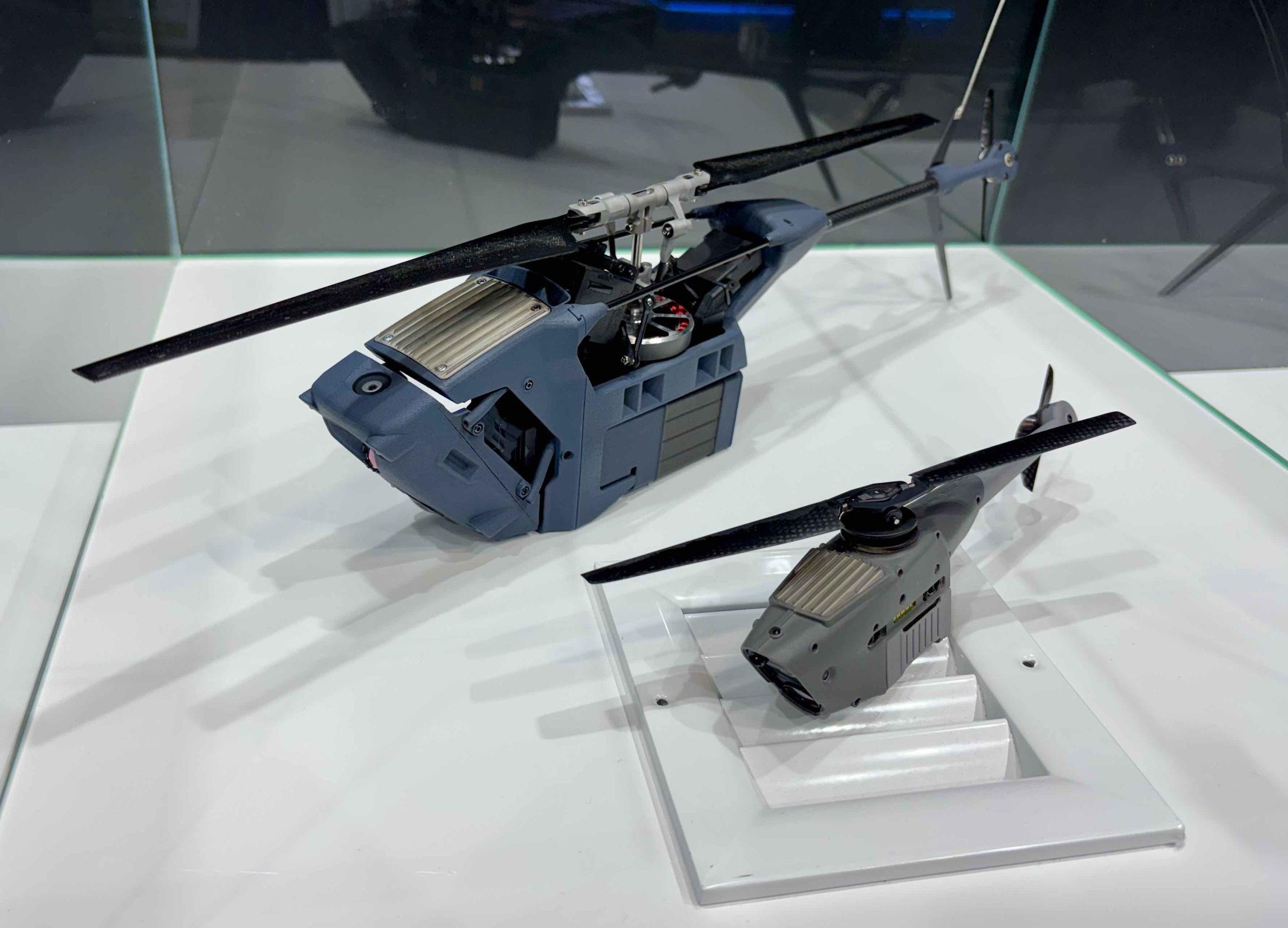
Black Recon by the Numbers
Each Black Recon UAV weighs under one pound in its standard configuration, but can carry an additional 100 grams (.22 pounds) mission module which can be integrated using open modular architecture. Current planned missions payloads include signal intelligence, chemical-bio-radiological-nuclear sensors (CBRN), and a droppable lethal payload under development to meet safe and arm requirements according to Halvorsen.
Base configuration Black Recons have 50-60 minutes endurance, can accelerate to speed of up to 56 miles per hour and fly up to 12,000 feet high. The drones can sustainably operate in up to 26 mile-per-hour winds and tolerate light-to-moderate rain (they are IP54 rated).
Black Recon’s base imaging payload involves five cameras: a 12-megapixel upward looking electrooptical sensor, a 50-megapixel wide-angle camera, and three 640x512p resolution thermals. “The three camera images are stitched together to get a larger view without compromising resolution,” Halvorsen explains.
As electronic warfare grows more ubiquitous in 21st century battlefields, Black Recon reportedly sports a Visual Inertial Navigation system enabling operation under conditions of satellite denial, can operate stealthily in an emissions-control mode, and has integral radio-relaying capability for extended-range operations.
The drone’s launch unit, meanwhile, weighs 185 pounds and measures just over 2×2 feet (27x26x18 inches). It can release a drone in 30 seconds, recovers one in 45 seconds, and controls them via AES256-encrypted datalink with 3.7 miles range. Halvorsen rightly cautions that topography and altitude impact radio control range, adding that ranges of 7.5 miles “should be possible” using relaying—something Teledyne plans to test later this year.
Regarding vehicular integration, Black Recon’s datasheet emphasizes the units meet environmental and electromagnetic compatibility standards (MIL-STD-810H and -461G) and support architecture including MavLink and STANAG 4609 (for FMV imagery) among others.
“The Power requirement met is MIL STD 1275,” detailed Halvorsen. “Idle consumption is less than 200W but can increase when in cold ambient environment when the heating is active. During Land/ Launch operation the power consumption peaks at 800W.” (For reference, a standard JLTV truck generates 8,000-10,000 watts of exportable AC power.)
Regarding Black Recon’s endurance at higher speeds—potentially important for a drone -potentially accompanying a fast-moving column—Halvorsen said endurance at speed was “…difficult to say since there are several factors that can influence endurance like headwind and temperature.”
Teledyne-FLIR above all emphasized that Black Recon can be operated with minimal cognitive load—a quality that may reign most important of all given the multi-tasking challenges UAS integrations entails for vehicle crews often lacking space to add a dedicated UAS operator.
Without significant degrees of automation and optimized ergonomics, vehicle-borne drones risk going under-utilized due to imposing excessive cognitive load, or conversely may consume excessive attention distracting from other vital tasks.
The ability for Black Recon to natively integrate with Black Hornets of dismounted soldiers could also be particularly interesting for a troop-carrying APC, IFV, or IMV etc. supporting dismounted operations.
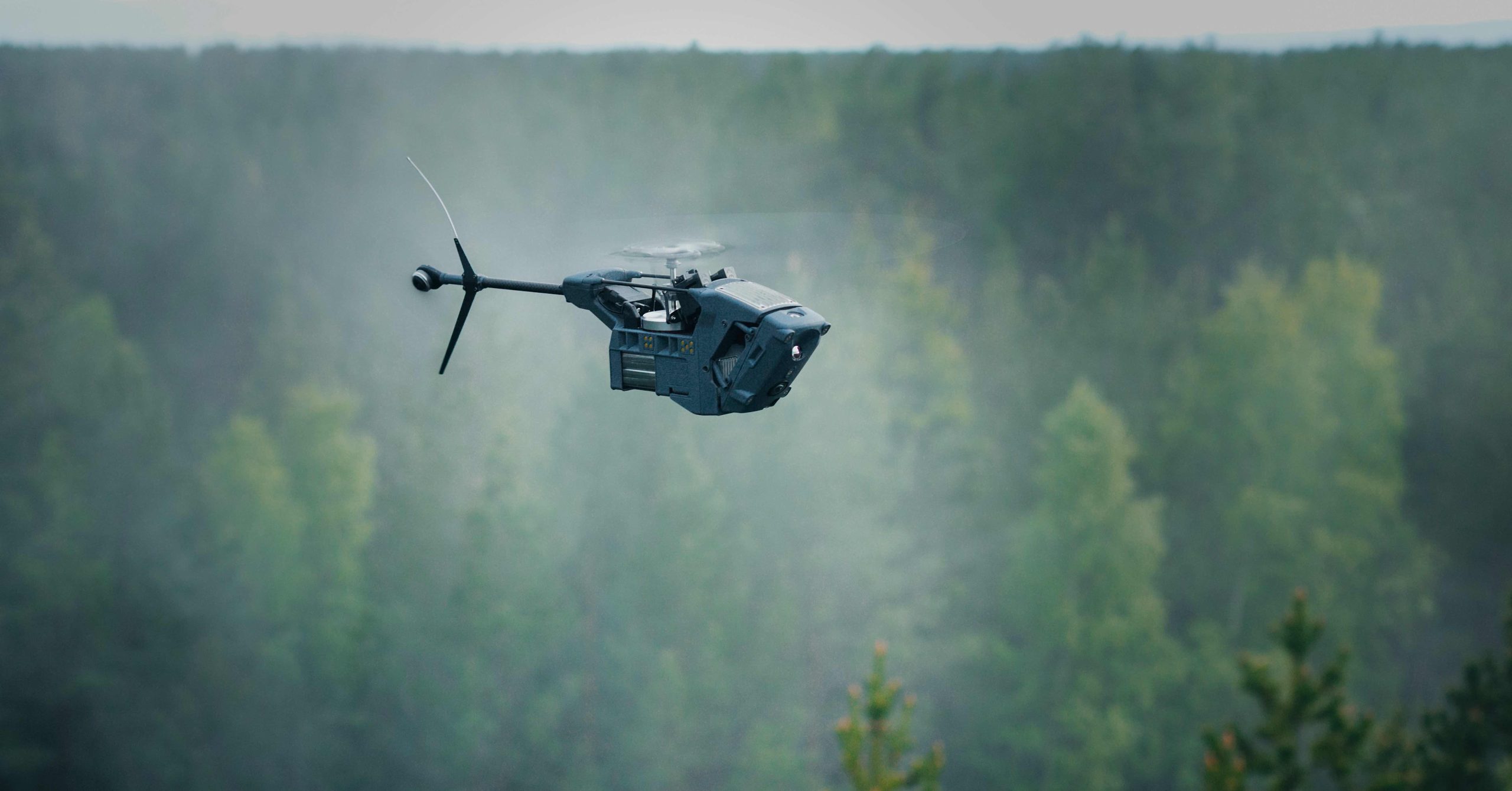
Operational Use Concepts: vehicle-born UASs
Situational awareness is the infamous Achilles heel of armored fighting vehicles (AFVs)—even given powerful optics and thermals, crews ensconced in AFVs often struggle to detect adversaries concealed in dense terrain, whether a forest to urban city blocks. Meanwhile, reconnaissance and infantry mobility vehicles may offer better visibility at the expense of protection, making their survival even more contingent on detecting threats promptly.
The Army’s Transformation-in-Contact (TiC) initiative, debuted in 2023, is premised on moving away from a world where enemy forces are usually discovered by blundering into their lines of fire. Affordable drones with low Size, Weight and Power (SWAP) requirements offer a promising and practical-seeming new way to redress that situational awareness deficit with little UAVs ranging ahead, gazing down from above, or peering around corners.
Therefore, one near-universal application of vehicle-borne UASs is surveillance/overwatch, in which a UAV remains relatively close to its mothership vehicle providing an elevated viewing angle (and perhaps one displaced to peer over line-of-sight obstacles like city blocks, hills etc.) Besides detection of ambushes, this can assist with detection of anti-tank mines.
More aggressively, integrated UASs could be tasked to push forward to search specific areas for threats, or track a mobile adversary’s position. Wondering if there’s a tank hiding behind that building, or an RPG team concealed beside a window? Better send a microdrone to find out rather than a manned vehicle.
Vehicle-borne UASs therefore can empower vehicle operators at the tip of the spear to initiate short-range reconnaissance reactively to tactical situations, rather than awaiting specialized recon assets—or being forced to press onward into danger when those aren’t available soon.
Meanwhile, additional specialized uses for Black Recon may include:
- Indirect-fire precision strikes—using gravity-drop munitions to combat dismounted adversaries shielded from a vehicle’s direct fire weapons in urban areas or entrenchments; or situations when a vehicle’s primary weapon system risks being indiscriminate or inconspicuous
- Target acquisition, fires spotting and damage assessment for shorter-range indirect fire weapons—notably including mortars, loitering munitions, and newer-generation anti-tank guided missiles.
- CBRN reconnaissance allowing specialized NBC units to extend their sweep, or enabling non-specialist units to deploy mobile CBRN detectors
- Electronic warfare/signals intelligence assisting with detection, interception and geolocation of enemy emitters (enemy vehicles, EW systems, drone operators etc.)
Broadly, then, integral UASs can help a vehicle crew project effects across distance, while reducing their exposure to hostile sensors and effectors.
Teledyne’s press release also suggests use of Black Recon in a first-responder or border security role; for monitoring critical infrastructure; and for maritime/riverine patrol.
Vehicle-borne UASs: Bespoke vs ad-hoc vs tethered
Black Hornet is more expensive than small quadcopter UASs proliferating on today’s battlefields, and the same is likely true of Black Recon with its sensors. What added value does a UAS tailored for vehicle integration offer over, say, bolting on a rack and charging station from which to operate a few FPV drones costing a few thousand dollars apiece?
Ad-hoc quadcopter integration may save on unit costs but shift burdens to vehicle operators to manage and pilot UASs in combat—potentially including requiring operators expose themselves outside the vehicle to manually handle UAVs for recovery, recharge and re-launch.
Furthermore, combat vehicles without space for a dedicated UAS operator might only leverage an ad-hoc drone capability when a crewmember can afford to forego core tasks (gunnery, driving, command etc.) to temporarily focus on UAS operations: say while occupying a static overwatch position, or facing a pressing tactical need.
By contrast, an autonomous recover-recharge-relaunch system can transform a vehicle-borne UAS from special-use equipment, to an additional persistent floating sensor providing elevated overwatch while retaining availability for more complex missions.
Black Recon and similar solutions are also competing with tethered vehicle-borne UASs which tie UAVs to motherships via a cable conveying both electricity and communications. Tethered UASs like Elistair’s Khronos have exceptional endurance—and can be designed to detach midflight from cables if desired. Still, a rotational, untethered UAS will better facilitate more distant operations from the mothership, and can potentially accompany vehicles moving at faster speeds, as tethered UASs usually cannot exceed 35 miles per hour while tethered.