
The XPONENTIAL keynote panel confronted the question the Drone Dominance Program answered first—and what it exposed in doing so.
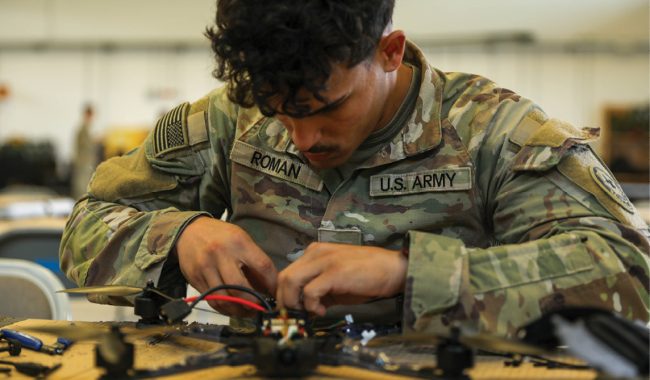
For years, the defining complaint from the domestic drone industry was the absence of a credible, sustained demand signal from the U.S. government. Companies could build platforms, win small contracts, and demonstrate capability—but they could not raise capital, invest in production infrastructure, or attract supply chain partners without knowing that government buying would scale with them. The Drone Dominance Program, and specifically Gauntlet One, answered that complaint. What it revealed in doing so is that demand signal was only the first problem..
“We solved the demand question—that was our biggest question from industry,” said Doug Reed of Auterion, the autonomous systems software company that competed in Gauntlet One. “But what it did is it shifted then to exposing some other weaknesses, and that’s important, because if we’re going to build the industry, we have to know what those pain points are.”
What Gauntlet One exposed, in Reed’s framing and echoed across the XPONENTIAL keynote session moderated by AUVSI President Michael Robbins, is that the domestic drone industry has been optimized for prototype innovation—getting a few systems out the door and demonstrating performance. Production at scale is a categorically different enterprise, with different supply chain requirements, different quality control obligations, and different vulnerabilities. The hard work, the panel argued, is only now beginning.
The Scale Imperative
Travis Metz, Drone Dominance Program Manager at the Defense Innovation Unit, framed the scale requirement without hedging. “If you just stare at what’s happening in Ukraine,” he told the session, “we think they’re going to make 6 million of these small one-way attack drones in 2026.” The U.S. military aspires to fight differently than the Ukrainians and Russians have—but regardless of doctrine, the volume requirement is real, and the United States does not currently have the industrial capacity to meet it..
Metz’s foundational assumption is that in any conflict with a peer adversary, Chinese supply chains will be unavailable. “If we are at war with our likely adversaries and we need millions of these drones,” he said, “they will not sell us the parts to make millions of these drones.” DJI, he acknowledged, makes an excellent product at a low cost. The plan cannot include it. The supply chains for U.S. drone production at scale have to be built in the United States and allied countries—and the mechanism the program is using to drive that build-out is sustained buying. “If we’re able to provide demand signal by orders that are going to be sustained, and we’re clear about what it means to be able to sell us drones in terms of supply chain restrictions, we assume the supply chains will scale.”
He was careful to add a caveat that the panel found credible: “We don’t assume it will be a straight line. It will be messy. Capitalism destroys things too. But this is our theory of the case.”
From Prototype to Production: What the Transition Actually Requires
Paul Fermo, president of Robinson Unmanned—the drone subsidiary of Robinson Helicopter Company launched in March 2026 to absorb and expand the Gauntlet One competitor formerly known as Ascent AeroSystems—offered the most concrete account of what the transition from innovation to industrialization demands in practice.
“It’s very different to produce 10 systems from producing 4,000 systems,” Fermo said. “The goal of Drone Dominance isn’t just a bunch of systems—it’s to build an enduring operational advantage for the warfighter, and that includes the entire ecosystem.”
The ecosystem problem manifests at the sub-tier level. Robinson Unmanned has the advantage of a parent company with five decades of aerospace manufacturing discipline—bill-of-materials traceability, quality control, supplier management—capabilities the drone industry as a whole has not been required to develop because it was not previously producing at aerospace volumes. The pain points are unglamorous: capacitors, resistors, wiring harnesses, fasteners. Components that individually cost almost nothing and collectively determine whether a platform can be manufactured compliantly at scale.
“It’s sort of like going to Home Depot and grabbing a bunch of nails and saying, well, this one came from Taiwan and this one came from Cambodia, but that one came from China, so you can’t use that one,” Fermo said. “We don’t really have that level of traceability or the quantities that we’re buying in some of these things, and it’s really hard.” Having Robinson Helicopter as a parent provides the institutional knowledge to build that traceability—but for companies without that lineage, developing it from scratch is a significant and underappreciated challenge. “Writ large, the whole industry is going to have to get to that level.”
Traceability as the New Table Stakes
Evan Smith of Altana AI, which provided supply chain visibility analysis to the Drone Dominance Program during Gauntlet One, argued that the traditional approach to supply chain risk screening in defense procurement does not work for this problem.
“If you’re merely screening entities in an extended network, you’re going to have lots of false positives and lots of false negatives,” Smith said. What Altana found is that part-site level visibility—tracing not just which company supplied a component but from which specific facility it was manufactured and how it flows into the bill of materials at the assembly level—is where the compliance risk actually lives. A U.S.-domiciled entity supplying a motherboard is not automatically compliant if that motherboard is manufactured at a facility in China.
The findings from Gauntlet One confirmed the analysis: the majority of supply chain problems surface at tier three, tier four, and tier five—well below the prime contractor relationship and invisible to traditional country-of-origin screening. Altana’s approach applies data and AI to build traceability and conduct risk screening at scale. For Gauntlets Two through Four, the firm is working toward persistent part-level certification—the ability to certify individual components and carry that certification forward as configurations evolve, rather than requiring full program-level recertification every time a bill of materials changes.
Smith’s advice for companies preparing for future gauntlets was direct: “You need to be proactively illuminating, mapping, and tracing upstream, beyond the direct supplier relationship, through these critical components and value chains. You need to think about that nested bill of materials and the sub-components and the raw materials.” He framed compliance not as a program-specific requirement but as a new operating baseline across the U.S. trade environment: tariff structures, forced labor trade laws, and national security procurement rules are all pointing in the same direction. “The direction of travel is very, very clear. You have to know and manage and be accountable for that extended value chain.”

The Software Layer and the Autonomy Question
Reed and Auterion addressed where the Drone Dominance Program is heading beyond Gauntlet One’s one-operator-to-one-drone model. Auterion describes itself as a software company that has found itself, somewhat against type, manufacturing drones for the program—a position Reed acknowledged as unusual but temporary. The company’s core value proposition is the flight control and compute layer: software that can be pushed to any platform and that enables one operator to direct mass effects across a distributed formation.
“It doesn’t matter what the platform looks like,” Reed said. “It is delivered onto the system and enables that scalability of allowing one warfighter to be more effective.” Auterion is working across industry partners on manufacturing the physical systems, while keeping its focus on the software stack that the panel’s moderator described as the defining capability gap between where the program is today and where it needs to go: moving from one-to-one operator-drone ratios toward the swarm operations that define the next phase of autonomous warfare.
The Published Framework and What Industry Should Do With It
Metz described the Drone Dominance supply chain framework published approximately two and a half weeks before XPONENTIAL as policy that goes meaningfully beyond the statutory NDAA baseline. The document, available at dronedominance.mil alongside the Phase Two Request for Solutions, lays out a phased path of increasingly stringent supply chain requirements through Gauntlets Two, Three, and Four—specifying what companies must demonstrate at each phase to remain eligible to sell into the program. Phase Two’s floor requirements include non-Chinese batteries and non-Chinese motors, with requirements deepening from there.
Metz suggested that investors should treat the document as a capital deployment roadmap, not just a compliance checklist. Having come from venture capital and private equity before the program, he said he would expect that document to shape where capital flows—into the domestic and allied production of the motors, batteries, and components the program needs companies to onshore. The supply chain framework is, in this reading, both a demand signal and an investment thesis.
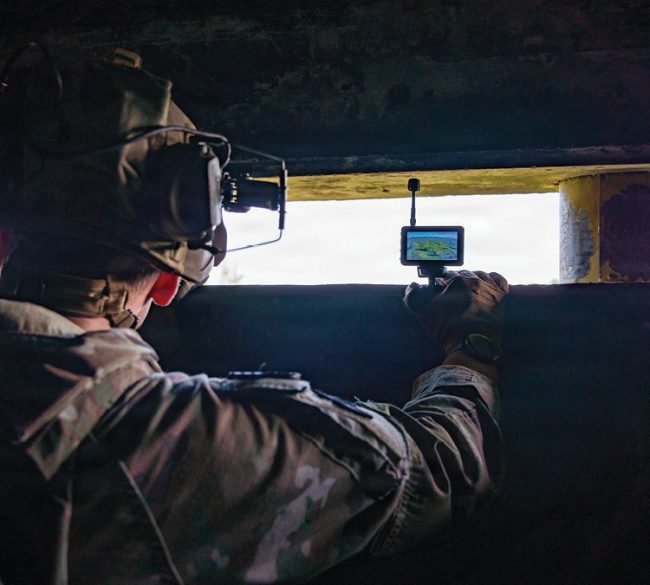
The panel also flagged that Gauntlet Two will introduce contested environment testing—electronic warfare, countermeasures, and longer-range strike scenarios absent from Gauntlet One’s relatively permissive conditions. Platform form factors that performed well at Fort Benning may face different requirements when tested against real-world electromagnetic environments. Companies designing for future gauntlets should be building with that operational context in mind from the start.