
Just a over a month after the U.S. Navy used a small unmanned surface vehicle (USV) for the first time to recover personnel in a search-and-rescue operation, on July 12 the service used the same Saronic Corsair USVs to pioneer a very different kind of combat operation: a direct kamikaze strike on Iran’s chief naval base at Bandar Abbas.
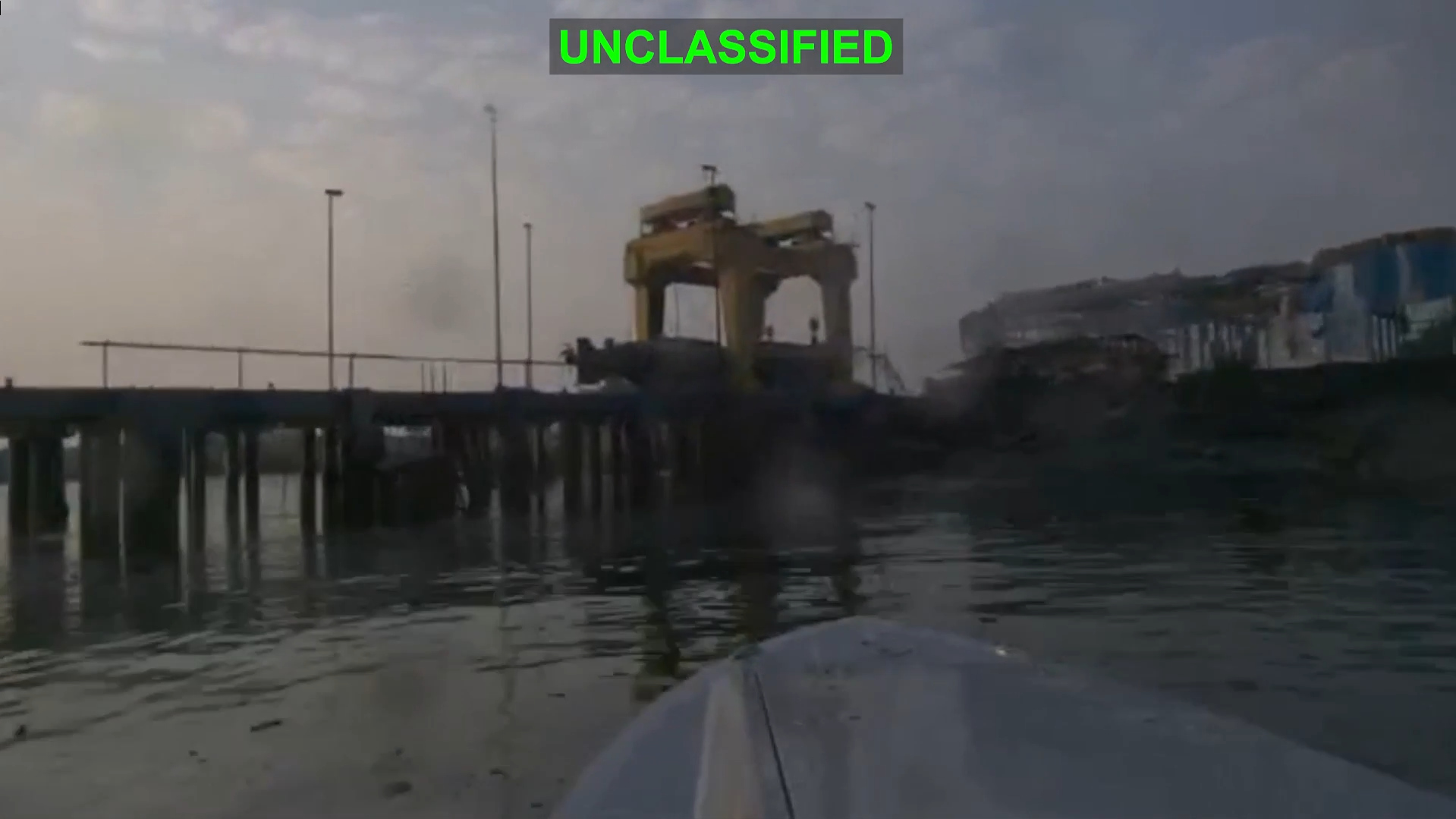
CENTCOM announced last Sunday that three of its USVs had struck an Iranian submarine and ship maintenance facility at Bandar Abbas. It also posted video on social media showing footage both from overhead aerial drones and recorded by USV’s own cameras showing their penetration into the Iranian naval base, and the strikes on port facility targets. One of the strikes is seen blasting a gantry upon which one of Iran’s 23 Ghadir-class mini-submarine is visibly suspended for maintenance (it’s conning tower having been removed), triggering a fire.
Thus, it’s possible the USV strike disabled a submarine, albeit one seemingly not then in operational condition.
The USV attack took place several days into escalating hostilities between the U.S. and Iran following the expiration of a ceasefire without apparent progress towards a deal with Iran regarding development of nuclear weapons and free access to shipping in the Strait of Hormuz. Unlike the earlier USV rescue operation executed by the Navy’s Bahrain-based Task Force 59 USV test unit, the attack on Bandar Abbas was reportedly carried out directly by CENTCOM itself.
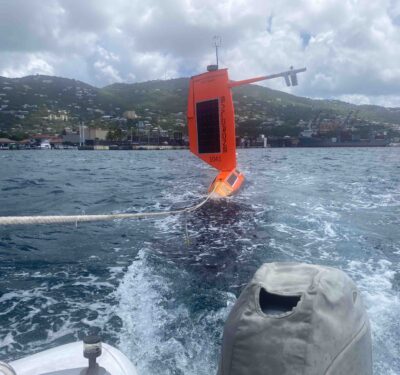
The 24-foot Corsair multi-role USV can carry a half-ton payload out to a range of 1,151 miles and sprint to a maximum speed of 35 knots (40 miles per hour). Trials have validated its ability to sustainably operate in Sea State 5, and the design’s autonomous features reportedly include cooperative ‘swarming’ between boats to execute coordinate attack, patrol or search operations. The vessel’s integral AI also reportedly facilitates navigations and operations under conditions of comms- and satellite-navigation denial.
Austin, Texas-based manufacturer Saronic is only four years old, but nonetheless broke ground last December when it received a $392 million contract from the U.S. Navy to produce Corsairs. The company, which a.sl has facilities in Franklin, Louisiana and San Diego and is opening a new shipyard in Brownsville, Texas—said it had built its 300th Corsair by May 2026.
Why the U.S. Navy is combat-testing new drone boats
The Navy’s evident eagerness to combat test its nascent USV capabilities is undoubtedly spurred by Ukraine’s massively successful USV campaign against the Russian Black Sea Fleet begun in 2022 which has expanded to a broader-based assault on Moscow’s maritime oil industry. Iran and its Houthi rebel allies in Yemen have also deployed kamikaze USVs since the 2010s against civilian and military shipping, though without success against Western warships.
CENTCOM’s successful USV combat operation could spur further funding and more rapid expansion of the Navy’s USV program, which has extensively experimented with small USVs but repeatedly swerved away from procurement decisions—with the notable exception of the Corsair, currently being procured via Other Transaction Authority funding. The Corsairs had only begun deployment in the Gulf with Task Force 59 in March.
That said, the U.S. Navy is pretty much the opposite of a naval underdog with limited conventional sea power like Ukraine or Houthi rebels. Thus, its operational doctrine and use concepts for USVs must identify under which circumstances they’re more efficient tools than its powerful aircraft carriers, missile-armed destroyers and submarines.
For kamikaze USVs specifically, that may includes scenarios where USVs are more effective or less costly to achieve desired effects than equivalent expenditures of munitions to achieve the objective; and situations in which accessing targets could incommensurate risks using a kill-chain involving manned vessels or aircraft.
In that regard, the Saronic Corsairs expended likely cost around $1-$1.2 million apiece—less than the cost of a Harpoon or Tomahawk cruise missile, but many times more than a JDAM glide bomb which a U.S. warplane could have lobbed at limited risk to strike Bandar Abbas. However, under conditions aerial access is more heavily interdicted, a USV might be just the tool for the job.
Also noteworthy is Iran’s apparent failure to deploy passive and active harbor defenses deterring agianst USV attacks like those Russia began building up around Crimean naval facilities after Ukraines devastating initial attack on October 2022. Iran’s Navy may belatedly take such measures to render future USV attacks less likely to succeed—but compelling an adversary to expend resources defending against threats of unclear magnitude can be a victory in and of itself.
The Navy last used kamikaze ‘Apex’ USVs in World War II
CENTCOM claimed the attack marked “the first time American forces have employed sea drones in combat operations.” Though accurate in a strictly modern context, that isn’t true historically: the Navy deployed radio-controlled kamikaze drones called ‘Apex boats’ in World War II in a coastal attack role for Operation Dragoon—the amphibious landing in southern France following two months after D-Day.
After experiencing massive losses to Navy combat demolition units (NCDUs) in D-Day, the planners for Operation Dragoon decided to support NCDUs with exploding boats to blast submerged concrete beach obstacles preventing ingress of landing craft. These ‘Apex’ boats were small 36-foot-long LCVP landing craft— ‘Higgins boats’—converted for radio remote-control while carrying four tons of TNT.
A total of 54 Apex boats remotely operated from 27 control vessels were mustered for the Operation Dragoon on August 15, following only two days of preparatory drills. At the Alpha beach landing zones, they effectively blasted paths through through obstacles, though one exploding boat inflicted heavy casualties to submarine chaser SC-1029. USVs arrayed near the ‘Camel’ beach, however, mostly malfunctioned with some having to be destroyed by Allied warships as they veered towards friendly shipping.
The experience with the Apex boats highlighted both the potential utility of USVs for specialized maritime attack operations—but also the major challenges using them reliably and safely that forestalled further operational experimentation in the post-World War II era. Eighty-two years later, the Navy has finally returned to this concept again armed with advancements in communications, AI-driven autonomy and experience gleaned from naval conflicts in the Black and Red Seas.