
At SOF Week’s solution stage, a Vannevar Labs presentation titled “Mission-Ready AI: Accelerating Decisions with Agent Control Plane and Mission Agents” built a notional Lebanon evacuation scenario to show how AI agents are being pitched to compress staff-level planning, targeting support, and pattern-of-life analysis into seconds rather than days.
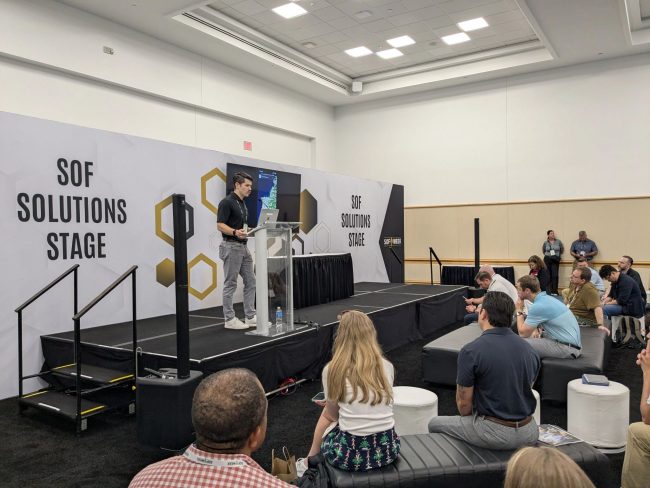
Every twenty minutes or so on SOF Week’s solution stage, a company gets a few minutes to explain what it does. Vannevar Labs used its slot for a session titled “Mission-Ready AI: Accelerating Decisions with Agent Control Plane and Mission Agents,” walking through a notional special operations scenario from first order to after-action review. The presenter, a mission manager on the company’s SOCOM team, described roughly 13 years as an Army officer before joining the company.
Vannevar built its early reputation on open-source intelligence work — its flagship product, Decrypt, applies natural language processing to foreign-language data for intelligence agencies. The presenter framed the company’s current pitch differently: a set of AI agents layered on top of that data foundation, designed to act less like a chatbot and more like an analyst who never sleeps. The framing tracks with the company’s public direction this year — in April, Vannevar announced a partnership with SMX to field what both companies are now calling “warfighting agents” across six combatant commands and select federal civilian agencies, the same term used throughout the SOF Week demo.
THE ARCHITECTURE
The company describes its capability as resting on two layers. The first is what it calls a digital sensing architecture — the infrastructure that retrieves hard-to-access public and commercially available information, aggregates it under managed attribution, and sandboxes it for users. The second, and the one the company is now built around, is an agent control plane.
“An AI agent is a large language model, but instead of just being a chatbot, where you ask it questions and it answers, it can do things on your behalf — it can interact with analytical tools, it can retrieve data,” the presenter said. Vannevar does not build its own foundation models. It relies on outside frontier labs for the underlying large language models and says that arrangement lets it swap in newer models as they become available. What the company says it builds instead are narrower, mission-tuned models — what it calls warfighting agents — trained to work against government data and the company’s own tools, with a coordinating agent sitting above the individual task-specific ones.
The presenter put the pitch in terms of compressed timelines: research tasks that once took operations and intelligence officers days, he said, can now be worked in a fraction of that time, because the effect is closer to having an entire staff on call. He also stressed that adopting the agents does not require an organization to re-platform its existing data or build a new ontology — the control plane, in his telling, is designed to sit on top of data and tools as they already exist.
One example offered was an agent built to operate inside ChatSurfer, the chat-search tool used across classified messaging environments. The pitch: rather than a user manually tracking activity across hundreds of chat rooms during a fast-moving operation, an agent can monitor all of them and answer direct questions about what happened. The presenter cited a nine-day turnaround between an initial request from the Navy and an initially operationally capable version of that chat agent — a number offered without further documentation but presented as illustrative of how quickly the company says it can move from request to fielded tool.
THE DEMO
The bulk of the session was a walkthrough built around a fictional crisis: a security emergency in Lebanon serious enough that the ambassador requests an evacuation of embassy personnel roughly ten miles to an airport, and a SOF task force is asked to protect the movement.
In the scenario, a task force planner opens the company’s mission-concept generation tool, describes the situation, and asks for options to disrupt or distract the threat to the convoy. The tool returns several mission concepts — each framed in a format familiar to military planners, weighing concept of operations against risk — which the presenter said took roughly fifteen seconds to generate. A planner can then refine the output with follow-up guidance, and the tool offers to format the result as a slide deck or document.
From there the demo moved to targeting support. Once a disruption option is chosen, a targeting agent draws on what the presenter described as a targeting stack built from billions of rows of publicly and commercially available data, including device-location telemetry from advertising data exchanges. The output, in his framing, is a partial — he put it at roughly 60 percent complete — unclassified targeting package: names, possible locations, and selectors that can be shared with partner forces precisely because it isn’t classified. He was direct that the tool is meant to augment classified collection rather than replace it, and that the underlying pattern-of-life analysis — identifying overlap between two points of interest, for instance — is generated by the agent rather than hand-built by an analyst.
The demo then shifted to the team on the ground, using an edge-deployed situational awareness application the company calls Mantis. Operating with the same underlying data as the headquarters elements, a team member was shown querying the system about threats along a planned reconnaissance route — checkpoints, protests, anything worth avoiding — with the interface resembling a conversational chat tool but drawing on a different, mission-specific dataset. The presenter noted the tool is built to preload maps and data layers for use in environments without connectivity.
Back at the task force level, the demo showed a chat-monitoring agent generating roll-ups of activity across the operation’s messaging traffic, pulling out events and locations and plotting them to a map on request, including conversion into standard military grid coordinates.
The session closed with an after-action review: the same tools used to ask whether the operation’s security held — whether the task force’s presence had been detected, what indicators an adversary might have picked up, and what open-source activity, such as social media posts referencing aircraft movements, suggested about how much had been observed.
WHAT’S NEXT
The presenter said roughly 15 agents have been built so far, with more in development based on user requests, and pointed attendees to the company’s booth for follow-up.
What the demo illustrated clearly is the direction vendors serving the SOF community are pushing: not new sensors or new platforms, but software meant to sit on top of existing data and compress the staff work that turns information into a decision.