
Secretary of the Army Dan Driscoll traveled to Paris this week to lead the largest single expansion of the U.S. Army’s Counter-UAS Marketplace since its establishment, signing a letter of intent with senior defense representatives from nine NATO allies on the second day of the Eurosatory defense exhibition at the Paris-Nord Villepinte Exhibition Centre.
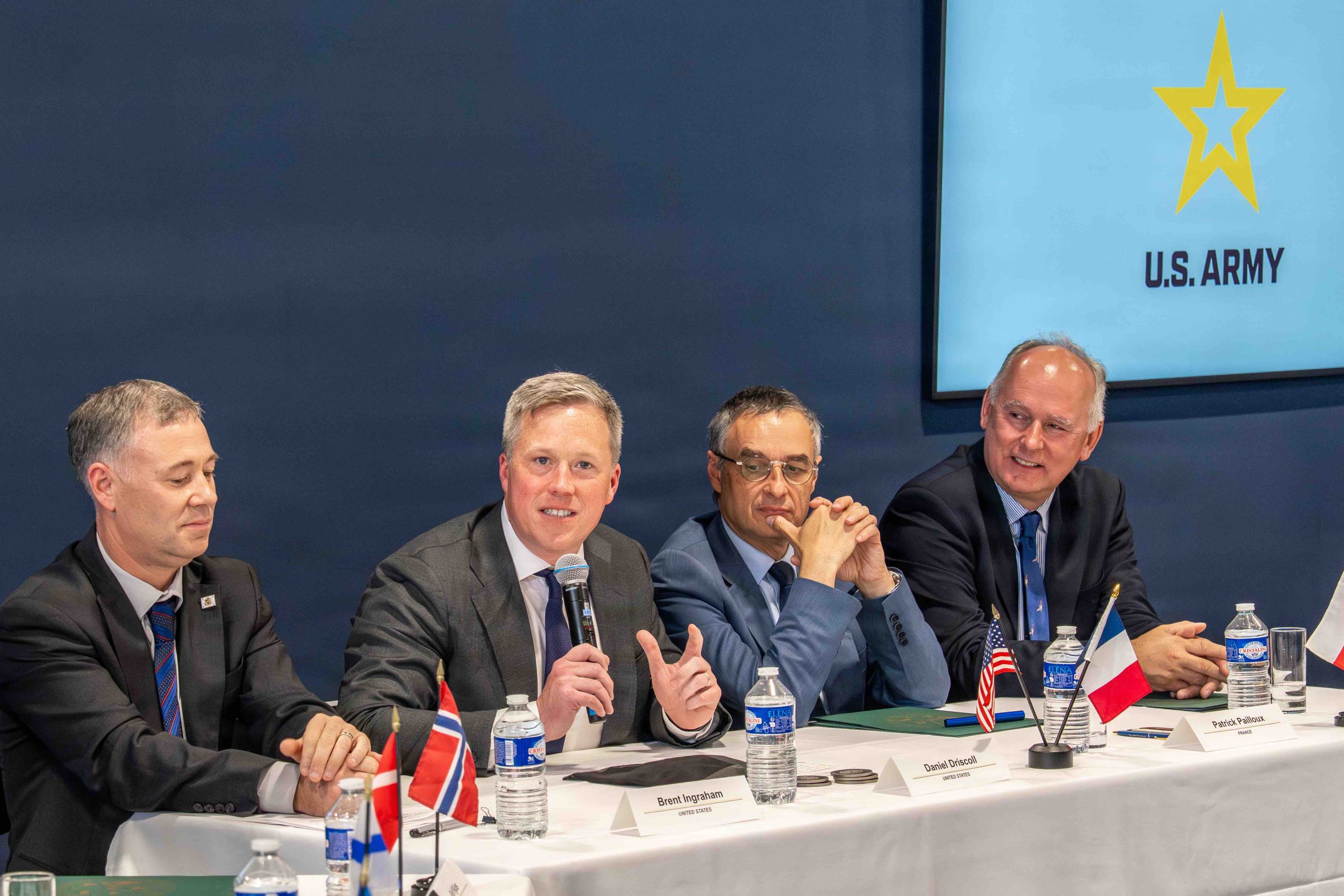
The signing brought together the United States and representatives from Sweden, Denmark, Norway, France, Poland, the United Kingdom, the Netherlands, Italy, and Lithuania to address what Driscoll described as one of the most urgent structural challenges facing modern militaries: how to move faster against the unmanned aircraft systems threat.
The ceremony included remarks by Driscoll and Honorable Brent Ingraham, assistant secretary of the Army for acquisition, logistics and technology, and was held at the Association of the United States Army Pavilion. The 10th Army Air and Missile Defense Command, which manages air and missile defense integration across U.S. Army Europe and Africa, provided the operational backdrop for the event.
The Counter-UAS Marketplace, managed by Joint Interagency Task Force 401 (JIATF-401), gives allied and partner nations a shared procurement pathway for capabilities proven on current battlefields, including low-collateral interceptors, radars, sensors, electronic warfare systems, and passive defense measures such as physical barriers. A parallel UAS Marketplace operates on the same framework, connecting allied buyers to vetted unmanned aircraft systems under common data standards anchored in a March 2026 joint declaration between the United States and the United Kingdom.
The marketplace model is designed to invert the traditional allied acquisition timeline. Historically, each nation has maintained its own counter-drone procurement pipeline, with timelines measured in years while drone threats evolve weekly. By aggregating allied demand and requiring every system in the marketplace to meet common data standards, the Army aims to let participating nations identify, evaluate, and field credible solutions at a pace more consistent with the operational environment.
Driscoll framed the signing as part of a broader effort to apply commercial market logic to defense acquisition. “What we’re fundamentally trying to do here is bring in the same market portals that have made so many companies successful in our country and yours, and just get our government and other governments’ regulation out of the way,” he said.
He described the marketplace mechanism in concrete terms: transparent access to user feedback, open vendor competition across participating nations, and government commitment to scale systems that prove effective in the hands of soldiers. “What we think will work is to allow transparent access to user feedback,” Driscoll said. “What we think will work is to allow everyone here to offer their products to Soldiers around the world and us to just listen to Soldiers, get their feedback, and then scale the things that work.”
Interoperability was a central theme. Driscoll argued that the drone inflection point demands compatible systems across the coalition, not merely capable ones. “What we know is this inflection point of war is going to require us to create compatible systems,” he said. “To do things like air defense, we need all of our equipment to be interoperable at a minimum.”
To illustrate the scale of the interoperability challenge, Driscoll pointed to Project Jailbreak, a U.S. Army initiative aimed at improving how Army systems share data. He said the Army reviewed approximately 100 systems in 30 days and identified a broader requirement to ensure equipment can transmit and receive data through common digital interfaces. The Army is preparing to apply similar lessons in Europe through the Eastern Flank Deterrence Initiative.
Brigadier General Ross, director of JIATF-401, described the effort as a deliberate attempt to operate at what he called the speed of relevance. “We are moving at the speed of relevance by cutting through red tape, consolidating resources, and establishing a robust two-way C-UAS marketplace,” Ross said. “The JIATF-401 marketplace helps aggregate that demand, ensuring our defense industrial base is ready to scale production to give our warfighters, allies, and partners direct access to proven counter-drone technologies.”
Driscoll also linked the initiative to the industrial base argument, contending that sustained allied demand keeps defense production capacity warm before it is urgently needed. “President Trump and Secretary Hegseth have been clear: speed and scale win,” he said. “A marketplace like this sustains the demand that keeps our defense industrial base warm — so that if the day comes when we need capability fast and in volume, the capacity is already there. You cannot build it after you need it.”
The Eurosatory signing extends agreements the Army concluded over the past year with the United Kingdom, Romania, Australia, Poland, and the Republic of Korea. The Army’s stated goal is to expand marketplace access to 25 allied and partner nations by the end of summer 2026. The letter of intent signed this week affirms allied commitment to streamline counter-UAS acquisition and training while helping participating nations identify, evaluate, and field capabilities at the pace required by the current threat environment.
Testing was a secondary focus of Driscoll’s remarks. He said the Army is working to expand vendor access to ranges and reduce delays that slow the process of proving systems before procurement. Faster testing, in his framing, is a prerequisite for the rest of the model to function: governments cannot scale what they have not yet evaluated.
Driscoll described a longer-term vision that extends beyond counter-drone systems to include drones, radars, sensors, and eventually major platforms such as tanks and helicopters — a trusted coalition environment in which allied nations can identify, evaluate, and procure equipment more efficiently while giving industry clearer sight lines into operational demand.
The coalition dimension carried weight beyond procurement. Leaders at the ceremony framed the marketplace as an information-sharing and requirements-alignment mechanism as much as a purchasing vehicle — a way for allied and partner forces to compare capabilities, reduce redundant evaluation cycles, and lower the barriers that slow emerging technologies from reaching the force.
The Eurosatory timing was deliberate. The biennial Paris exhibition draws defense ministers, senior military officials, and procurement authorities from across Europe and the broader alliance, making it a natural venue for coalition-level capability agreements. The C-UAS Marketplace signing was among the most significant U.S. government actions at the show, underscoring the Army’s position that drone and counter-drone capability has moved from a niche program area to a core coalition interoperability requirement.