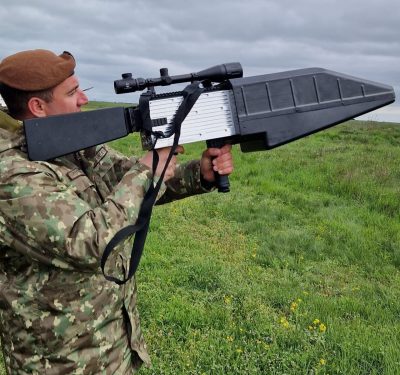

Russia is reportedly deploying a truck-mounted satellite jamming system designed to deny Starlink access to Ukrainian drones over a localized area. What it can and cannot do—and what it signals for U.S. drone communications acquisition—is the more consequential story.
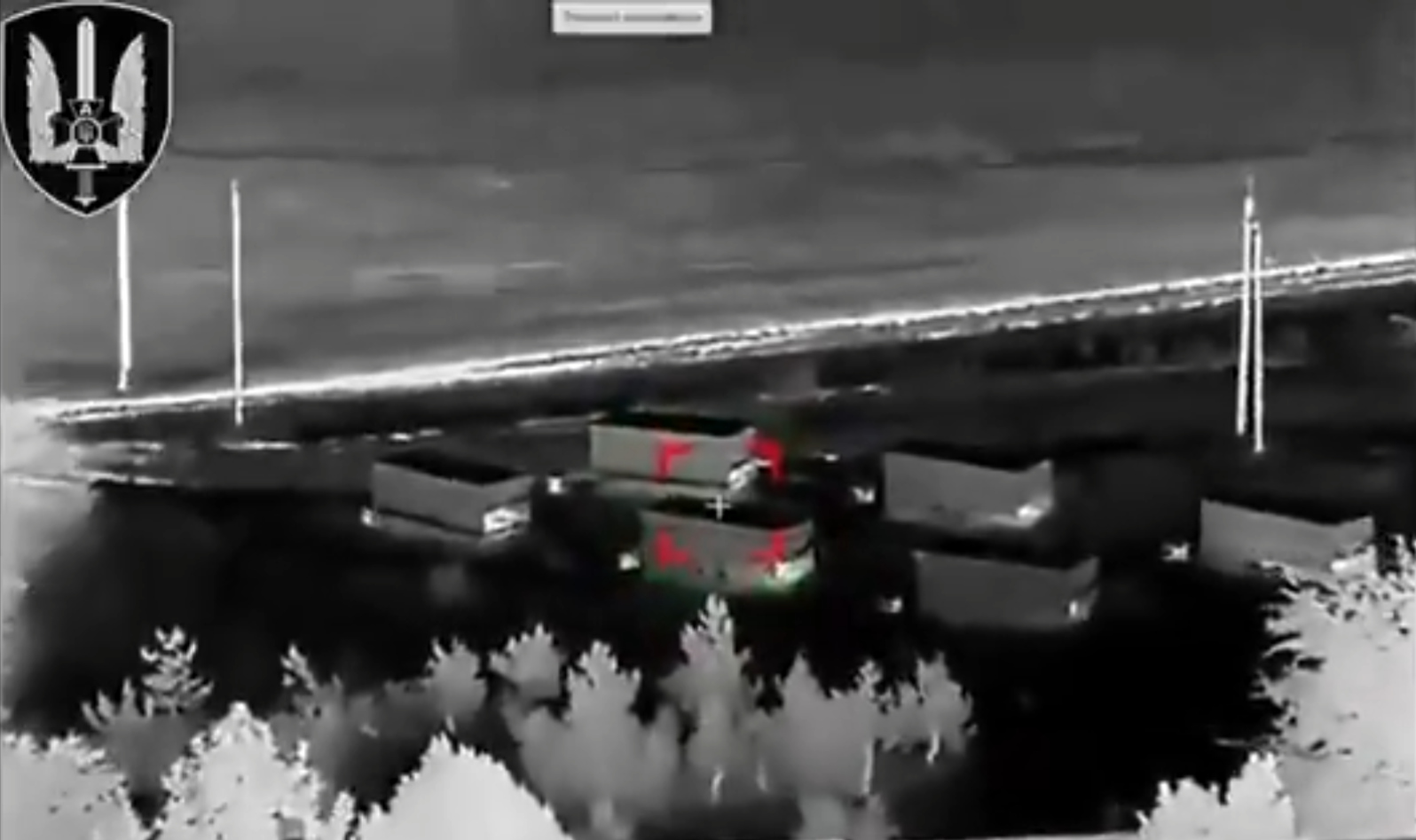
Ukraine’s 422nd “Luftwaffe” Unmanned Systems Regiment—attached to the 17th Corps operating in central-southern Ukraine—has released videos showing two successful strikes on individual trailers of a Russian electronic warfare system called Volna Kupol Garant. The strikes are notable not just as battlefield footage but as a signal: the system appears effective enough to be worth attacking, and conspicuous enough to be vulnerable to drone strikes.
The system being struck is Russia’s answer to a problem that has defined the air war in southern Ukraine: Starlink-equipped medium-range drones targeting Russian fuel logistics along the highway land bridge between Russian territory and Crimea, contributing to reported fuel shortages in the occupied peninsula. Guarantor—developed by Rossiysky Kupol LLC, based in Simferopol, Crimea—is Russia’s deployed response.
The Mission: Deny the Signal, Stop the Strike
According to a June 16 Telegram post by Serhii “Flash” Beskrestnov, advisor to Ukraine’s Ministry of Defense, Guarantor is designed to jam Starlink’s uplink band—the frequency range between 14 and 14.5 GHz through which user terminals communicate with satellites overhead. Russia’s approach, as described by Beskrestnov, is technically blunt but operationally deliberate: eight satellite dishes, one per frequency channel, each transmitting interference toward the satellite simultaneously. Beskrestnov claims the approach is sufficient to “deafen” the satellite to terminals in the affected area.
Each Guarantor system spans six trailers, each carrying up to two rotating dish antennas housed under egg-shaped domes. The antennas can be dismounted, and the system can draw power from onboard generators or external sources.
The coverage footprint the system reportedly achieves—roughly 20 square kilometers, a circular radius just over 2.52 kilometers, or 1.57 miles—is limited by design. This is not an area air defense system. It is a point-denial system. And at a reported price of $1.5 million per unit, it is priced for localized, high-value-area protection rather than broad corridor coverage.
What It Can Do: Local Denial Is Still Denial
The tactical logic is straightforward. A drone operating on Starlink loses datalink within the coverage area. But the operational implications are more nuanced than a simple outage. A drone with automatic target tracking and electro-optical guidance can potentially acquire a lock from outside the denial bubble on targets inside it—including Guarantor itself. The strike videos released by the 422nd Regiment suggest that may have happened in at least one engagement.
Russian Telegram drone blogger “Unmanned Brotherhood” acknowledges Guarantor is generating “significant problems” for Ukrainian forces while conceding the system is “large and conspicuous.” Russian technical specialist Sergei Trukhachev, speaking to TASS, credited the system with “high effectiveness during local tactical operations.”
The system’s primary vulnerability is the one that defines all large EW platforms on the modern battlefield: it is detectable by its own emissions, targetable at range with electro-optical guidance, and potentially vulnerable to RF-cued targeting or purpose-built home-on-jam weapons.
The system reportedly delivers denial over roughly 20 km²—a circle with a radius of 2.52 km, or 1.57 miles. At a reported $1.5 million per unit, coverage of even a modest highway corridor would require dozens of systems deployed in overlapping rings. That math constrains deployment to fixed high-value points, not linear routes.
Why Starlink Is Hard to Jam at Scale
Guarantor appears to target one satellite at a time. The problem for Russia—and the design principle that makes this relevant to U.S. acquisition planners—is that Starlink is not one satellite.
As of mid-2026, Starlink operates more than 10,000 low-Earth orbit satellites. Individual satellites remain overhead for only minutes, while terminals and the network transition among satellites as geometry changes. A jammer focused on one satellite therefore has only a narrow window before the relevant connection path changes.
This is the “cloud of gnats” problem. Jamming a single element in a distributed mesh does not disable the mesh. The scale of emitters required to achieve wide-area denial was quantified in a November 2025 study from China’s Zhejiang University and Beijing Institute of Technology: at least 935 high-powered aerial jamming platforms—or 2,000 low-powered—would be needed to deny Starlink across an area the size of Taiwan.
What Russia is doing with Guarantor is not solving that problem. It is working around it: accepting that wide-area denial is not achievable and concentrating denial capability over a defined high-value point instead.
Whether that is sufficient depends on the operational question. Is the goal to protect a fuel depot? A command post? A stretch of highway? For fixed, localized assets, Guarantor’s 20 km² footprint may be enough. For a 200-mile logistics corridor, it is not.
Starlink also incorporates design characteristics beyond distributed targeting that limit jamming effectiveness, including adaptive interference nulling that can suppress returns from known jamming sources. Whether Guarantor specifically overcomes that countermeasure is not addressed in available sourcing.
The Strategic Context: Who Else Is Building Constellations
The force design implication extends beyond Ukraine. Russia itself is spending approximately $5.3 billion to build a 292-satellite constellation called Rassvet by 2030. Progress to date is limited: 16 satellites launched from Plesetsk in the March 2026 batch, one of which has since failed.
China is advancing three constellations simultaneously—the commercially oriented Qianfan, or “Thousand Sails,” aiming for 15,000 satellites; the dual-use, state-owned GuoWang, or “National Network,” aiming for 13,000 satellites; and the telecom-oriented Honghu-3, aiming for 10,000 satellites.
Within a decade, adversary LEO constellations may provide the same communications redundancy to opposing drone forces that Starlink currently provides to Ukraine. When that happens, the counter-constellation problem becomes bilateral—and the tactical demand for localized LEO denial capability will no longer be a Russian-only acquisition priority.
Implications for U.S. Drone Communications Procurement
The Guarantor precedent raises three questions for U.S. defense planners:
Uplink hardening. Publicly available information does not establish how far current terminals can go beyond network-level redundancy in countering localized uplink jamming. As adversary uplink jamming becomes a tactical expectation rather than an exception, requirements for terminal-level anti-jam features, protected waveform management, or multi-path communications architectures may need to move into program-of-record language.
Alternative datalinks and autonomy. Drones operating in contested LEO denial zones may need more than one communications path. Mesh radio, directional links, optical communications, onboard autonomy, and preplanned mission execution all become more important when beyond-line-of-sight satellite connectivity cannot be assumed.
The cost-exchange question. At a reported $1.5 million per system, Guarantor is not cheap relative to the FPV and medium-range drones it is designed to disrupt. But if it can reliably deny Starlink datalink over a logistically critical area, the cost-exchange calculus shifts. Understanding at what force density and deployment cost Guarantor-class systems become viable area-denial tools—rather than point-defense curiosities—is a warranted intelligence and acquisition planning exercise.
A New Category, Not a Solved Problem
Guarantor is not a Starlink killer. It cannot broadly overcome the distributed redundancy of a 10,000-satellite network with rapidly changing satellite geometry and frequent terminal transitions. But it does not need to be a Starlink killer to be tactically significant—it needs to be good enough to disrupt drone operations over a defined, high-value area long enough to matter.
What the system represents is more important than what it currently achieves. Russia is attempting to bring satellite denial to the unit level—not as a strategic counterspace tool operated by centralized command, but as a deployable tactical EW capability that field commanders can position against a specific threat. The vehicles are conspicuous and the coverage is narrow, but the concept is sound, and the industrial incentive to miniaturize and proliferate it is real.
The U.S. and its partners are unlikely to face adversary LEO constellations at Starlink scale in the near term. But as drone communications architectures increasingly assume resilient beyond-line-of-sight connectivity, reliable LEO access should be treated as a vulnerability to be engineered around, not a given. Guarantor is an early indicator of what challenging that assumption looks like at the unit level.
About Rossiysky Kupol LLC
A Russian article published in March 2025 provides additional detail on a C-UAS “super EW” system developed by approximately 150 scientists at Rossiysky Kupol LLC, funded in part by local Crimean authorities. That earlier system was described as effective against drone targets at a 20-kilometer radius and was alleged to have “unintentionally suppressed” GPS signals in a neighboring European country—presumably Romania—while also reportedly preventing a 25-drone attack on a facility near Rostov. Whether the satellite jamming system reported in June 2026 is a separate development or an evolution of that earlier platform is not established in available sourcing.