
A military parade in Beijing on September 3, 2025 saw the unveiling of many new weapon systems quietly under development by China’s military-industrial complex. Among new nuclear missiles and armored vehicles, observers were shocked by two new advanced unmanned combat aircraft evidently aimed at greater speed, range and payload than expected.
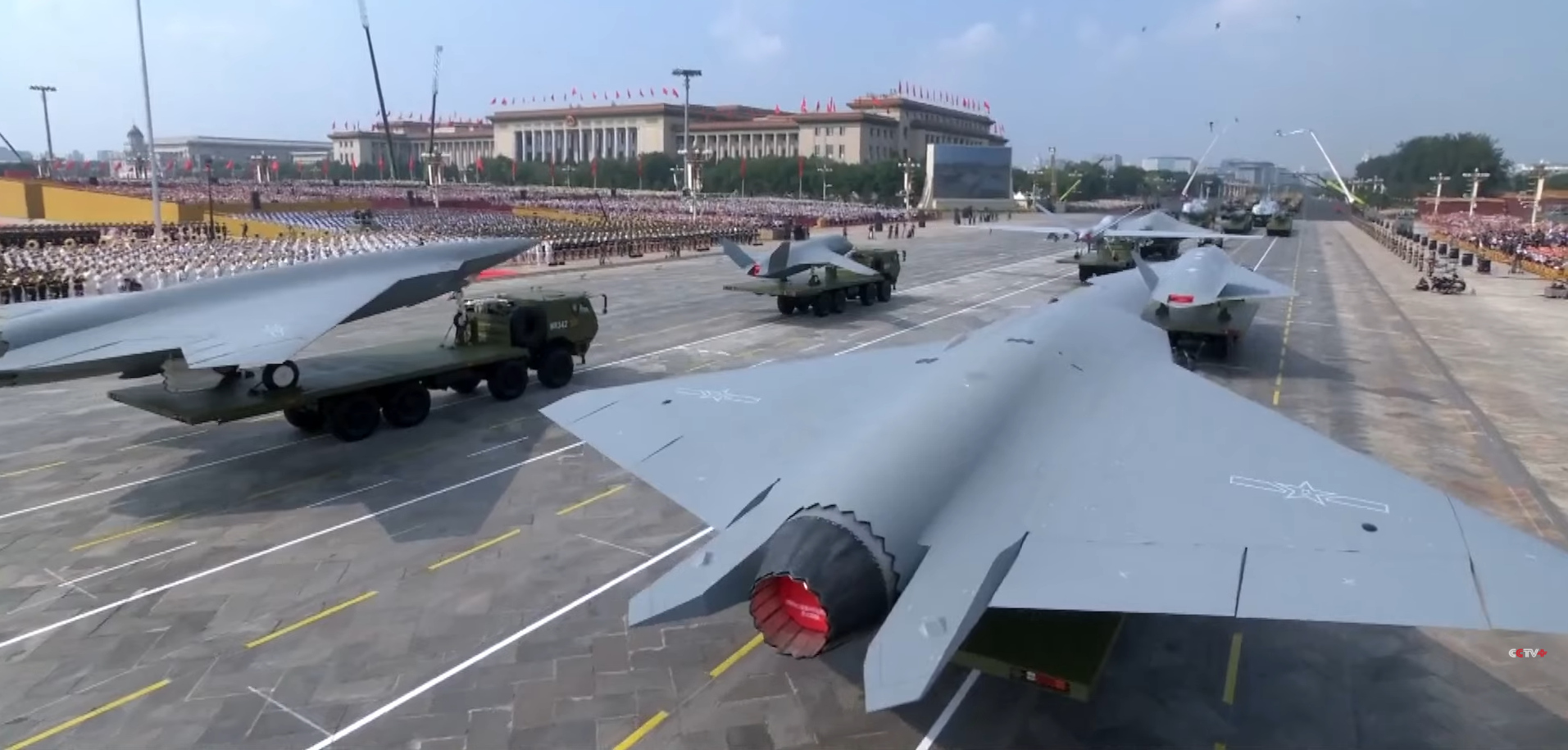
And that was in addition to at least two new loyal wingman aircraft more along the lines of Western designs, and an improved stealth UCAV–another type of drone the U.S. does not operate (at least openly).
That means, faced with choosing between pursuing attritable loyal wingmen like aircraft versus exquisite full-fledged drone stealth fighters, China’s military-industrial sector is doing both—as well as strike-oriented stealth UCAVs. And that while concurrently developing many at least three sixth-generation crewed fighters (the latest of which, seen flying in August, may also be unmanned) and a stealth bomber.
The Pentagon is not (at least publicly) developing or fielding a full-fledged drone fighter—an F-22-like combat jet sans pilot—nor a stealth UCAV like the GJ-11. The trend instead prioritizes production speed, volume and cost efficiency with UASs, which seems wise given the Pentagon’s major challenges generating adequate combat mass while also managing ballooning platform costs. Still, there are a minority of missions which cost-efficient platforms might be unable to perform that exquisite ones can.
But are the paraded UAVs real? The ‘detailing’ visible on the UASFs—including very real-looking engine nozzles, access panels, landing gear, and EO sensors—suggest either an actual prototype/demonstrator, or an especially elaborate mockup. The smaller CCAs, however, don’t seem as detailed. The UAVs all have 53-series serial numbers associating them with a PLA UAV Brigade stationed at Hotan Airbase in Xinjiang province.
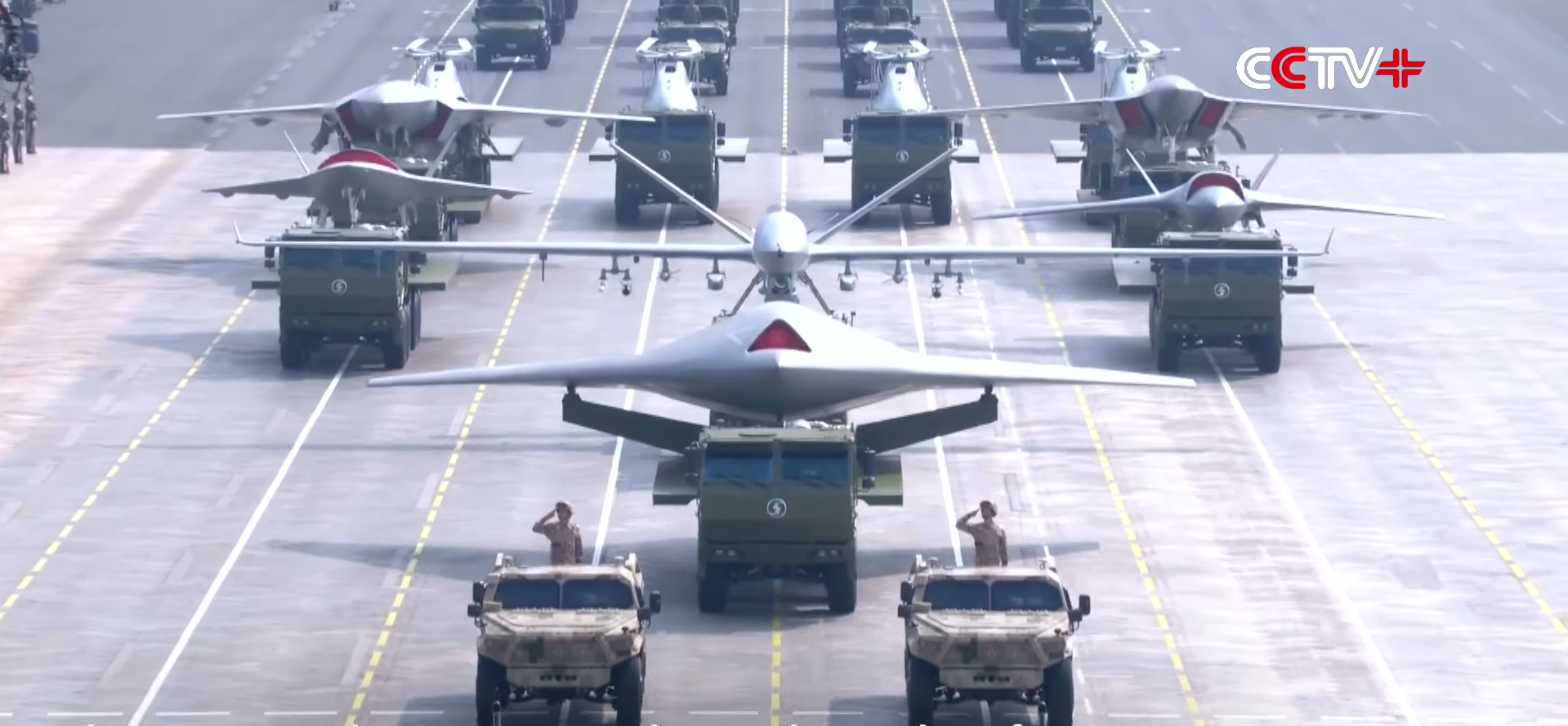
China’s big new drone fighters under the microscope
For lack of any official designation (PLA typically only announces them late in the game) some Chinese netizens allege the two larger UAVs are collectively designated Unmanned Air Superiority Fighters (UASF).
The larger ‘Type B’ is estimated to be the same size as a manned J-10 single-engine fighter, and reflecting emphasis on radar cross-section reduction and seemingly supersonic flight performance. It’s tailless (excellent for stealth and weight-saving, but requiring complex steering and stability solutions), and like U.S. stealth fighters feature two forward canted divertless supersonic intakes (DSIs) like those of an F-35 and a single flexible rear nozzle with serrated edges (both the nozzle and its fuselage mount) suggesting potential for thrust-vectoring engines.
Visible underbelly grooves also imply a capacious internal weapons bay. It additionally mounts a not-so-stealthy electro-optical sensor under the chin. Perhaps this would be replaced by a conformal should Type B be developed into an operational platform.
The smaller Type A shares similar features, but has stealthy lambda wings (instead of Type B’s modified delta wings); rearward-swept intakes, and no external sensors. A groove in the wings could indicate folding wingtips for carrier-based operations.
The other two parade fighter drones (Type C and D) are smaller aircraft more comparable to the U.S. Air Force’s Collaborative Combat Aircraft concept. Perhaps China’s most prominent Loyal Wingman prototypes were the Feizhong FH-97 and FH-97A—dissimilar to each other, but clearly imitations of the Kratos XQ-58A Valkyrie and Boeing MQ-28 Ghostbat respectively. The sincerest form of flattery, as the saying goes.
Of the paraded designs, one does seem in the vein of the FH-97/XQ-58, while the other is relatively novel. There are likely more CCA-style drone types, however—before the parade analysis of social media photos of assembling airframes suggested there were between 2-4 additional loyal wingmen designs! Perhaps these did not make the final parade cut.
Historically, the novel platforms featured in China’s parades are likely at least undergoing military testing and a majority do eventually make their way into service.
One notable example is the stealthy GJ-11 Sharp Sword UCAV—a turbofan-powered flying wing reminiscent of the RQ-170, but sporting two payload bays accommodating two tons of weapons. The 2025 parade presented a new GJ-11J or GJ-21 model featuring folding wings intended for deployment from China’s growing fleet and amphibious carrier fleets.
The parade also showcased a new compact unmanned naval helicopter capable of ISR and attack missions, described as already in operational service. It evokes the MQ-8C Fire Scout, which the U.S. Navy is in the process of retiring in favor of smaller UAV solutions.
How would China use a high-end drone fighter?
Time will tell how much China focuses on the expensive UASF concept versus attritable Loyal Wingmen/CCAs. But likely Beijing has the budget and production capacity to develop and field both, as well as slower advanced stealth UCAVs.
But it remains unclear how China would use UASFs: as a super CCA intended for teaming with manned fighters, or independently? Again, that need not be an either-or proposition.
On the manned-unmanned teaming side, UASFs likely have the speed and fuel efficiency to accompany China’s rapidly growing fleet of manned stealth fighters for longer-range, longer-endurance missions. Especially two-seat J-20S stealth jets and forthcoming J-36s are widely believed to be used (or at least tested) as drone-control platforms. China’s in-development H-20 stealth bomber and many large EW aircraft, could probably also control drones, and might benefit from longer-range/endurance stealth escorts.
Tethering to manned aircraft substantially reduces demands on drone mission autonomy and command-and-control. But being crewless, UASFs seem likely to have greater range and endurance than a J-20. They might therefore have appeal for independent sorties, or high risk/one-way missions (though cost would limit the appeal of expending UASFs sacrificially).
Of course, this requires more sophisticated autonomy to allow mission execution with sporadic or no human direction. However, China’s military may prove less restrictive in fielding killer autonomy than the U.S. due to different views on acceptable risks and collateral damage.
Of course, we can’t externally evaluate the sophistication of autonomy from parade photos. Even radar-cross section reduction involves factors beyond airframe geometry pictures can’t betray.
Countering any potential long-range drone stealth jets likely involves the introduction of additional UAVs to saturate sensors more densely and broadly across the battlespace, respond to attacks from unexpected vectors and serve as a buffer diverting attacks away from manned aircraft.
This of course is one role CCAs are intended to assume! Sea- or space-based unmanned systems might also contribute to sensor picket lines. EW, meanwhile, is unlikely to disable advanced warplanes with solid signal interruption contingencies, but still may help disrupt video feeds and man-in-the-loop instructional updates.
The U.S. defense sector doesn’t need to chase after every novel Chinese platform, and likely perfecting CCAs will serve as a stepping stone to an unmanned 7th-generation fighter in a decade or two. Still, it will be worth observing whether China’s experimentation with UASFs ends up making a case for exquisite drone fighters.