
A new study from the Center for a New American Security (CNAS) warns that the United States must accelerate the development and fielding of counter-uncrewed aerial systems (C-UAS) to maintain battlefield effectiveness.
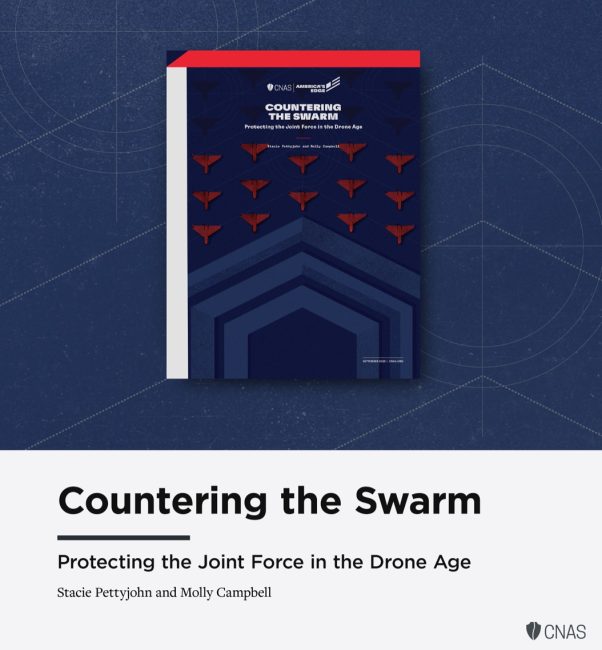
The report, Countering the Swarm: Protecting the Joint Force in the Drone Age, concludes that current U.S. defenses are insufficient to address the growing range of drone threats, from commercial quadcopters to long-range one-way attack systems.
From Niche Threat to Strategic Challenge
The CNAS study, authored by Stacie Pettyjohn and Molly Campbell, frames drones as a central feature of contemporary and future conflicts. Over the past decade, small and medium UAS have evolved from tactical nuisance into weapons capable of undermining U.S. force protection and complicating joint operations.
Whereas legacy air defenses were designed primarily to defeat aircraft, helicopters, or cruise missiles, the report notes that modern drone threats are cheaper, more numerous, and harder to detect. A $2,000 commercial quadcopter or a $20,000 Iranian Shahed-136 can threaten targets that require the U.S. military to respond with interceptors costing hundreds of thousands—or even millions—per engagement .
This mismatch in cost and scale, the authors argue, places U.S. forces at a long-term disadvantage unless new approaches are fielded.
Operational Lessons from the Middle East
The report points to recent U.S. experiences in Iraq, Syria, and the Red Sea as examples of how drone warfare has already reshaped the operational environment.
After October 2023, Iranian-backed militias launched more than 170 drone and missile attacks against U.S. positions in Iraq and Syria. These strikes killed three U.S. service members and wounded more than 150 . While units adapted and intercepted many incoming systems, the frequency of attacks depleted missile inventories and revealed gaps in U.S. short-range defenses.
At sea, the USS Carney shot down waves of drones and missiles during sustained operations in the Red Sea. Although the destroyer’s systems proved effective, the high expenditure of interceptors underscored the challenges of countering persistent, low-cost threats with expensive munitions .
The CNAS report highlights the Army’s 2nd Brigade Combat Team, 10th Mountain Division, as a positive case. The unit downed nearly 80% of incoming drones by combining rapid tactical adaptation with new technologies. Even so, CNAS emphasizes that such results cannot scale without institutional investment across the force.
The Cost Curve Problem
A recurring theme in the report is the unfavorable economics of counter-UAS. Adversaries can flood the battlespace with inexpensive drones, while U.S. responses rely heavily on high-value interceptors.
- DJI quadcopter: ~$2,000
- Shahed-136 one-way attack drone: $20,000–$50,000
- Coyote Block 2 interceptor: ~$125,000
- Stinger missile: ~$480,000
- SM-6 interceptor: ~$5.9 million
This imbalance, CNAS argues, is unsustainable. The authors call for stockpiling cheaper interceptors—including rockets, guns, and other scalable defenses—capable of handling high volumes of small UAS.
Technology Pathways: AI, Lasers, and Microwaves
The report reviews the status of advanced technologies often discussed in the counter-drone mission.
- Artificial intelligence (AI): Seen as critical for battle management, AI can speed decision-making, fuse sensor inputs, and coordinate multiple defensive systems simultaneously.
- Directed energy (lasers): Despite more than $3 billion in U.S. investment over the past decade, no laser system has yet reached full operational deployment. Lasers offer the promise of deep magazines but remain constrained by weather, power, and mobility limitations.
- High-power microwaves (HPMs): Identified as especially promising, since they can disable entire swarms of small drones simultaneously. CNAS suggests HPMs may be the only viable technology for large-scale swarm defense .
The authors caution against over-reliance on prototypes and stress the need to transition from experimentation to field-ready systems.
Budget Trends
The CNAS analysis tracks U.S. defense spending on counter-drone systems from 2015 to 2025. Funding rose from $4.8 billion to $7.4 billion over the period, though much of this has gone to adapting legacy missile defense systems rather than building purpose-designed C-UAS platforms.
The Army’s Low, Slow, Small UAS Integrated Defeat System (LIDS), which employs the Coyote interceptor alongside sensors and command systems, is one of the few purpose-built systems currently in production. Even so, CNAS notes that production numbers remain limited compared to the scale of the threat .
China and the Indo-Pacific
Although much of the report draws on Middle East case studies, CNAS emphasizes that the most consequential drone challenge may come from China.
The People’s Liberation Army (PLA) is investing heavily in autonomous drones and swarm tactics. In a Taiwan contingency, CNAS projects that China could employ massed, mixed salvos to overwhelm U.S. distributed operations. In such a scenario, layered defenses integrated by AI-enabled command systems would be essential .
Training and Force Integration
A major recommendation is to expand counter-drone responsibilities beyond air defense units. According to CNAS, every unit in the joint force must be trained to defend against drones, with passive measures—such as camouflage, deception, and dispersion—integrated alongside active interceptors.
The authors call for counter-UAS doctrine to be standardized, exercised, and resourced across all services. Without such institutionalization, they argue, the U.S. risks facing a threat that outpaces its organizational response.
Implications for Industry and Policy
For industry, the report suggests a shift in priorities: away from high-cost, exquisite systems toward affordable, rugged, and scalable solutions. Companies developing low-cost interceptors, modular sensors, AI-driven command systems, and HPMs are likely to align with the Pentagon’s future procurement needs.
For policymakers, the findings reinforce debates in Congress about balancing investment between legacy missile defense and emerging C-UAS programs. The report’s emphasis on joint integration also suggests potential changes in how funding streams are allocated across the services.
The CNAS report frames the counter-drone challenge as both immediate and long-term. In the short term, U.S. forces face the economic strain of defeating low-cost drones with high-cost interceptors. In the long term, advances in autonomy and swarming could present threats beyond the capacity of current defenses.
“The stakes are not theoretical,” the authors write. “Without adequate defenses, even the most advanced systems and tactics will be rendered irrelevant in the face of overwhelming drone attacks” .
The report underscores how central counter-UAS has become to the defense technology landscape. Whether through AI, directed energy, or new generations of interceptors, the race to align defense capabilities with drone proliferation will define procurement and operational priorities well into the next decade.