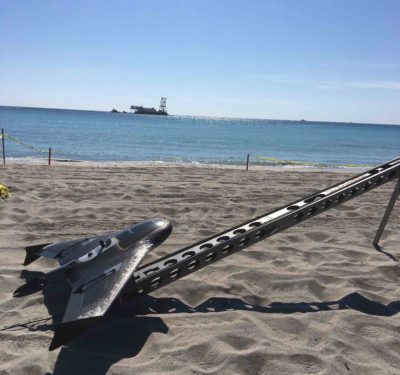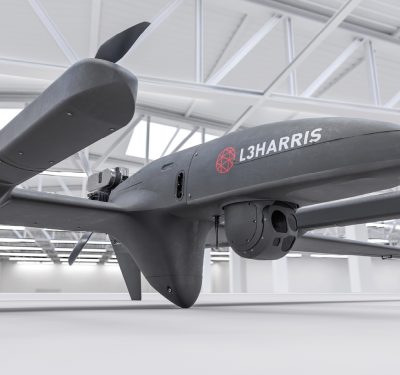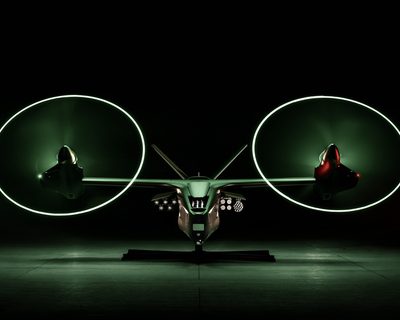

Starting February 17, 26 drone manufacturers participated in a multi-week Drone Dominance Gauntlet designed to identify the best first-person view (FPV) one-way attack drones industry could furnish off the shelf to the U.S. military. This was the first of four such Gauntlets in the $1.1 billion Drone Dominance Program, which aims to procure more than 200,000 small FPV one-way attack systems by 2028 from a diverse set of manufacturers.
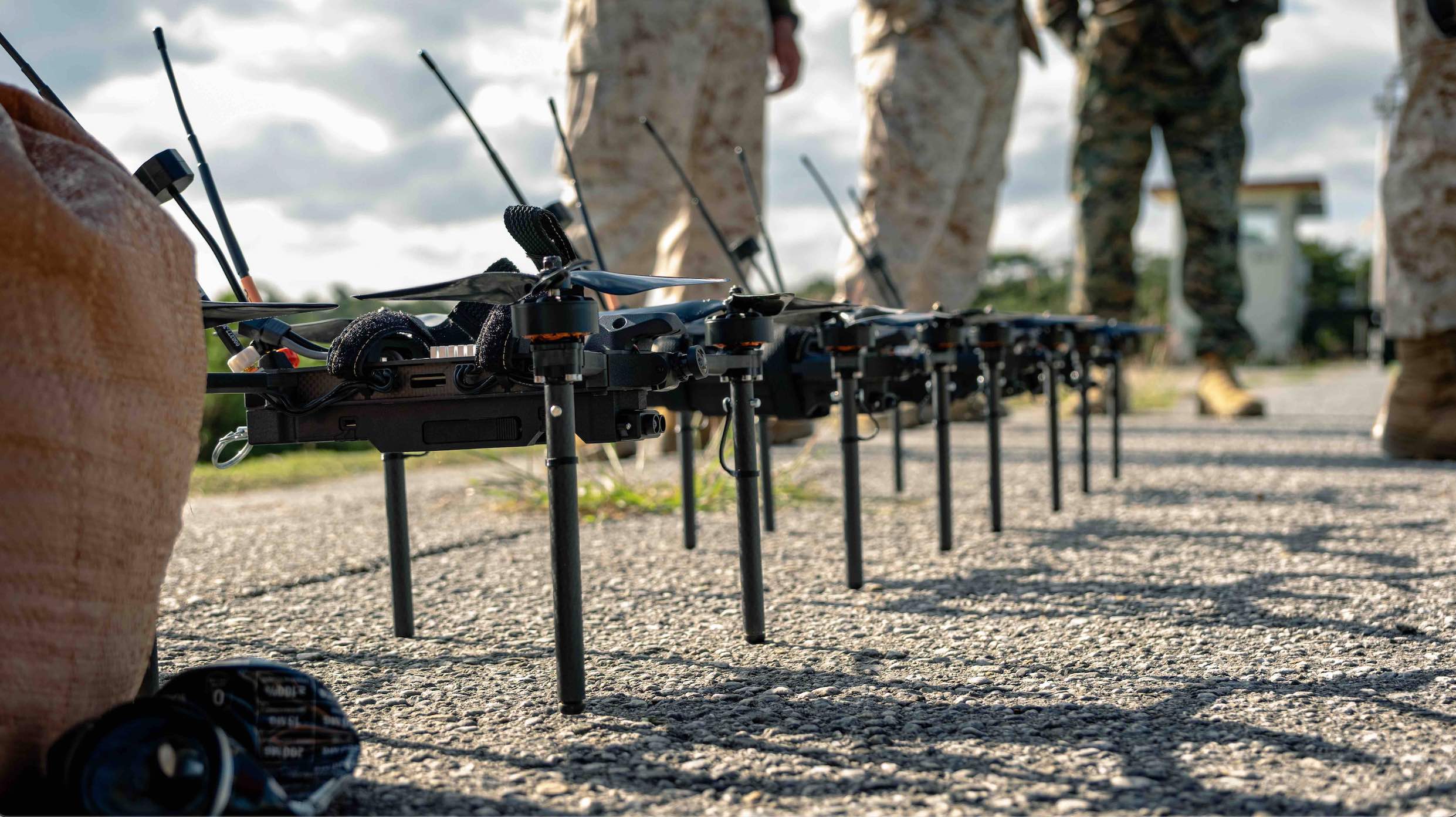
The Pentagon has announced eleven winners for Gauntlet Phase I, publishing a leaderboard based on a combination of industrial capacity and readiness assessments, mission performance evaluations, and user ratings generated by the soldiers who operated the systems following a short two-hour training session.
Beyond ranking individual systems, program officials are explicit that the Gauntlet is also intended as a live test of the emerging small-UAS industrial base. The four phases are structured to expose bottlenecks in motors, batteries, radios and sub-tier components, and to push vendors toward fully NDAA-compliant, “covered-country”-free bills of material. As quantities increase and target unit prices fall across phases, firms that can demonstrate resilient domestic or allied sourcing—and withstand scrutiny of their capitalization and ownership—are likely to be better positioned for follow-on orders and related trusted-autonomy programs.
Phase I results
Leading the initial leaderboard with 99.3 points is the Shrike 10 Fiber drone produced by British company Skycutter and Ukraine’s Skyfall (also known for its very low-cost P1 Sun drone interceptor). This sub-model of the Shrike FPV system is controlled via a fiber-optic cable measuring 12.4 miles long.
In second place with 87.5 points is the Neros Archer—a system already inducted in 2025 by the Marine Corps and then by the Army for Tranche 1 of its Purpose-Built Attritable System (PBAS) program aimed at fielding squad-level FPV one-way attack drones. Archer is already the Pentagon’s first FPV one-way attack UAS to be purchased at Ukraine-level prices.
Meanwhile, companies Napatree, ModalAI and Auterion scored between 77 and 80.3 points, with Napatree also receiving the highest grades for military operator evaluations specifically. The remaining finalists scored between 70 and 72.9 points, including Ukrainian Defense Drones, Griffon Aerospace, Nokturnal AI, Halo Aeronautics, Ascent Aerosystems (deemed most production-ready) and Farage Precision.
The program opted not to name a twelfth-place finalist as was originally contemplated. Several prominent drone builders did not make the final cut, including Draganfly, Dzyne Technologies, Ukraine’s General Cherry, Performance Drone Works, XTEND Reality, Teal Drones and others.
However, non-finalists are still eligible to compete in the subsequent three phases of the competition—because those will test different scenarios and use conditions. New vendors may also be welcomed mid-competition according to the Pentagon, so long as they meet standards including NDAA compliance.
A Pentagon statement emphasizes that the Gauntlets are designed to find rapidly adoptable solutions for defined mission sets, rather than any single universal UAS. Program officials have also said they deliberately avoided overly prescriptive technical specifications in order to foster creativity and keep the emphasis on usability, cost and outcomes.
The Gauntlet ends, the production race begins
FPV one-way attack drones, widely proliferated in Ukraine, have demonstrated that low-cost, mass-produced precision-strike munitions can impose significant tactical and operational effects. The open question for the United States has been how readily and affordably the military and industry could adopt similar systems given the Pentagon’s tendency toward lengthy R&D cycles and highly customized, expensive weapons programs.
The Drone Dominance Program was designed to challenge that tendency by simulating wartime evolutionary pressures that emphasize cost minimization, production speed and delivery, user satisfaction and iterative upgrades sustained over time.
Phase I winners will be rewarded with up to $150 million in contracts (drawn from Other Transaction Authority funding, with no more than $5,000 per drone), but will also be subject to a new level of scrutiny: a test of their ability to deliver on time and in quantity.
Per contract specifications, Skycutter/Skyfall may receive a maximum order of up to 2,500 UAVs, while runners-up receive progressively smaller orders. Eleventh place, for example, will receive an order for 1,500 drones. The contracted companies will subsequently be rated on their ability to deliver 50% of that order within 2.5 months, and the remainder 75 days later, with the financial reward substantially greater for completing the second delivery on time.
Early deliveries may be rewarded with upsized orders, while late deliveries will be compensated at a lower rate or even canceled. The aim is to prevent pursuit of perfection from becoming the enemy of “good enough,” and to determine whether companies can actually meet their promised cost and delivery timelines.
How Phase I Drone Dominance was competed
Roughly 100 personnel primarily drawn from the U.S. Army, Marine Corps and Special Operations community participated in the two-week Phase I evaluation at Fort Benning—all of whom received only two hours of training before being tasked with locating and attacking a stationary target up to 6.2 miles (10 km) away, first with an individual drone and then multiple UAVs in simultaneous flight. Each team expended 10 UAVs in total.
The UAS were then tested on search-and-destroy missions within 3 miles in an urban environment, where cover is abundant and maintaining control links is challenging. Finally, an optional tertiary test using live ammunition undertaken by vendor pilots offered bonus points for UAS already fielded with an integrated warhead.
Military operators then evaluated their UAS based on usability: did they deem the drone just tested ready to take into battle? The emphasis on user experience after short training timeframes reflects the program’s intent to field systems suitable for general across-force adoption, rather than tools reserved for elite UAS specialists.
Separate evaluators scored UAS based on observed outcomes in strike accuracy, setup time and time to locate the target.
The Drone Dominance Program’s main leaderboard is complemented by sub-headings detailing the best-ranked UAS in terms of mission types, operator evaluations and industrial evaluations.
Companies that ranked favorably for mission performance without making the combined-score leaderboard include General Cherry, Greensight, Vector Defense, Firestorm, Draganfly and W.S. Darley. Meanwhile, Performance Drone Works and again W.S. Darley were identified as being in the top 5th percentile for production capacity without making the global leaderboard.
Technology choices and trade-offs
It is notable that a fiber-optic drone led the field in a competition dominated by radio-controlled UAS. In Ukraine, fiber-optic systems have proved difficult to defeat using electronic attack because they retain high-quality control links and video feeds throughout the engagement. They also present trade-offs stemming from cable-entanglement risks, inability to circle back for a second attack run, higher costs, supply-chain constraints and the weight added by lengthy cable drums. Those constraints, however, have not prevented a strong preference for fiber-optic UAVs in that conflict when they are available.
The winning Shrike drone is reportedly produced for around $1,500 in its fiber-optic, night-operations subvariant, or as little as $300 for the cost-minimized daytime variant—both below the $2,000 unit-cost target for Gauntlet Phase IV. Positive production-readiness scores awarded to Shrike and Neros Archer also reflect the fact both are already being mass-produced, with Neros reporting it could produce 2,500 Archers monthly in 2025.
What’s happening next in the Drone Dominance Program?
In “approximately six months” Gauntlet Phase II will kick off, ultimately leading to the selection of seven winners, followed by a final two phases after additional six-month intervals. For each new phase, the number of selected winners declines, required quantities increase, and unit-cost targets become more stringent.
While the requirements for Phase II are not due until May 15, current documents state that it will include additional missions in an operating environment that is “substantially more difficult with comprehensive C-UAS applied, and at least one mission evaluated during night operations.” Furthermore, “munition readiness,” including a requirement for fully integrated training rounds, will play a large role in Phase II.
Electronic warfare is likely to define any future high-intensity ground-warfare environment, and U.S. small UAS built prior to 2022 proved vulnerable to such threats in Ukraine. As C-UAS resistance and night operations were explicitly not tested in Phase I, it is possible some lower-performing UAS could receive higher marks in Phase II and vice versa. On the other hand, factoring in electronic warfare may simply reinforce the scores of fiber-optic UAS like Shrike which are largely immune to RF-based attack.
Program documentation states that Phases III and IV will involve further escalations in complexity, including:
• Integration of more advanced autonomy to reduce cognitive load on operators
• Relatedly, testing support for a single operator to control multiple UAVs simultaneously
• Ability to overcome more sophisticated C-UAS threats including denial of communications and navigation
• Effectiveness against moving targets
• Ability to operate in cold, hot and high-altitude environments
Across those phases, the Gauntlet is intended to do more than select individual systems: it is a mechanism to shape an industrial base capable of delivering trusted, attritable small UAS at scale under realistic operational and production pressures.