
The Army-led Joint Interagency Task Force 401 has released a new public guide explaining how counter-UAS detection technologies work and how they are designed to comply with U.S. surveillance and communications law while protecting individual privacy.
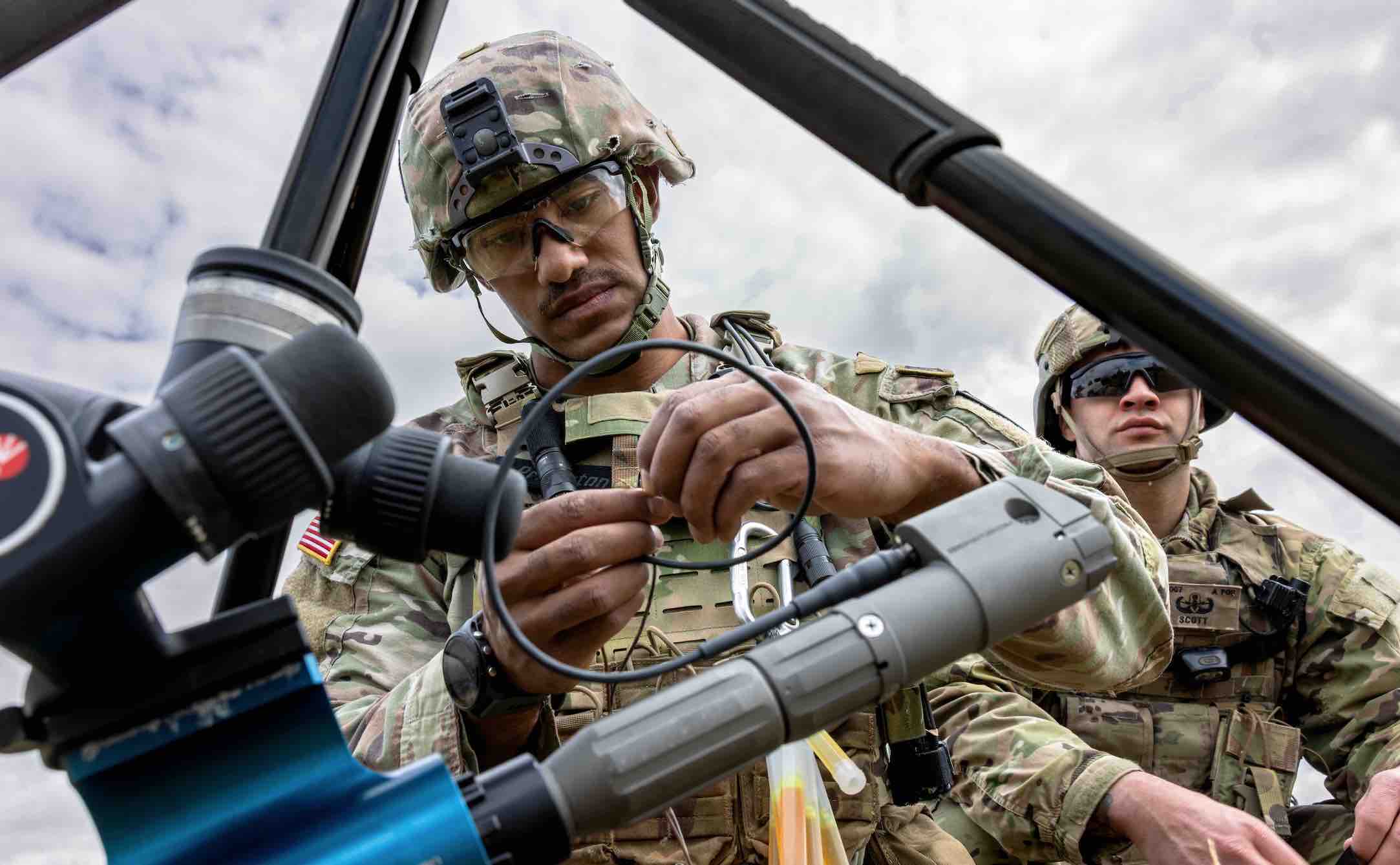
The publication, “Counter-UAS Operations: Safeguarding Freedoms and Preserving Privacy,” is intended to demystify radar, electro-optical/infrared (EO/IR), acoustic and RF-based drone detection for commanders, local authorities and the public.
The guide follows JIATF-401’s earlier physical-protection framework for critical infrastructure and public venues, which focused on low-cost, non-technical measures stadiums and bases can adopt ahead of the 2026 World Cup and other large events. Together, the documents outline both how to harden sites and how sensor systems can be used in a legally compliant, privacy-respecting way.
Explaining how counter-UAS sensors work
The new guide walks through the layered sensing approach used in many counter-UAS systems, highlighting four main sensor categories: radar, EO/IR, acoustic detection and radio-frequency sensing.
- Radar is described as detecting physical objects in the air by transmitting radio waves and measuring reflections, allowing operators to track size, speed and movement.
- EO/IR cameras are used to visually confirm a drone once another sensor has detected it, improving classification and tracking.
- Acoustic sensors can identify distinctive motor and propeller noise signatures, particularly useful in environments where radar or RF detection may be constrained.
- RF detection systems passively scan for control links, telemetry and video signals, analyzing their technical characteristics to see if they match known drone profiles.
Importantly, the guide stresses that these detection systems are passive during normal operation: they “listen to signals already being transmitted and do not emit disruptive signals or actively interrogate devices,” a distinction meant to separate them from electronic attack or jamming tools.
Signal “fingerprints,” not content
A central theme is the difference between analyzing technical transmission characteristics and intercepting the content of communications. JIATF-401 frames this as the difference between “how a signal is transmitted” and “what it says.”
The document explains that counter-UAS RF systems focus on:
- Detecting RF signatures associated with drone control and telemetry links
- Analyzing waveforms and modulation types
- Measuring frequency, signal strength, bandwidth, power levels and timing
- Using direction-finding and triangulation to estimate the location and movement of a drone and its controller
This process, sometimes called “signal fingerprinting,” is used to match unknown emitters against a library of known drone signatures without decoding any underlying message content.
Legal framework and “privacy by design”
One section of the guide is devoted to the legal and regulatory framework governing counter-UAS detection. It cites the Electronic Communications Privacy Act (ECPA), the Pen/Trap statute, and Federal Communications Commission (FCC) rules as key constraints on how these systems can be designed and operated.
To comply with those laws, the guide states that operational systems:
- Are explicitly engineered to filter, truncate or discard communication content on reception
- Do not decode message content or read private communications
- Function as spectrum-survey tools for security, not as eavesdropping devices
It also describes data-minimization practices such as real-time signal processing with no long-term content storage, and privacy features like automatic blurring or anonymization of faces and license plates in imagery when that information is not relevant to a threat.
JIATF-401 Director Brig. Gen. Matt Ross calls counter-drone defense “a homeland defense imperative,” and links the work to a broader effort to integrate sensors, effectors and mission-command systems into a distributed network that protects both service members and civilians. Col. Scott Humr, the task force’s deputy director for science and technology, characterizes the approach as “safeguard[ing] privacy by design,” emphasizing data minimization and secure handling so only information needed to identify a potential threat is collected.
JIATF-401 is trying to pair rapid deployment of counter-drone capabilities with public-facing explanations of how those systems work and what limits are placed on them. That transparency push sits alongside the task force’s other recent outputs, including its “Harden, Obscure, Perimeter” playbook for physical protection of critical infrastructure and major events.