
DroneDash Technologies and GEODNET have formed a joint venture to bring a new class of autonomous agricultural spraying drone to industrial-scale farming operations.
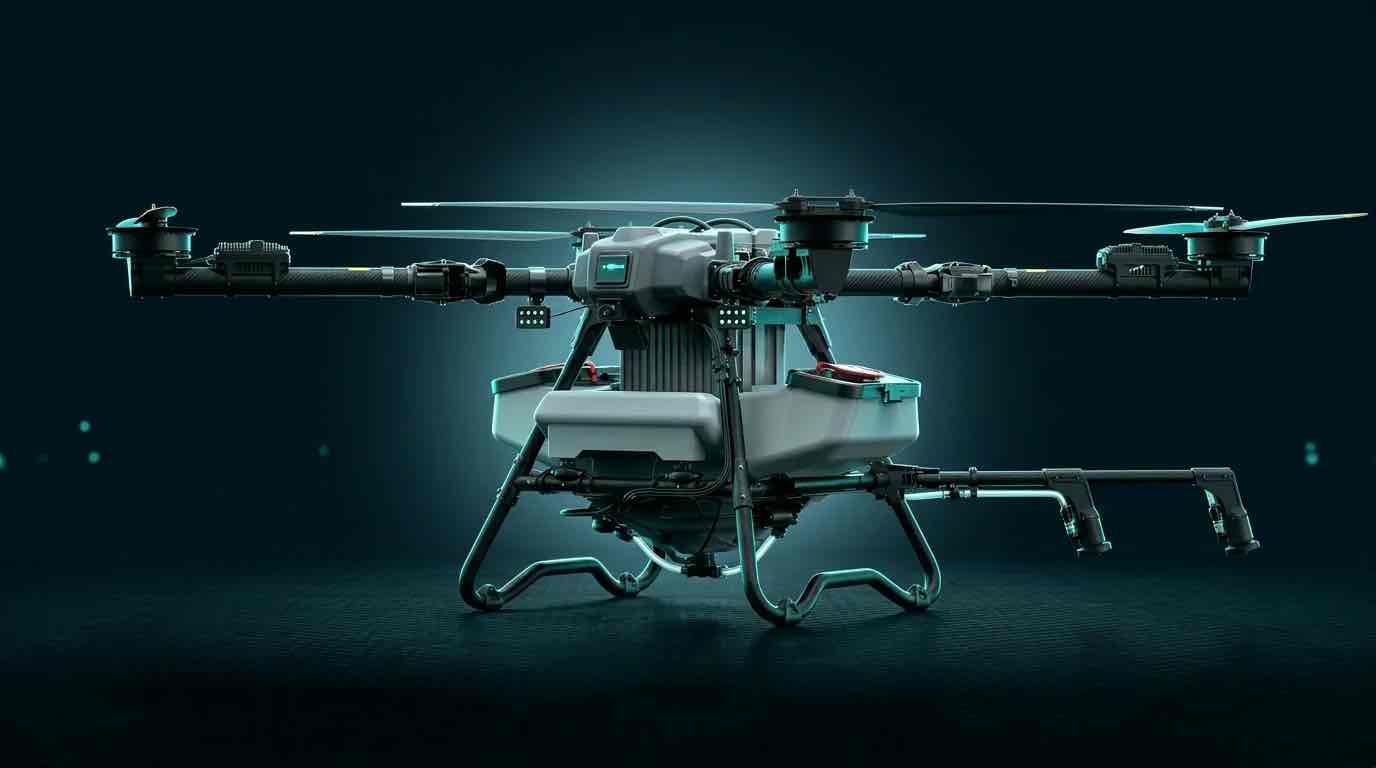
GEODASH Aerosystems Pte. Ltd., incorporated in Singapore, is targeting commercial deployment of its GDA80-120 heavy-lift platform in Q3 2026, with initial markets in Southeast Asian oil palm and sugarcane plantations and subsequent rollout across U.S. and South American broad-acre operations.
The GDA80-120 is designed around a specific operational constraint that has limited the scalability of agricultural drone spraying programs: the pre-mission mapping requirement. Conventional ag spraying drones require operators to manually survey and map each field before deployment, generating static flight plans that have to be regenerated whenever terrain, canopy, or planting patterns change. At industrial plantation scale — estates measured in thousands of hectares with variable terrain and mixed-age crops — that overhead is a direct ceiling on how much area a drone team can cover and how quickly they can respond to emerging crop conditions.
GEODASH Aerosystems removes that requirement from the workflow. The platform uses DroneDash’s AI Vision system for real-time perception of plantation structure, canopy height, and terrain features during flight, combined with centimeter-accurate RTK positioning delivered through GEODNET’s decentralized correction network. The result is a drone that can be deployed without a prior survey step and redeployed immediately after replanting or field reconfiguration events, with continuous altitude and spray-rate adjustment over variable terrain handled autonomously during the mission.
GEODNET, the world’s largest decentralized GNSS-RTK network with more than 20,000 active reference stations across 140-plus countries, provides the positioning backbone. Co-founder Mike Horton, who serves as co-founder of GEODASH Aerosystems, described the combination as making autonomy predictable and reliable at the scale industrial agriculture requires.
Beyond spraying, each operational flight generates agronomic data fed into DroneDash’s AI Smart Farming backend: canopy density and uniformity analysis, crop stress and anomaly detection, spray effectiveness validation, and terrain profiling. The platform is designed to function as a continuous aerial intelligence layer, with each mission producing decision-support data for plantation managers alongside its primary spraying function.
Pilot deployments and system validation have been conducted in collaboration with plantation operators through 2025 and into early 2026. Manufacturing readiness and regulatory approvals are underway ahead of the Q3 2026 commercial launch.