
Joint Interagency Task Force 401 (JIATF-401) and the Federal Aviation Administration completed a two-day high-energy laser test campaign at White Sands Missile Range, New Mexico, held March 7–8, aimed at advancing the safe use of directed-energy counter-UAS systems in U.S. airspace.
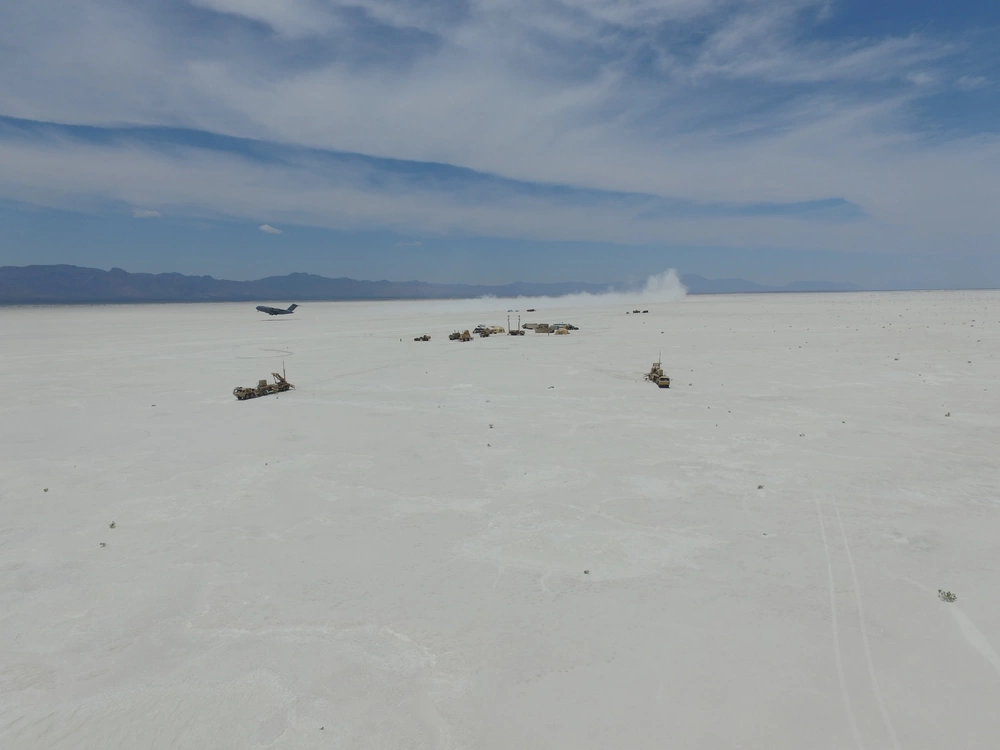
According to the DoD release announcing the event, the tests were the latest milestone in a multi-year partnership between the department and the FAA to ensure that counter-drone technologies can be integrated into the National Airspace System without compromising safety. The plan for the campaign was developed with support from the White House Task Force to Restore American Airspace Sovereignty and other interagency stakeholders.
The White Sands series built on earlier directed-energy work and was structured specifically around FAA concerns about how high-energy lasers interact with aircraft and aircrews. Test activities focused on gathering data on the laser’s material effects on aircraft surrogates, validating automated safety shut-off functions, and informing analyses for aircrew eye safety, according to the department.
“This is a critical step in making sure our warfighters have the most advanced tools to defend the homeland,” U.S. Army Brig. Gen. Matt Ross, director of JIATF-401, said in the statement, adding that success is measured by how quickly C-UAS capabilities can be delivered to operational forces.
Interagency context after El Paso airspace closure
The White Sands campaign followed a series of incidents along the southern border in February that pushed domestic counter-drone operations and interagency coordination into the spotlight. In early February, the FAA issued a temporary flight restriction over El Paso, Texas, and surrounding airspace—initially announced as a 10-day shutdown—after the use of an anti-drone laser system near the border. The TFR effectively halted commercial, medical and general aviation flights before being lifted after several hours.
Roughly two weeks later, a separate incident near Fort Hancock, southeast of El Paso, saw a U.S. military laser system used against what was believed to be a threatening drone, prompting additional airspace restrictions and calls from lawmakers for closer coordination among the Defense Department, Department of Homeland Security and the FAA.
Against that backdrop, JIATF-401 and the FAA framed the White Sands tests as part of an ongoing unified federal effort to counter unmanned aircraft threats while maintaining airspace safety and sovereignty. Key partners supporting and observing the event included White Sands Missile Range, the Army Program Acquisition Executive–Fires, U.S. Northern Command, Joint Task Force–Southern Border, as well as representatives from the Department of Energy, National Nuclear Security Administration, Department of Homeland Security, Customs and Border Protection and the New Mexico National Guard.