
Vertex Modernization and Sustainment’s Tempest vehicle, armed with radar-guided Hellfire missiles, has already destroyed 21 Shahed drones in Ukraine, giving the Corps a rare case of fielding a system with an active combat record.
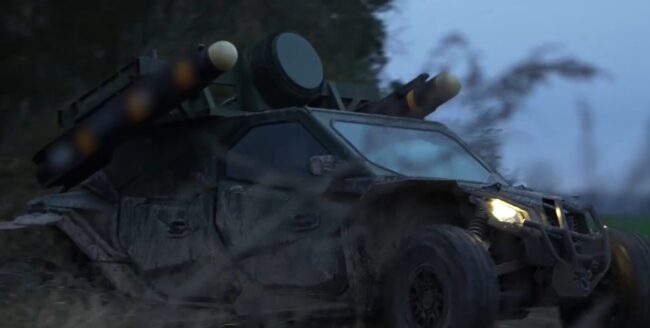
The U.S. Marine Corps has ordered 10 more Tempest counter-drone vehicles under a contract worth roughly $19 million, according to a Pentagon contract announcement dated Aug. 11.
The award goes to Vertex Modernization and Sustainment, an Indianapolis-based company operating as part of defense contractor V2X, and covers the vehicles along with software, spare parts, training and other support services. Work is expected to run through Aug. 10, 2027, based out of Vertex’s Indianapolis facility.
Built From Commercial Parts
The Tempest is a lightweight, four-wheel-drive combat vehicle built from commercially available components rather than custom military hardware, a design choice intended to keep costs down and simplify repairs, since parts can often be sourced from civilian suppliers rather than specialized defense manufacturers. Reporting on the vehicle’s origins indicates it was built on a modified Can-Am Maverick X3 off-road buggy, sold commercially for recreational use, then outfitted with dual missile launchers and a sensor suite to detect, track and shoot down drones. V2X publicly unveiled the Tempest at the Association of the United States Army’s annual conference in October 2025.
A Combat Record Already in Hand
The vehicle carries AGM-114L Longbow Hellfire missiles, a radar-guided version of the Hellfire family originally developed for Apache attack helicopters, mounted on launchers that let the Tempest engage what the military classifies as Class 2 and Class 3 unmanned aircraft systems, roughly meaning drones ranging from small tactical reconnaissance aircraft up to systems approaching the size of a small manned aircraft. At least two Tempest vehicles are already operating in Ukraine, where the Ukrainian Air Force has credited the system with destroying 21 Shahed drones since entering service, giving the Marine Corps a rare case of buying a weapon system with an active combat record rather than one that exists only in testing.
The contract blends firm-fixed-price, cost-plus-fixed-fee and cost contract structures under the IDIQ vehicle, meaning the $19 million figure represents a starting point rather than a hard ceiling on what the Marine Corps might eventually spend on Tempest vehicles and support.