
DroneShield’s Tom Branstetter on U.S. Manufacturing Expansion, Multi-Domain Integration, and an Unprecedented Moment of C-UAS Alignment
Tom Branstetter has spent nearly seven years watching the counter-UAS market evolve from a niche concern into a mainstream defense priority. A former Navy SEAL and high-threat protective officer for the U.S. government, he now serves as DroneShield’s Vice President of Business Development and Sales for the United States, overseeing a product portfolio that spans four categories: dismounted systems including the RfPatrol Mk2 body-worn detection device and DroneGun Mk4 handheld effector; expeditionary platforms; fixed-site installations; and command-and-control infrastructure anchored by the DroneSentry-C2 Tactical system. The range reflects a philosophy the company has maintained throughout its growth: solutions should follow the operator, not the other way around.

VP of U.S. Business Development,
DroneShield
At SOF Week in Tampa—packed, by Branstetter’s account, across all three days—he described a company accelerating on multiple fronts simultaneously. A U.S. manufacturing expansion is underway, a strategic partnership with Overland AI is extending DroneShield’s C-UAS stack onto autonomous ground vehicles, and a software update cadence is keeping detection libraries current in an environment where the threat never stops evolving.
“I’ve been with DroneShield for close to seven years,” he said, “and I’ve never seen this type of alignment and this type of momentum being pushed towards the counter-UAS threat.”
Ground and Water: The Multi-Domain Play
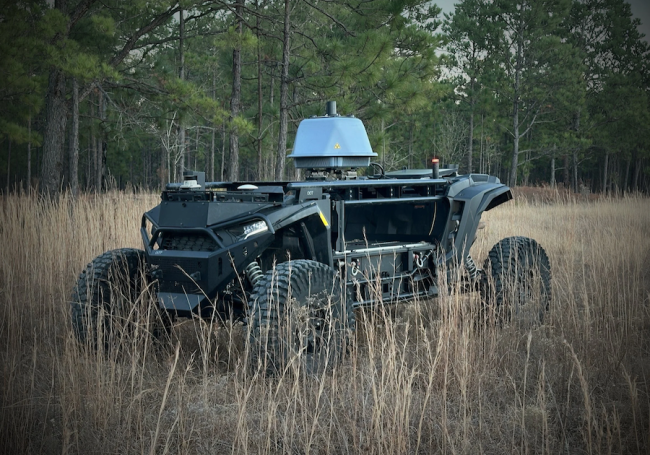
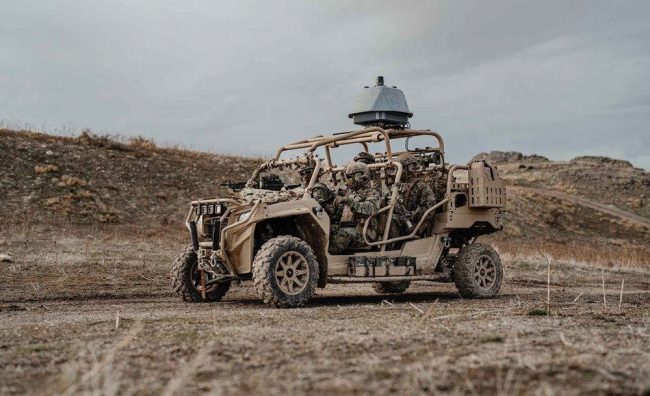
The second major thread at SOF Week was DroneShield’s push into multi-domain integration, anchored by a strategic partnership with Overland AI for unmanned ground vehicle applications. The demand signal mirrors the one that built the aerial C-UAS market: unmanned platforms proliferating across new operational domains, each requiring the same kind of persistent airspace awareness that has driven drone detection adoption over the past decade.
The operational concept Branstetter described centers on an overwatch mission: an autonomous ground vehicle self-navigating to a ridgeline and deploying DroneShield’s counter-UAS stack to provide wide-area coverage across critical locations. The vehicle positions itself; the detection and defeat capability handles the airspace picture above it. “We’re able to leverage an autonomous platform that’s again self-navigate to a ridgeline, leveraging some of our counter UAS technology to provide wide area overwatch across critical locations,” he said.
The same logic extends to unmanned surface vessels. Demand for counter-UAS capability embedded in maritime autonomous platforms is following the same trajectory as the ground vehicle requirement—autonomous systems operating in environments where a stationary or crewed detection post is impractical, and where the aerial threat remains just as real. Branstetter described this convergence as enabling “some creative mission sets” that would be difficult to field through conventional means.
Integration at the Speed of Data
Making multi-domain integration tractable, Branstetter said, comes down to mature APIs and adherence to common data standards—the interoperability architecture that defense acquisition has been pushing across the unmanned systems ecosystem. Without it, the engineering overhead of connecting a counter-UAS stack to a new platform type compounds with every integration. “You can quickly get bogged down if you’re not integrating quickly and efficiently,” he said. Common data standards are what make seamless integration achievable across the diversity of mission sets and platform types DroneShield is now pursuing.
The Software Imperative
DroneShield’s detection libraries are updated on a quarterly software release cycle, and Branstetter framed that cadence as a competitive necessity rather than a differentiator. The dynamic he described maps directly to what DroneShield has called the technology turnover: the pace of drone innovation frequently outruns CUAS upgrade cycles, and systems that cannot adapt without a full hardware overhaul will fall behind.
In practice, that means new chipsets, new communication protocols, and new threat types entering the operational environment continuously. “It’s a big game of cat and mouse,” Branstetter said. “There’s a lot of new technology, new chipsets, new protocols that’s constantly evolving. We’ve got new threats that come into the environment nonstop, and if you’re not able to keep pace, you quickly become irrelevant.”
The Public Safety Opening
SOF Week is a defense-focused venue, but Branstetter used part of the conversation to describe a parallel market developing in the public safety sector—one where the same layered security logic that has driven military adoption is beginning to take hold at the civilian level. The Safer Skies Act has been a meaningful catalyst, and the regulatory maturity required to bring law enforcement and public safety agencies into C-UAS procurement is progressing.
FIFA 2026 is accelerating that process. As a high-profile event with complex airspace security requirements, it is pushing public safety agencies to formalize their aerial threat posture and move procurement forward at a pace that would have been unusual even a few years ago. “The days of fences and barricades as part of your physical security posture” are over, Branstetter said. Any comprehensive layered security package, in his framing, now has to account for the aerial threat as a matter of standard practice—not an afterthought bolted onto a physical perimeter plan.
The manufacturing is scaling. The multi-domain integrations are moving. The policy direction is sharper than it has been. The next test is whether the pace of solution development can stay ahead of a threat environment that is not waiting for anyone.