
A new federal designation positions Michigan’s National All-Domain Warfighting Center as a national test and training range for advanced uncrewed aircraft and counter-UAS tactics, with a 60-mile drone corridor, BVLOS infrastructure and permissive National Guard access at the center of the concept.
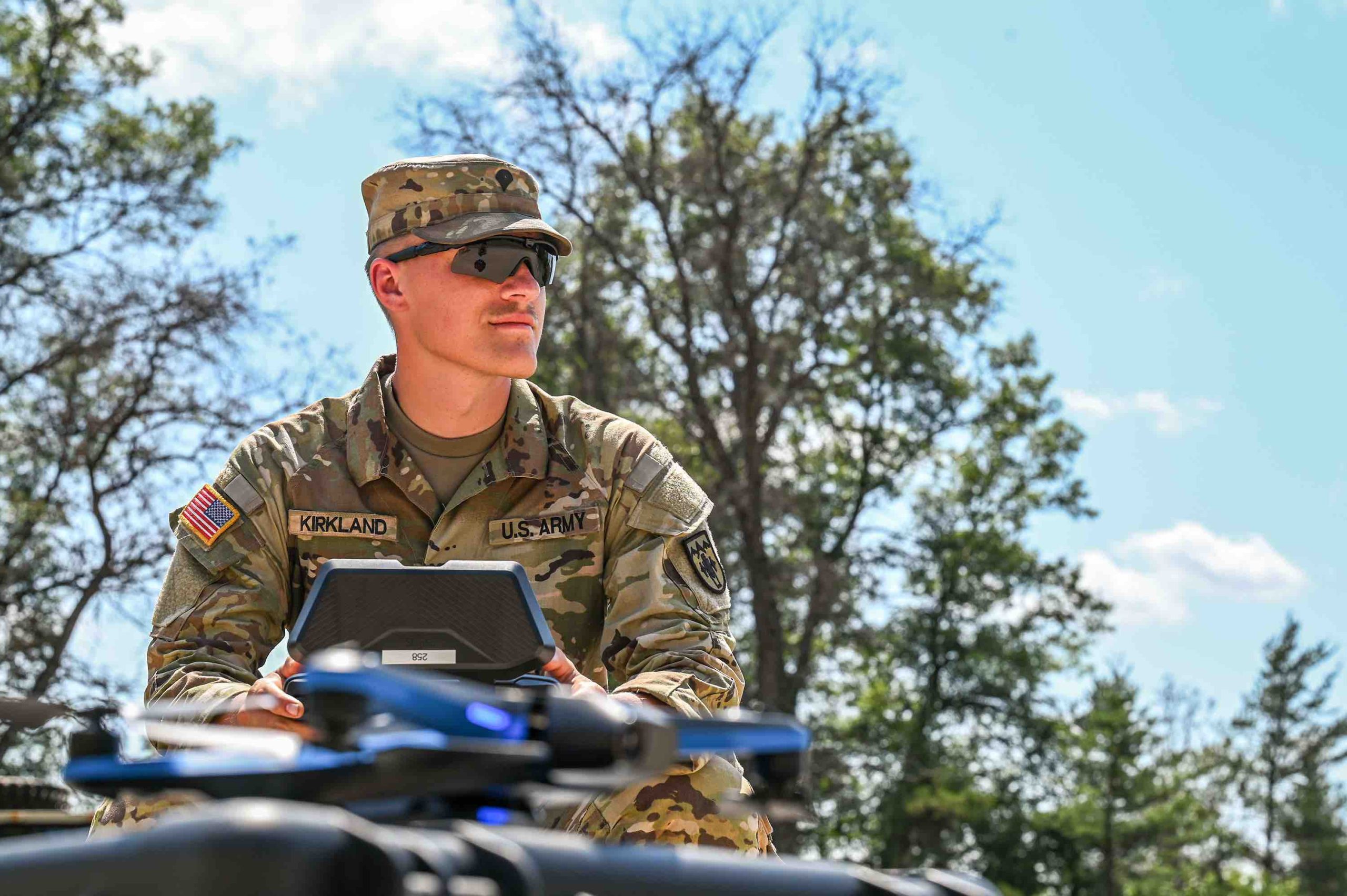
Michigan’s National All-Domain Warfighting Center (NADWC) has been selected by federal defense officials as a key national training site for advanced uncrewed aerial systems, according to a new announcement from the Michigan House of Representatives and follow-on statements from congressional leaders.
Anchored by Camp Grayling and the Alpena Combat Readiness Training Center, the NADWC will serve as a designated range for “deep” UAS training, testing and tactics development, supporting both drone and counter-drone operations. The decision follows months of lobbying by Michigan’s congressional and state delegations, and builds directly on the administration’s “Unleash American Drone Dominance” executive order issued in June 2025.
State Rep. John Roth (R-Interlochen) said the designation “puts Michigan at the forefront of safeguarding our national defense” and secures the long-term viability of the state’s major training installations.
A national hub for large-scale UAS exercises
The NADWC is already the host of Exercise Northern Strike and other large-scale joint events. The new designation elevates that role, formally recognizing the complex as a national drone test site for the U.S. Army and National Guard Bureau.
According to the Michigan House release, the combined complex offers:
- Roughly 148,000 acres of four-season training terrain at Camp Grayling.
- About 17,000 square miles of special-use military airspace tied to Alpena CRTC, including airspace over Lake Huron, enabling altitude-stacked, multi-ship and long-range UAS operations.
- A dedicated, approximately 60-mile drone corridor instrumented for advanced UAS testing.
- A clean electromagnetic environment with access to up to 6,000 frequencies, supporting dense RF experimentation without the interference profile seen near major population centers.
That combination allows the Army, National Guard and partner units to run end-to-end UAS vignettes that mix long-range ISR, swarm behaviors, contested-spectrum operations and live-fire effects in one place, year-round.
All-domain training and counter-UAS focus
Michigan officials stress that the NADWC is designed as an all-domain venue, not just an air range. Facilities support:
- Land operations, including maneuver and combined-arms live fire with artillery, tanks and mortars.
- Air-to-air and air-to-ground training, including integration with crewed aircraft.
- Maritime and littoral scenarios, leveraging access to inland lakes and the Great Lakes region.
- Cyber defense and electronic-warfare events.
- Space-based ISR integration, tying overhead sensors to tactical UAS and ground units.
The Michigan House statement explicitly points to “emerging counter-UAV technologies” and a built-out BVLOS system to support autonomous operations and threat-replication profiles.
Exercises like Northern Strike and technology events such as Silent Swarm already bring dozens of companies into the complex to test sensors, effectors, autonomy stacks and command-and-control tools in realistic conditions. The new designation is expected to increase that flow of industry participation, with a particular emphasis on systems aligned to the administration’s drone-mass and counter-UAS priorities.
Innovation partnerships and cost-effective access
A major part of Michigan’s pitch was that NADWC is not a closed, active-duty installation but a National Guard complex structured for shared use. The Kelly Johnson Joint All-Domain Innovation Center, along with regional universities and private-sector partners, has been set up to support rapid prototyping, integration and field experimentation on site.
State and federal materials highlight several advantages for industry and program offices:
- Permissive access: Public and private stakeholders can rent range space and facilities at lower cost and with shorter wait times than many active-duty test ranges.
- Industrial base proximity: The complex sits within reach of Michigan’s automotive, aerospace and advanced manufacturing clusters, as well as established venture-capital networks, shortening the loop between prototype and production.
- Exercise integration: Vendors can plug into existing events like Northern Strike to see how their systems perform in complex, joint scenarios rather than isolated trials.
For drone manufacturers, payload providers and counter-UAS firms, that mix of all-domain complexity and relatively straightforward access is likely to make NADWC a priority venue for demonstrations tied to Drone Dominance solicitations and other near-term acquisition efforts.
Part of a broader “drone dominance” and trusted-autonomy push
Michigan lawmakers clearly see the designation as both a national-security and economic development win. Congressman Tom Barrett’s statement on behalf of the state’s federal delegation underscored that the NADWC will “deploy additional military missions and investments to Michigan” while supporting reconnaissance, search-and-rescue and combat-focused drone testing.
The move also fits into a larger pattern of policy and procurement decisions:
- Executive-branch initiatives to rapidly scale domestic production of attritable small UAS.
- FCC moves to restrict foreign-produced drones and critical components via the Covered List, effectively shaping which systems can be newly authorized for U.S. operations.
- FY26 NDAA language that treats uncrewed and counter-uncrewed systems as priority capabilities, including co-development pathways with key allies.
In that context, NADWC’s new role looks less like a one-off win for Northern Michigan and more like a node in the emerging U.S. test-and-training infrastructure for trusted autonomy: large enough for swarm and long-range trials, instrumented for BVLOS and electronic warfare, and open enough that program offices and vendors can actually get on the range.