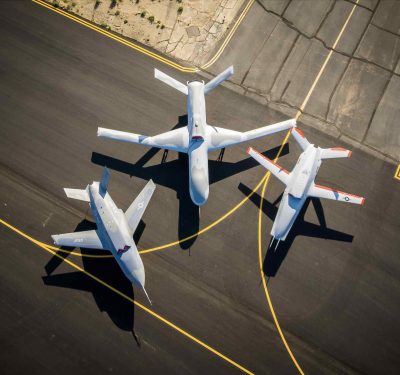

The Naval Air Systems Command has awarded Pittsburgh-based Near Earth Autonomy a contract to develop an aircraft-agnostic autonomy solution for ship-to-shore and shore-to-ship uncrewed logistics operations in contested maritime environments.

The award, structured as an Other Transaction Agreement under the Naval Aviation Systems Consortium, targets U.S. Marine Corps resupply requirements in GPS-denied and emissions-controlled conditions.
At the center of the work is Near Earth’s Firefly compact autonomy system — a two-pound unit designed for integration across a broad range of Class 3 and Class 4 aircraft. Firefly has previously been fielded on platforms including the L3 Harris FVR-90 and BAE TRV-150. Under the new contract, the company will mature capabilities including autonomous confined area operations, ship recovery in EMCON environments, and GPS-free navigation.
The award extends a program lineage stretching back more than thirteen years. Near Earth’s prior defense work includes the Autonomous Aerial Cargo/Utility System, which established rotorcraft autonomy for Marine Corps resupply; the Joint Capability Technology Demonstration for Unmanned Logistics Systems Air, which proved small-UAS autonomy in confined areas; and the USMC Aerial Logistics Connector Program. Firefly now supports the Marine Corps’ Tactical Resupply Unmanned Aircraft System program.
“This contract with the Navy is a key next step, maturing our autonomous systems performance for maritime missions,” said Sanjiv Singh, CEO of Near Earth Autonomy. “We will build upon our past work on compact systems for uncrewed aerial logistics. This effort supports the Navy’s ability to perform resilient, reliable maritime operations across aircraft.”
The contract will culminate in a final demonstration at Naval Air Station Patuxent River in September 2026, covering ship searching, deck tracking, night operations, and autonomous flight between moving vessels.