
The biggest contract announcement to emerge from SOF Week 2026 came not from one of the traditional defense primes but from a California startup that most of the industry had barely heard of eighteen months ago.
On May 19, Joint Interagency Task Force 401 awarded Perennial Autonomy a three-year indefinite-delivery, indefinite-quantity contract with a ceiling of $500 million to accelerate enterprise-wide procurement of counter-unmanned aerial systems — the largest single C-UAS award the Pentagon has issued to date.
The contract covers three platforms already in operational service: the Merops interceptor, the Bumblebee quadcopter, and the Hornet mid-range strike drone. All three were proven in combat before the contract existed.
Army Brig. Gen. Matt Ross, director of JIATF-401, called drones “the defining threat of our time” and framed the award around a procurement imperative. “We must be proactive with creating a layered defense that deploys and scales low-cost, attritable air-to-air drone interceptors at all our facilities at home and abroad,” he said. The contract, Ross added, provides “the joint force with state-of-the-art counter-UAS capability to remain lethal on today’s modern battlefield.”
The origin of Perennial Autonomy is itself part of the story. Former Google CEO Eric Schmidt launched the company quietly in 2023 under the name White Stork, following meetings with Ukrainian officials the previous year. Schmidt set out to build attack drones, but his Ukrainian counterparts redirected his focus: the more urgent problem was intercepting the Russian Shahed one-way attack drones that were arriving in waves. The company rebranded to Project Eagle in February 2024, then again to Perennial Autonomy this year, and assembled a technical team drawing on engineers from Apple, SpaceX, and Google, alongside former Pentagon innovation chief Will Roper.
The flagship product is the Merops, whose operational designation is the AS-3 Surveyor. The system launches a three-foot fixed-wing, propeller-driven interceptor from a truck-portable launcher at speeds up to 175 miles per hour, with an operational range of three to twelve miles. Targeting draws on radar, RF, and electro-optical sensors, with AI-powered terminal guidance for the intercept. The system has downed more than 4,000 Russian drones over Ukraine. In April, Army Secretary Daniel Driscoll told lawmakers that the service had purchased 13,000 Merops interceptors in the early days of the Iran conflict, at roughly $15,000 per unit — a figure he contrasted against the $30,000 to $50,000 cost of a Shahed. That cost arithmetic — where a successful intercept is cost-positive for the defender — is the commercial argument Perennial has been making since the company’s earliest conversations with Ukrainian frontline operators, and it is now embedded in how senior U.S. officials talk about the C-UAS problem.
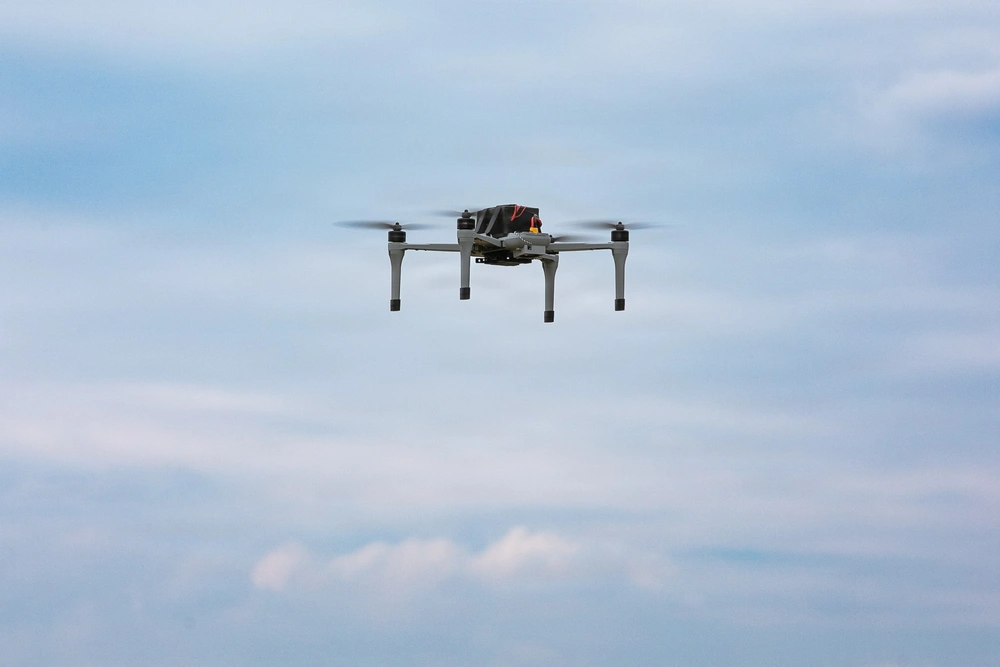
The Bumblebee is a semi-autonomous quadcopter interceptor capable of hit-to-kill engagements as well as reconnaissance and target tracking. JIATF-401 had already awarded Perennial a $5.2 million Bumblebee V2 evaluation contract in January before the larger IDIQ was issued. The Hornet is a pneumatically launched, AI-enabled mid-range strike drone; the Army tested it in March. Together the three platforms are described by the company as providing “scalable effects and multi-purpose mission capability, enabling commanders to generate attritable mass across the battlefield.”
The systems’ operational record outside Ukraine has also been expanding. In late 2025, unmanned aerial incursions into Polish and Romanian airspace prompted the Army to move quickly, and Perennial’s platforms were already positioned. The Army’s G-TEAD office secured an initial procurement of 50 Merops systems and then locked in a bailment agreement with Perennial within 48 hours of a demonstration, obtaining roughly $6 million in equipment across all three platforms. Those systems are now fielded across Europe. Lithuania purchased 48 Merops in April without competitive bidding, making it the latest NATO country to acquire the system. Merops deployments and training have proceeded with Polish and Romanian forces as well.
On the manufacturing side, Perennial has partnered with Munich-based Twentyfour Industries to produce the Merops in Germany, adding European capacity as allied demand grows. The company has stayed notably quiet for an organization with this level of operational exposure, declining in a statement following the contract announcement to characterize performance of the equipment in the Middle East or describe expected production volumes under the $500 million ceiling.
The award sits within a broader reorientation in Pentagon procurement. The Drone Dominance initiative, a roughly $1 billion program launched in December 2025 to acquire large numbers of low-cost attack drones, operates on the same logic of treating unmanned systems as consumable materiel rather than durable aircraft. The Perennial contract is the defensive half of that same bet.