

Picogrid, a leading developer of integrated systems technology, today announced a new partnership with CX2, a company specializing in advanced Electromagnetic Warfare (EW) and Radio Frequency (RF) sensing. The companies demonstrated their integrated capabilities at the Scarlet Dragon exercise with the XVIII Airborne Corps, focusing on survivable, mobile air defense for tactical Army operations.
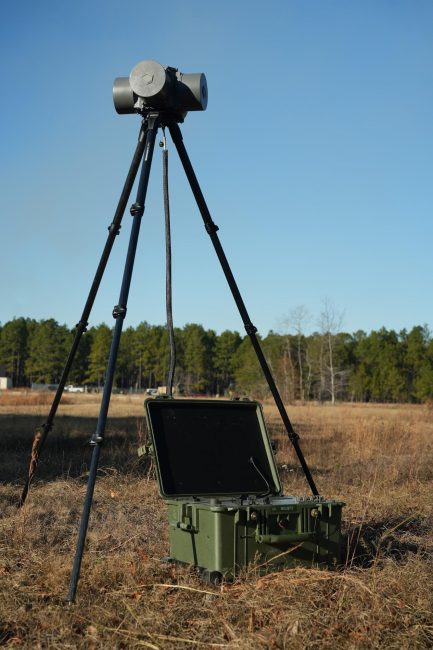
RF-emitting threats and devices of interest, such as small unmanned aerial systems (sUAS), proliferate rapidly in modern conflict environments, and legacy spectrum sensing cannot keep up. This creates critical operational gaps for militaries around the world, a challenge CX2 previously outlined in its ‘Spectrum Imperative’ analysis. CX2’s capabilities address this need by detecting a range of threats across the RF spectrum.
CX2’s systems are now natively compatible with Legion, Picogrid’s battlefield integration platform. Legion allows military operators to tie threats identified by the CX2 sensors with situational awareness from other sensors, ranging from radars to passive acoustics.
During the Scarlet Dragon exercise, CX2’s sensors detected and tracked large RF emission signatures from assets like UAS and Apache helicopters. The Army then used Legion to cue a radar to obtain additional information about the point of interest, successfully demonstrating automated, sensor-to-sensor interactions.
“With [..] the Scarlet Dragon series of exercises, we will be able to develop and test Soldier-driven, rapid innovation and technical transformation while providing the Army a model to revolutionize the acquisition process,” said Lt. Gen. Greg Anderson, commanding general of the XVIII Airborne Corps. “It is making us more lethal at the tactical and operational levels of war.”
In addition to executing multi-sensor workflows, Legion allowed the Army to seamlessly connect CX2 sensors, radars, and additional systems into its Command and Control (C2) architecture. The XVIII Airborne Corps is an early adopter of the Palantir Maven Smart System, used in this exercise to receive threat information, underscoring Legion’s role in rapidly connecting disparate sensors to advanced C2.
“Bringing CX2’s capabilities into our unified architecture allows soldiers and their commanders to deploy layered air defenses and execute sophisticated workflows,” said Martin Slosarik, Co-Founder and Head of Business Development at Picogrid. “Air defense—especially in tactical environments where large systems are not survivable—is a critical challenge. Our engineering team is working incredibly hard to help the Army adapt best-of-breed solutions to meet this need.”
CX2 joins the Picogrid Partnership Ecosystem as its newest member. Once new systems are added to Picogrid’s library of integrations, these partner capabilities are natively compatible with Picogrid’s software, allowing military users to simplify integration of sensors, drones, robotics and other devices. The partnership also provides companies such as CX2 with go-to-market opportunities and insertion into exercises without integration overhead.
“Working within the Picogrid ecosystem, we demonstrated the versatility of the Hexon sensor’s ability to identify key mobile emitters and immediately enable automated tipping and cueing,” said Scott Zolendowski, Head of Growth at CX2. “This partnership will accelerate the deployment of our advanced RF detection into critical defense missions globally, giving warfighters an asymmetric advantage.”