
Shield AI unveiled last week its development of a new X-BAT aircraft that may be the most unconventional concept of the new breed of fighter-like Unmanned Combat Air Vehicles to date: a tail-sitting supersonic stealth jet harnessing an afterburning turbofan engine designed for F-16 fighters to take off and land vertically from trailer-like Launch and Recovery Vehicles (LRVs).
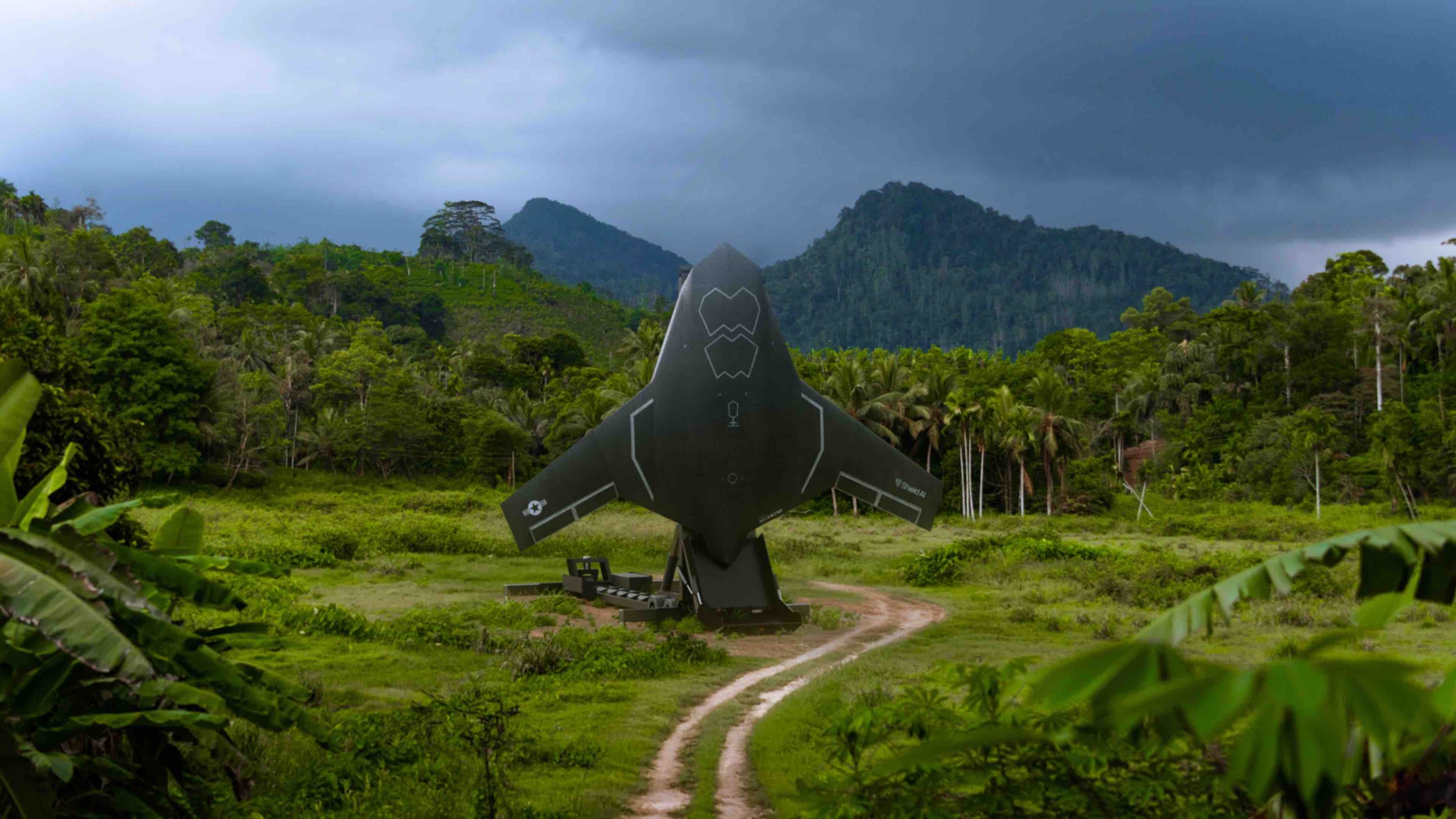
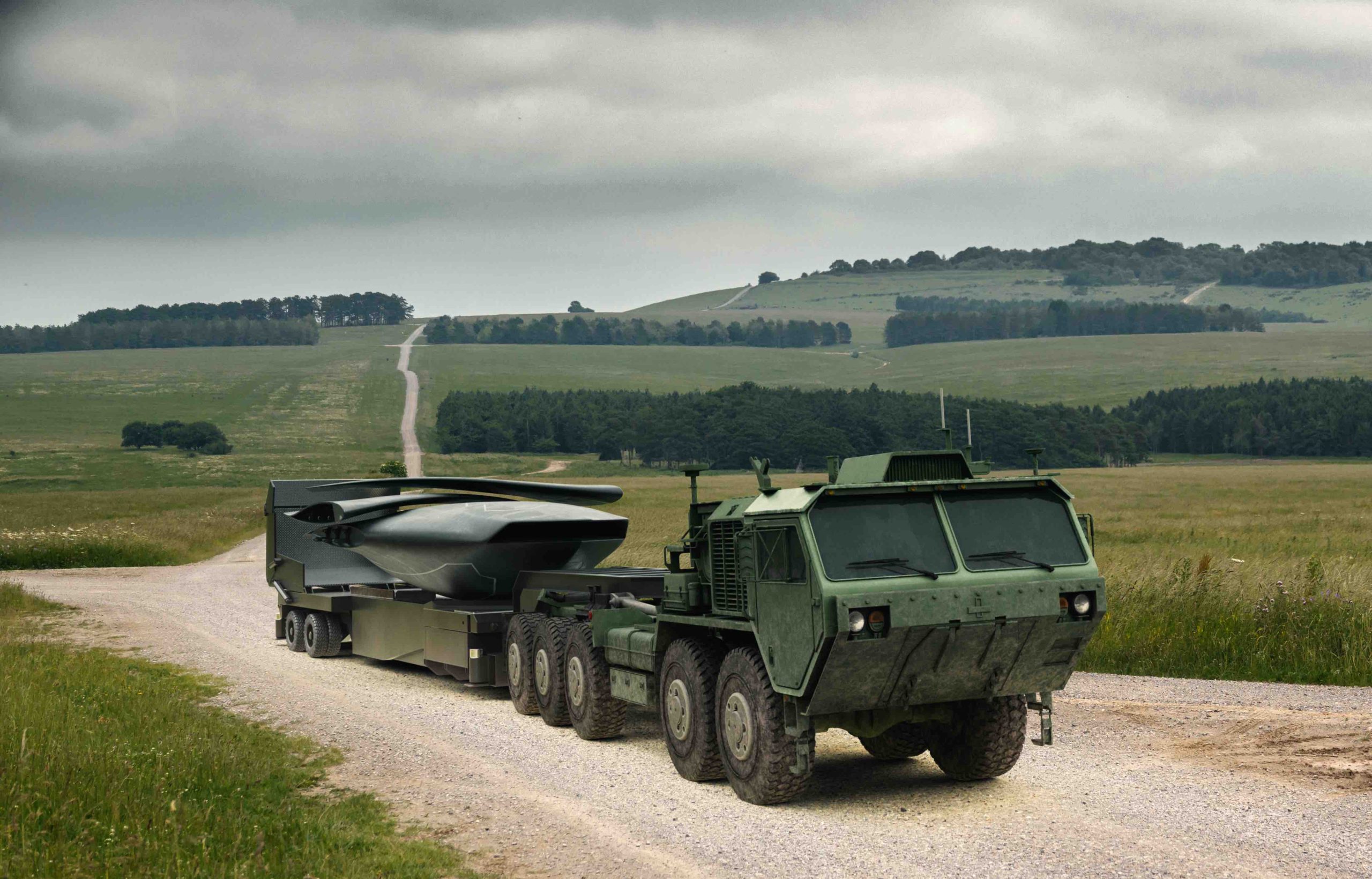
X-BATs would perform air-to-air, strike, electronic warfare and ISR missions, each supported by multiple LRVs to diversify landing options and confuse enemy targeting.
Shield AI confirmed to IUS that X-BAT is aimed for performance thresholds significantly exceeding those of Collaborative Combat Aircraft (CCAs) currently being competed by the U.S. Air Force, with ability to execute some missions independently using the company’s AI-powered autonomy solution called Hivemind—not just buddy with manned jets.
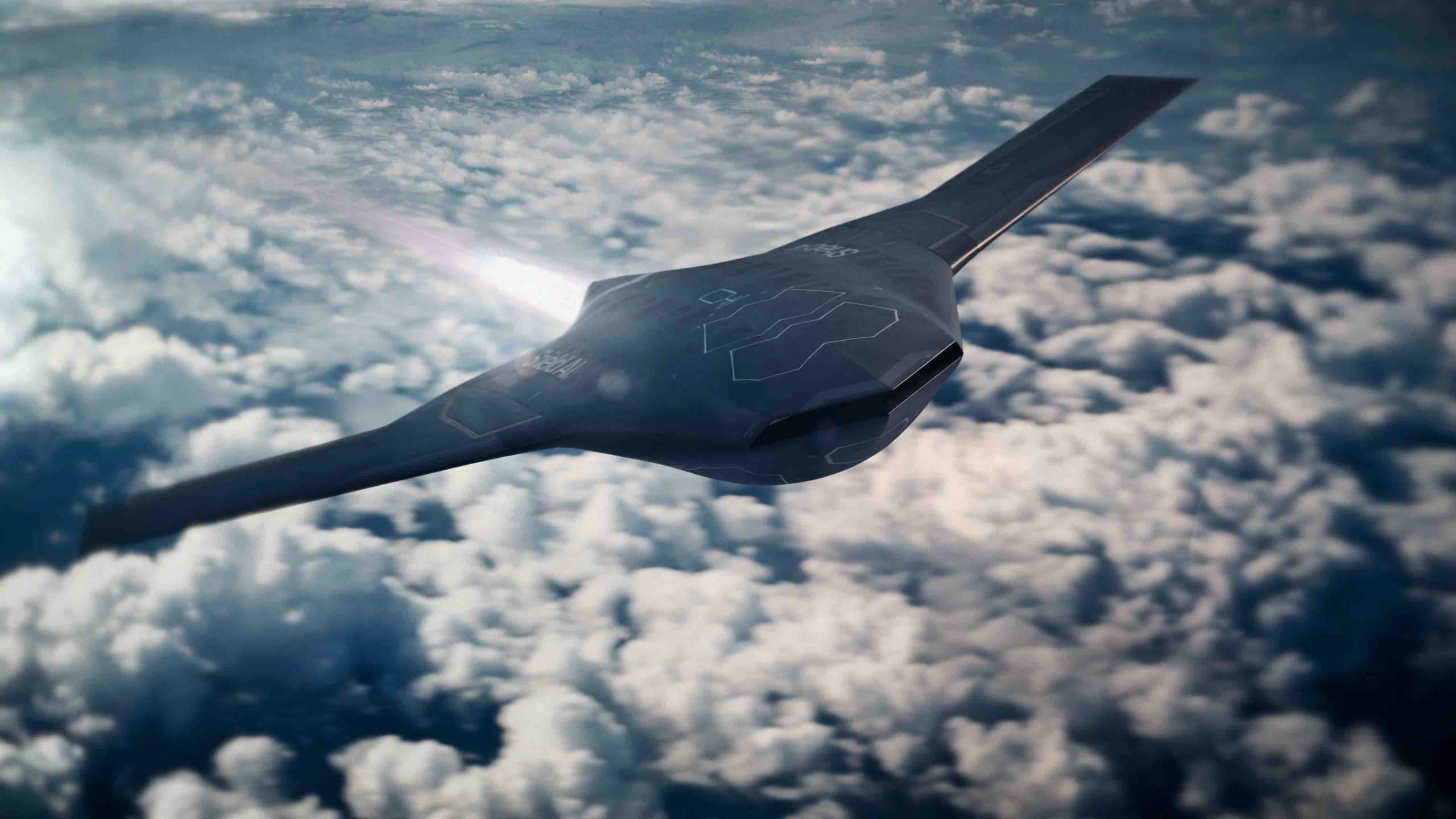
Ambitious characteristics include including greater range (2,300 miles), apparently supersonic dash speeds, and greater radar cross-section reduction including but not limited to a tailess airframe, internal weapons storage bays and conformal electronic warfare systems.
Furthermore, X-BATs are planned to carry multi-mode radars (ie. air and surface-capable) enabling them completion of their own kill chains, rather than relying entirely on external cueing; and would support external carriage of heavier weapons like LRASM long range missiles.
The San Diego-based company, founded in 2015, claims each X-BAT could be operated at one-tenth the cost of a fifth-generation stealth fighter, and that at sea three X-BATs could fit in the space occupied by one manned fighter.
X-BAT has throughlines with Shield AI’s prior work developing Hivemind with the Air Force’s X-62 autonomy testbed jet, as well as the penchant for vertical lift aircraft reflected in its tail-sitting MQ-35 V-BAT VTOL drone procured by maritime services in the U.S. and Japan.
Still, going from AI/autonomy software and piston-engine Group 3 drones to a turbofan-powered unmanned stealth jet fighter is a big swing bringing Shield AI into territory traditionally dominated by defense-aerospace giants.
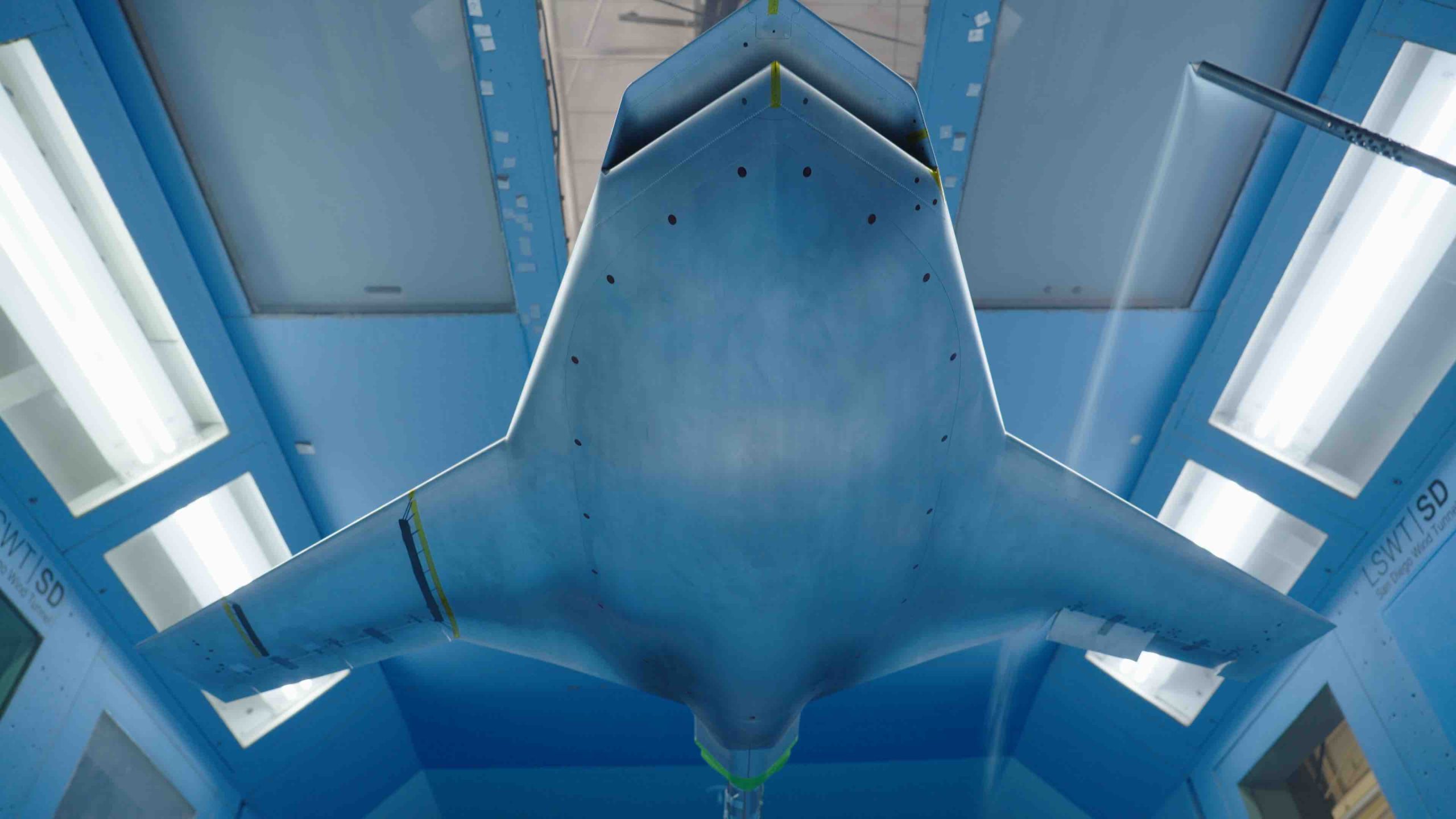
Initial takeoff and landing tests are forecast in third quarter of 2026 per media reports, with “full” flight testing ensuing in 2028. The company shared footage of it conducting engine, radar cross-section and wind tunnel testing, the latter using scale models.
Can drone fighters operate without handholding?
The Air Force CCA programs Increments 1 and 2 and the Navy’s more recently launched effort seek drone fighters able to assist manned jets in combat by bearing sensors, weapons or EW capabilities—not necessarily all at once. Accordingly, American aerospace firms have taken pains to characterize their fighter-like drones as CCAs.
So it’s notable Shield AI hasn’t emphasized the CCA buzzword for X-BAT. The company confirmed to IUSthat’s because they believe X-BAT will be suitable for autonomous operations independent of manned aircraft, as well as collaborative missions.
Without manned fighters nearby as sheepdogs, independent fighter drones require greater autonomy to execute missions even should control and satellite-navigation links get disrupted. Shield AI has expertise developing such autonomy—its Hivemind system is already integrated into Anduril’s YFQ-44A CCA prototype—but there remain thorny procedural questions on how to safely and ethically complete kill chains when the “man-in-the-loop” may not reliably remain on the loop in the tactical edge.
Vertijets and F-15 ancestry
Two experimental X-13 Vertijets built by Ryan Aeronautical in the 1950s successfully demonstrated capability for nose-up vertical takeoff and landing in conjunction with a trailer-based platform. Today Anduril’s missile-like Roadrunner C-UAS interceptor can execute vertical takeoffs and landings using turbojet engines. But Shield AI argues the concept is worth resurrecting for a larger fighter-like platform.
“VTOL matters because our wargames show most [combat aircraft] losses happen on the ground,” Shield AI told IUS. “The United States optimized for in-air survivability while China built ways to crater runways, push bases far from the fight, and hold tankers at risk. True VTOL disperses aircraft on small pads near the fight, removes runway and tanker dependence, and makes them survivable on the ground and in the air.”
Of course, while manned Harrier II and F-35B VTOL jets jump jets have demonstrated utility since the 1970s, they’ve remained relatively rare due to being more complex, costly and accident-prone, and less performant than comparable conventional jet fighters.
However, Shield AI believes X-BAT’s tail-sitting launch and recovery concept averts the cost and complexity of VTOL solutions like lift fans by combining mature ‘off-the-self’ technologies—notably fitting a three-dimensional thrust vectoring nozzle (experimentally developed for the 1990s-era F-15 ACTIVE program) to an afterburning F100 or F110 turbofan.
The overabundance of thrust produced by mating an engine designed for an F-16 fighter to a smaller airframe –described as one-third the size of an F/A-18—enables a superior thrust-to-weight ratio allowing vertical takeoff, and larger-scale electrical generation for electronic warfare missions or long-range sensors.
Shield AI also projects X-BAT will have a service ceiling exceeding 50,000 feet, and insinuates supersonic dash capability. Its thrust-vectoring nozzles may assist with horizontal-flight maneuvering, though G-Force tolerance will remain at 4Gs.
Transitioning back from horizontal to vertical flight for landing reportedly involves a Pugachev’s Cobra-like maneuver nosing the X-BAT up 90 degrees before turning to thrust vectoring to execute a precise landing. Senior VP Armor Harris told interviewers X-BAT’s inlets would be optimized to maintain adequate airflow in both horizontal and vertical flight modes.
Developing a flight control system to reliably execute such landings under varying conditions seems technically challenging, though Shield AI has recruited SpaceX engineers familiar with technology for controlled vertical landing of separated rocket boosters, and has already leveraged their know-how to improve landing capabilities of newer V-BATs.
X-BAT proposed capability and size could have novel applications at sea, allowing more ships to embark, deploy and recover fighter-like aircraft than was possible even using jump jets. Shield AI’s marketing mentions platforms ranging from modified container ships and amphibious carriers carrying up to 60 X-BATs to much smaller Littoral Combat Ships and unmanned surface vessels. Theoretically, that could enable distributed deployment concepts of fighter-like aircraft onto surface ships for air defense or other purposes.
How much less does a robot fighter plane cost to fly?
Unit and sustainment costs are particularly important when evaluating unmanned substitutes for manned combat aircraft. In 2025 F-35A stealth fighters averaged $100 million per unit and (more problematically) operating costs of around $34,000 per flight hour (ie. $272 million in a 30-year/8,000 flight hour service life). The more ‘public’ Loyal Wingman proposals have ranged from $10 million to $35 million or higher unit costs.
Shield AI characterized X-BAT’s cost as similar to current CCAs (CCA) programs, currently in the $20-$30 million range. (Some sources claim $27 million per X-BAT.) The company puts more emphasis on operating costs, allegedly one-tenth that of manned stealth fighters (or “a tenfold increase in cost per effect compared to legacy 5th-generation [stealth] aircraft”). That implies $3,000-$4,000 per flight hour over a shorter 10-year service life (aimed at avoiding long-term upgrade costs).
However, achieving such low costs developing, manufacturing and operating a larger, faster and stealthier aircraft with more sensors, weapons and propulsion capabilities than current CCAs seems likely to prove difficult. Asked how such cost reductions would be achieved—say, due to reduced volume, or removing systems and regulations supporting human pilots—Shield AI told IUS those and “a combination of additional factors enable low cost.”
If X-BAT meets targeted characteristics, its operational sustainment in remote areas will still require ironing out, as even pilotless aircraft with powerful turbofans and heavy payload capacity will require substantial logistics for sustained use. Some analysts also warn past studies found large jet fighter-supporting trailers struggle to access off-road terrain.
Shield AI’s strategy for attracting government procurement will also be vital, as X-BAT isn’t tailored to a specific program, though it does fit with the Air Force’s Agile Combat Employment doctrine emphasizing distributed basing at remote locations to avoid airbase strikes. However, both Air Force and Navy CCA programs have excluded smaller companies. Shield AI’s concept to dramatically upscale into a large-scale jet aircraft manufacturer (in event of procurement) will also attract scrutiny.
Given the applicability to forward basing on ships and islands, X-BAT may be most favorably received by the Marine Corps, a service fond of VTOL aircraft that’s also proven most receptive to Shields’s V-BAT and Kratos’s XQ-58.
Shield AI told IUS it’s looking abroad too: “We began customer engagements earlier this year and they are going very well.” Foreign clients have generated sales for both XQ-58 and Boeing’s MQ-28.
X-BAT is an intriguing stab at a ‘drone fighter’ with a novel distributed deployment concept aimed at offering more versatile, higher-end autonomous combat capabilities than the Air Force is currently seeking for CCAs. The next few years should reveal whether Shield can muster hardware and software solutions needed to realize that ambitious vision.
A note on sources: This article draws on comments from Shield AI to IUS, and references interviews with its Senior VP Armor Harris linked here by Air and Space Forces Magazine and The Warzone.