
On September 5, reports began coming out revealing the U.S. Navy’s Naval Air Systems command (NAVAIR) had issued contracts to companies seeking conceptual designs for a carrier-based Collaborative Combat Aircraft (CCA) ‘drone fighter’.
The news comes as a surprise, as Navy officials spent most of the year suggesting the service was in no hurry to develop CCAs, and preferred to learn from the Air Force’s effort first.
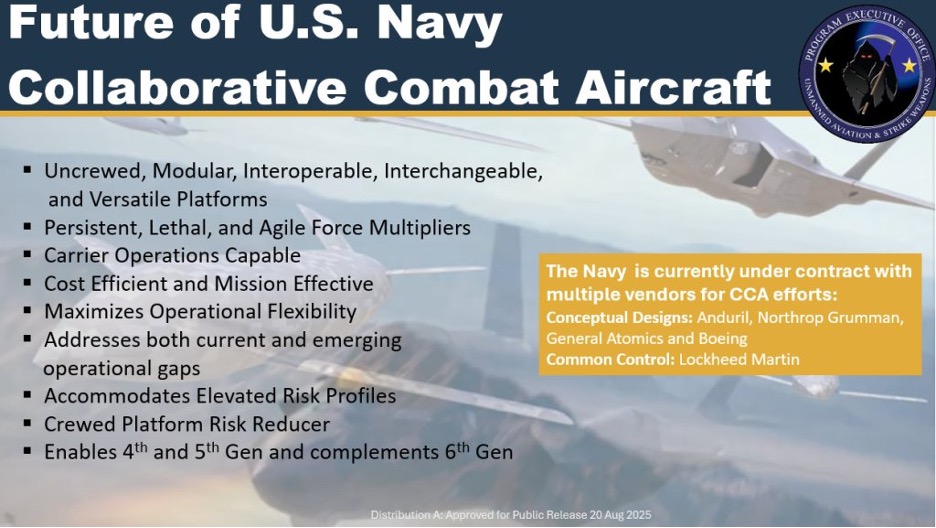
A slide dated August 20, 2025 from the PEO of NAVAIR’s Unmanned Aviation and Strike Offices shows Boeing, General Atomics, Northrop-Grumman and Anduril all received contracts. A fifth defense giant, Lockheed-Martin is listed as developing Common Control architecture for the drone.
Broadly, CCAs are jet-powered drones designed for teaming with more expensive manned jet fighters for combat missions. The Navy presentation calls for a “persistent, lethal and agile” design that is “carrier operations capable” and characterized by cost-efficiency, modularity/versatility, and interoperability. It also requires effectiveness/survivability against powerful adversaries (“accommodates elevated risk profiles”), ability to reduce risks to manned aircraft, and application “addressing current and emerging operational gaps”.
All five companies have since confirmed their participation, though when the contracts were issued remains unclear. Lockheed has since linked its contract to its interoperable MDCX autonomy platform already in development for the Navy’s Unmanned Carrier Aviation Mission Control System (UMCS) program. MDCX executed its first live controlled flight in 2024 controlling a General Atomics MQ-20 Avenger drone.
The Navy’s cautious approach to carrier-based drones
The U.S. Air Force has aggressively moving towards fielding CCAs for many years. But while the U.S. Navy also intends to operate CCAs, it has yet to operationally integrate any combat UAV on carriers. For now, Boeing MQ-25 Stingray UAVs will eventually enter service in an air-refueling capacity. But even Stingray was chosen to substitute for the more ambitious, combat-capable UCLASS drone program.
Still, the Navy has had a CCA program largely veiled in secrecy since at least 2023. It has reportedly worked closely with the Air Force to ensure they share common standards for architecture, mission planning, and control stations.
NAVAIR chief Rear Admiral Michael Donnelly also has described the MQ-25 as vital for establishing a “baseline” for UAV carrier operations before more complex combat UAVs are integrated. However, if CCA adoption is accelerated there may be limited time to learn from the MQ-25, which is only expected to begin Initial Operational Testing and Evaluation in 2028, four years behind schedule.
At the Sea Air Space conference in April 2024, Navy unmanned program executive Rear Admiral. Stephen Tedfor said the Navy was leaning towards significantly cheaper CCAs than the Air Force’s, costing around $15 million each. These ‘attritable’ UAVs would have short services lives lasting “a couple hundred hours” before being expended as kamikaze or target drones.
That explicit focus on ISR and surface attack missions seems a far cry from the air-to-air role Air Force CCAs are initially focused on. Perhaps the stresses induced on CCAs by catapult launches could make ruggedization for long service lives impractically heavy and expensive. Or the service may feel the pace of technological advances will favor rapid replacement of CCA designs for newer types rather than long-term sustainment.
Ultimately, it’s unclear whether the Navy still favor Tedfer’s low-cost, short service life CCA concept, especially given the change in administrations.
CATOBAR and drones: a tricky relationship
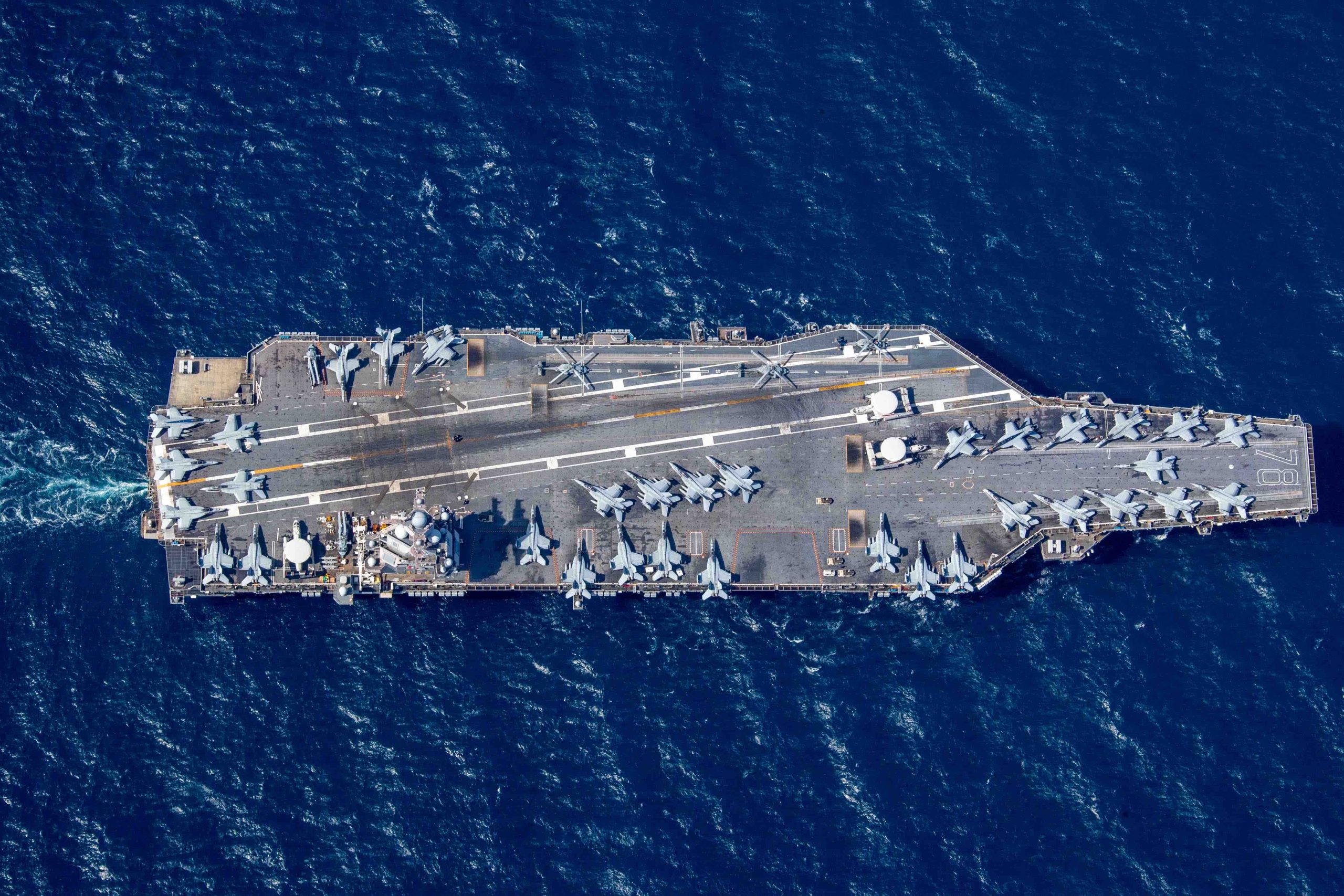
Carrier-based CCAs will require compatibility with the catapult-launch and barrier-assisted recovery (CATOBAR) systems on the U.S. Navy’s unique fleet of eleven flat-deck super carriers. (China and France presently have one such carrier each.)
These vessels can generate more sorties, and launch aircraft carrying heavier payloads compared to other, smaller carrier configurations. The service’s new Gerald Ford-class carriers furthermore sport new electromagnetic catapults able to down-tune impelling force for effective launch of smaller drones.
However, future Navy CCAs will likely require stricter performance and reliability margins than Air Force CCA. Back in 2013 an experimental jet-powered General Atomics X-47B with a tailhook conducted the first arrest landing of a jet-powered drone on an aircraft carrier. But technical failures resulted in just two of the four planned landings being executed.
It’s possible the Navy’s newly accelerated embrace of CCAs reflects the intervention of the Trump administration, which generally favors unmanned platforms—and furthermore its desire to defund the service’s F/A-XX program seeking a sixth-generation stealth fighter to replace its non-stealth Super Hornet jets. Perhaps CCAs are intended console the Navy for F/A-XX cancelation and compel the service to redirect funding away from manned airplane towards unmanned platforms
However, the Navy and industry have strongly opposed cancelation, arguing F/A-XX is necessary for carrier air wings to remain viable against evolving threats. For now congressional overseers are battling to restore F/A-XX funding at a program sustainment level.
Intriguingly, the slide says Navy CCAs should “enable” fourth-generation and fifth-generation jets (F/A-18E/Fs and F-35Cs respectively) and “complement” sixth-generation aircraft. That suggests the service expects CCAs to interact differently with hypothetical F/A-XX, even when compared to stealthy F-35Cs. NAVAIR apparently views CCAs and F/A-XX as complementary (as originally intended) rather than the former substituting for the latter.
The candidates
The contracted companies all have significant experience with either carrier aviation, CCAs or both. General Atomics and Anduril already have land-based CCA-style UAVs designated YFQ-42A and YFQ-44A respectively flight testing with the U.S. Air Force. General Atomics last year showcased concepts for a carrier-based spinoffs of the YFQ-42A, and helped develop the EMAG catapaults on Ford carriers.
Northrop Grumman, builder of the Navy’s famous Tomcat fighter, also developed the pioneering X-47B carrier landing demonstrator. Boeing builds the Navy’s mainstay Super Hornet jets and MQ-25s, and has proposed its CCA-style MQ-28 Ghostbat drone as a carrier-based platform.
However, Kratos—a pioneer of loyal wingmen UAVs—again didn’t make the shortlist, having also missed the Air Force’s Increment 1 CCA down select. That despite its lower-cost approach to CCA-style drones and the Marine Corps’ plans to procuring more of the company’s XQ-58 Valkyries.
Why Collaborative Combat Aircraft?
The Pentagon hopes CCAs can cost-efficiently address multiple growing issues afflicting the U.S. military’s status as an air power juggernaut. The first is declining mass due to the growing costs of development, procurement and sustainment for manned combat aircraft, particularly stealth aircraft.
Furthermore, the increasing range and capability of Russian and Chinese surface-to-air and air-to-air missiles (and their supporting sensors) are making it increasingly difficult to penetrate contested airspace without significant risk of losses—particularly non-stealth fourth-generation jets, but even stealth fighters too.
Finally, both land- and sea-based U.S. fighters mostly lack the range to execute combat missions in the Pacific using internal fuel, unless their bases or aircraft carriers are situated dangerously close to China’s high density of land-based missiles.
Therefore, unmanned CCAs are hoped to effectively multiply the number of aircraft, weapons carried and sensors an individual manned fighter brings to the table, leveraging manned-unmanned teaming (MUM-T). CCAs could also moderately extend the effective attack and target acquisition range minimizing risks to parent aircraft, helping screen against low-observable threats and diverting incoming missiles.
Furthermore, CCA costs are intended to be low enough that losing some to execute critical missions is tolerable (if not yet trivial) particularly if that prevents manned losses. However, the requisite design modifications needed for safe CATOBARs might make cost minimization more difficult than expected.