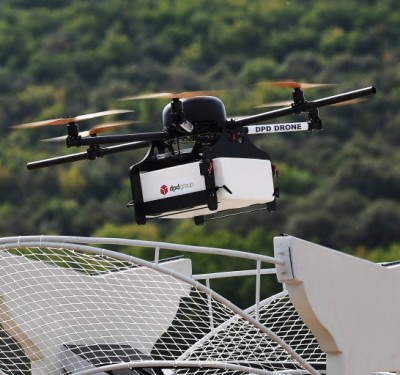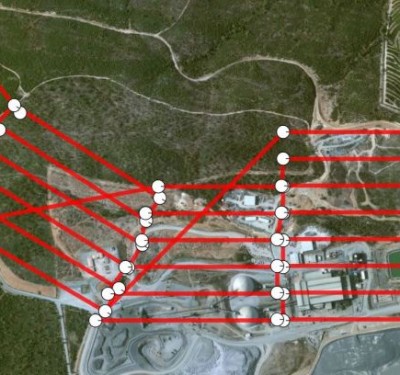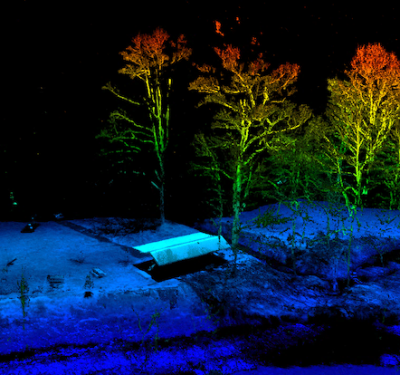

A new 90-page handbook from Joint Interagency Task Force 401 gives warfighters, federal agencies, and local law enforcement a shared framework for countering small drones—built around two mnemonics, the “Four Ps” and “Five Ds,” and informed by lessons from Operation Epic Fury and the war in Ukraine.
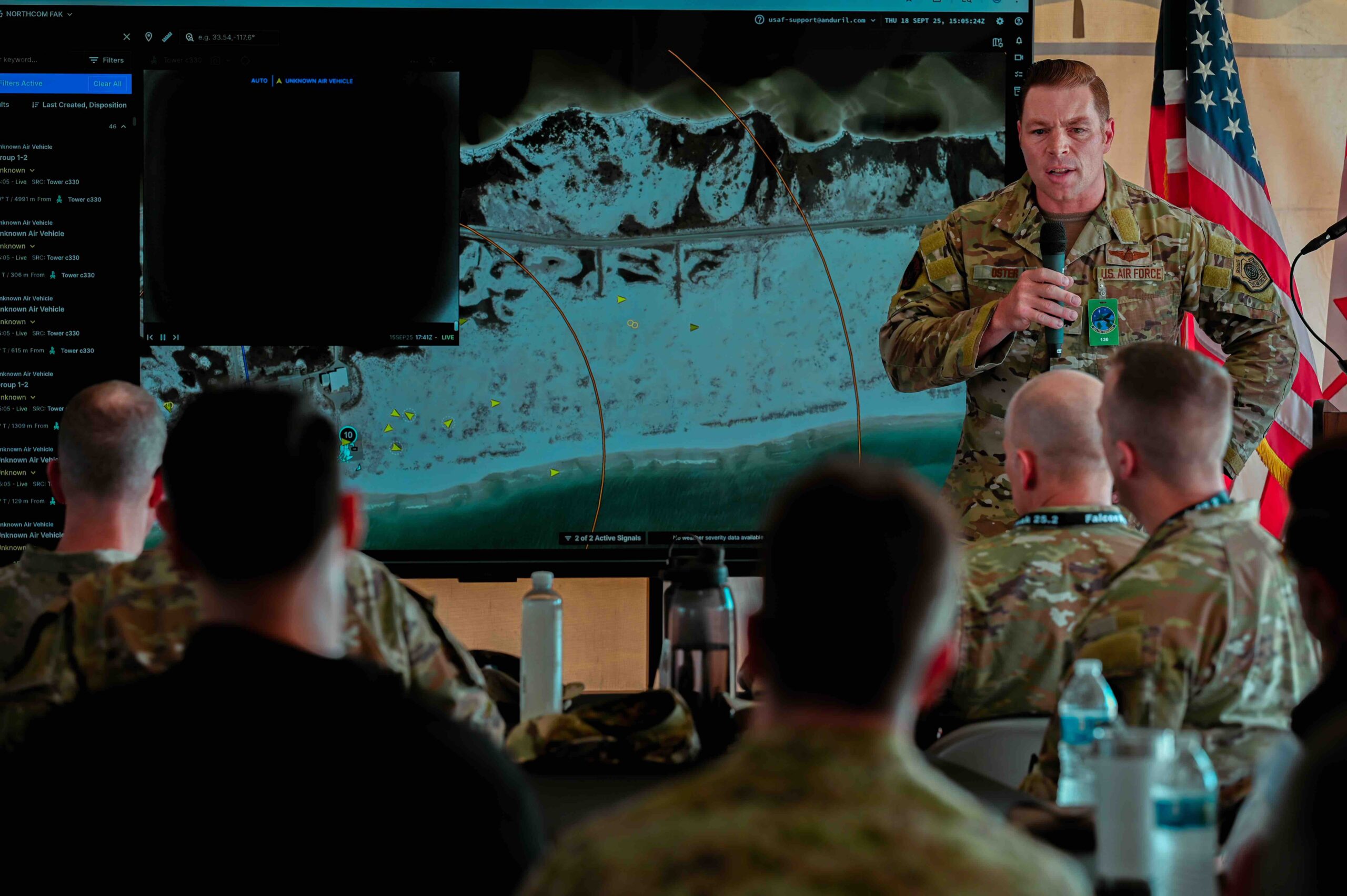
Joint Interagency Task Force (JIATF) 401 has published a 90-page handbook intended to give warfighters, federal agencies, and local law enforcement a shared vocabulary and a common mental model for countering small drones. Titled “Small Drones, Big Problems: A First Principles Approach to Countering-UAS,” the guide was released July 8 and dated June 18, 2026, and is framed less as doctrine than as an orientation document—something meant to be read start to finish rather than consulted like a field manual. It is published through the Department of Defense (DoD) Drone Dominance Spotlight site and authored out of JIATF 401’s Alexandria, Virginia, headquarters.
A RESPONSE SHAPED BY EPIC FURY
The timing is not incidental. According to JIATF 401, the handbook draws on lessons from Operation Epic Fury, the U.S. response to Iranian Shahed-136 strikes across the Middle East that began February 28, 2026, and on counter-drone experience accumulated in Ukraine. The handbook states that Shahed-136 strikes accounted for 66% of Iran’s counterattack operations during the initial phase of Epic Fury, from February 28 to March 9 but that the attacks did not erode U.S. combat power or undermine American resolve. In response, according to the handbook, the Department of Defense fielded counter-drone capabilities to soldiers across U.S. Central Command, some of them transferred quickly from Ukraine along with training from Ukrainian drone experts—an effort the handbook credits with reducing the frequency and effectiveness of subsequent Iranian drone attacks.
Army Maj. Joe Amoroso, deputy chief of strategic initiatives for JIATF 401, said the guide packages direct feedback from warfighters using counter-UAS systems so the community has what it needs to counter “the defining threat of our time.” Army Brig. Gen. Matt Ross, the task force’s director, framed the effort as incremental rather than transformational, writing in the handbook’s foreword that there is no single technology that resolves the drone threat, and that the goal instead is a layered defense built through partnership across government.
WHAT A DRONE ACTUALLY IS
The handbook opens by establishing a common definition before addressing tactics. A drone, in its telling, is any system that operates without a person physically onboard—small or large, remotely controlled or automated, tethered or free, and able to operate in the air, on the ground, on or under water, or in space. The common thread across all of them is the absence of an onboard pilot, plus a shared architecture of propulsion, power, controller, communications, and payload.
The handbook sorts drones into three rough size classes. Small drones—commercially available Chinese DJI models among them—typically fly between 100 and 500 feet, at 20 to 45 miles per hour, with an effective range of one to 10 miles and endurance of 15 to 40 minutes; their size and quiet handling make them well suited to short-range surveillance, spotting, or dropping small munitions. Medium drones, such as the Turkish TB2 and the Iranian Shahed-136, operate between 15,000 and 25,000 feet at 70 to 140 miles per hour, can travel 150 to 300 miles using satellite or relay communications, and can remain airborne 20 hours or more while carrying guided weapons. Large drones, exemplified by the MQ-9 Reaper, fly up to 50,000 feet at 200 to 300 miles per hour, exceed 1,000 miles of range, and can stay aloft 24 to 30 hours—but their cost and vulnerability to air defenses put them out of reach for most non-state actors.
The handbook traces this lineage from 19th-century pilotless balloons and Civil War reconnaissance balloons through World War I’s “Kettering Bug,” World War II’s radio-controlled “Queen Bee” (a likely source for the term “drone” itself), and Vietnam-era “Lightning Bug” reconnaissance drones, before arriving at the post-9/11 and post-2022 acceleration of the technology. It credits Russia’s 2022 invasion of Ukraine with popularizing first-person-view (FPV) drones, and cites figures showing that while only 20-40% of Ukrainian FPV drones found their targets, they accounted for 60-70% of damaged or destroyed Russian systems and 70-80% of Russian casualties in some accounts. The same section notes the spread of unmanned systems beyond the air—Ukraine’s 2022 use of an unmanned surface vehicle against a Russian cruiser in the Black Sea, and China’s experiments with weapon-mounted robotic ground platforms.
THE FOUR PS OF DRONE THREATS
Chapter Two introduces the handbook’s first mnemonic device for assessing any drone threat: the “Four Ps”—person (the operator), platform (the drone itself), process (how it’s commanded and controlled), and payload (its purpose). The handbook argues that a drone threat can’t be meaningfully assessed by looking at the aircraft alone; understanding who is likely to be operating in a given area, what hardware is prevalent there, how it’s likely being controlled—radio frequency remains the most common method, though waypoint navigation, cellular data links, and AI-assisted image recognition are all covered—and what purpose the operator is pursuing all shape what a defender should expect and how to prepare.
The chapter is explicit that a drone can achieve its purpose even if defeated: A drone meant to disrupt an event can “succeed” merely by forcing an airspace closure, and a reconnaissance drone can succeed once it has recorded a few minutes of video, whether it survives the flight home. The chapter also introduces a distinction between “mass” swarms—drones launched together or in sequence toward a common objective, illustrated by Ukraine’s Operation Spider’s Web and Iran’s Epic Fury strikes—and “intelligent” swarms, in which AI-enabled drones adapt, reposition and divide tasks collaboratively without constant human direction.
THE FIVE DS OF PROTECTION
Chapter Three lays out the handbook’s central protection framework: detect, deny, disrupt, defeat and discipline, a deliberate sequence in which kinetic defeat is positioned as a last resort rather than the default response. The handbook illustrates the cost of skipping straight to defeat with an account of a December 2023 incident at Joint Base Langley-Eustis, where unidentified drones were observed over restricted airspace on and off for 17 days, forcing the relocation of F-22 Raptor jets before officials could determine what was flying, who was flying it, and why.
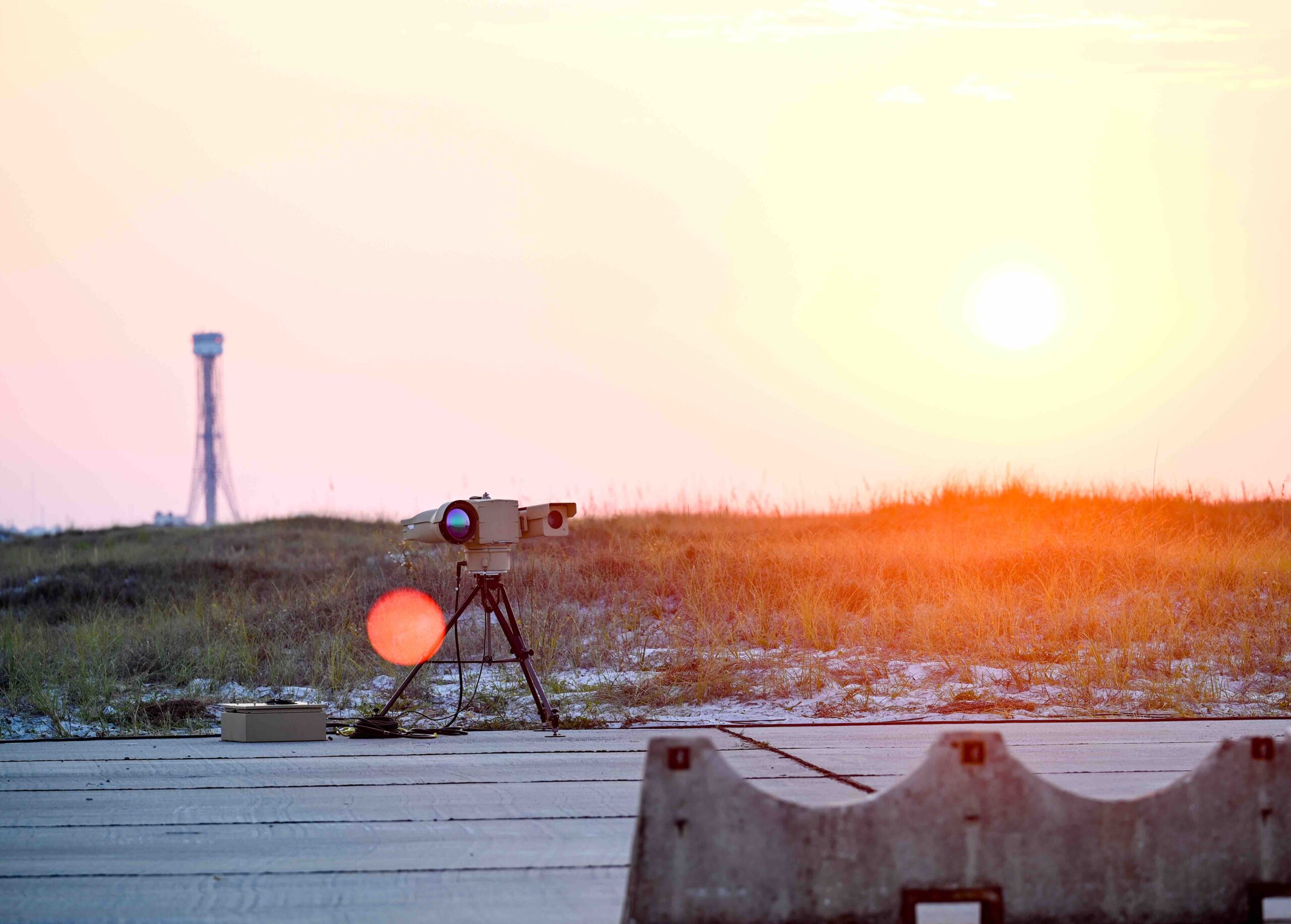
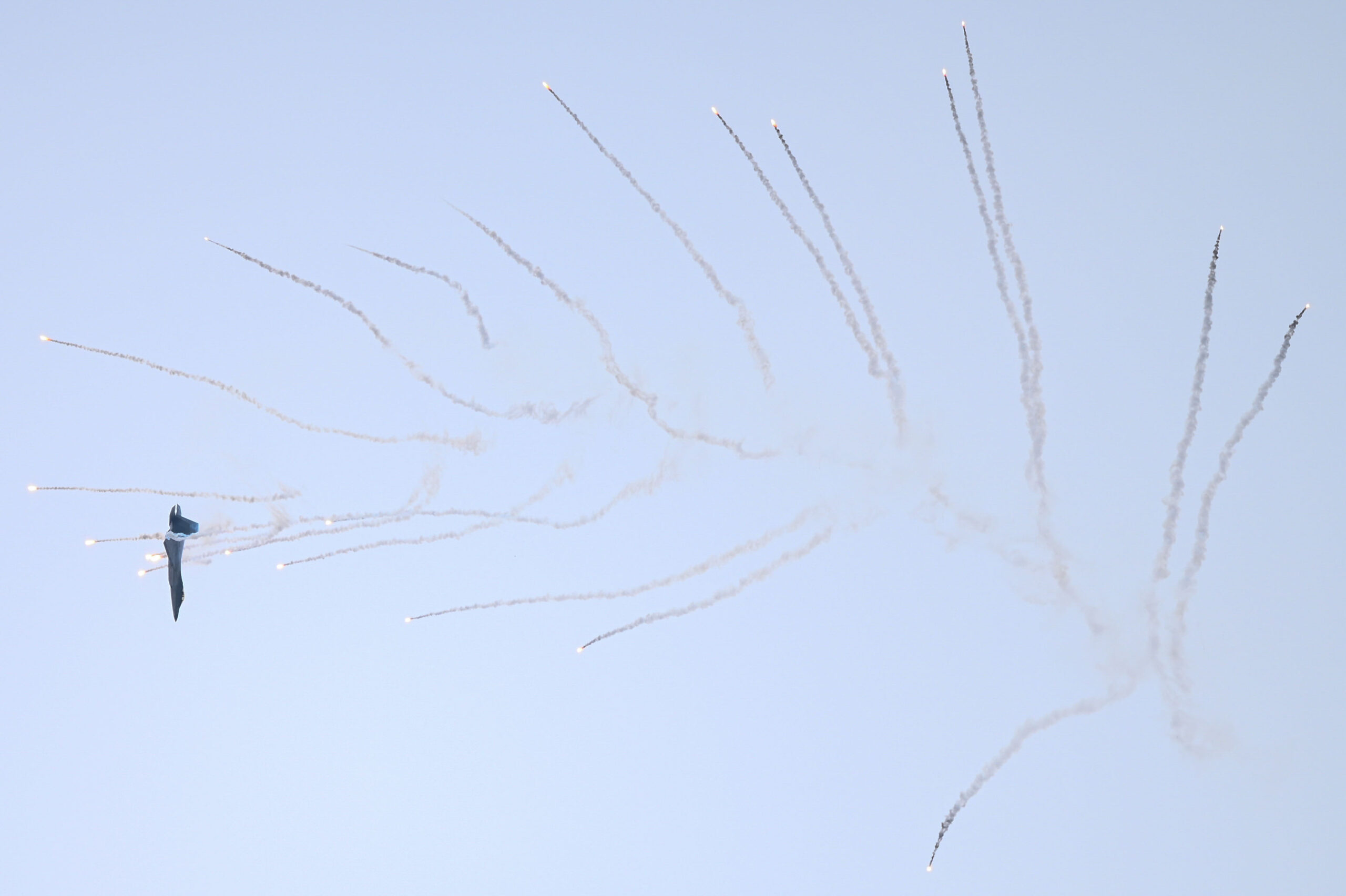
Detection, in the handbook’s framing, begins well before a drone leaves the ground—with understanding who might target a given site and why, and layering complementary sensors, since no single detection method is sufficient alone: radar for range, direction, and speed; optical and infrared cameras for visual and heat confirmation; acoustic sensors for motor and propeller signatures; and radio-frequency detection for signal interception. Denial—described as the most overlooked but often most effective step—means removing what a drone is trying to see, reach or exploit, whether through dispersal, obscuration or deception; the handbook revives the World War II camouflage of Seattle’s Boeing Plant 2, disguised under netting to resemble a suburban neighborhood, as its illustrative case. Disruption accepts that a drone may still fly but works to make the flight difficult, chiefly by degrading control links, GPS or navigation signals, or by shaping the physical environment to push drones into unfavorable routes.
Defeat, the handbook stresses, should be the least-used tool. It outlines four defeat mechanisms—link disruption through jamming; navigation disruption through jamming or spoofing; software disruption targeting the operator’s devices or data links; and kinetic defeat through interceptors, nets, or direct fire—and notes that kinetic methods carry the greatest risk of collateral damage. Most of these tools, the handbook adds, are restricted to the military and law enforcement; it is often illegal for a private individual to shoot down a drone, leaving detection, denial and disruption as the primary options available to most defenders. Discipline, the fifth D, is described as what turns the other four into action under uncertainty—clear rules of engagement, clear authority to act, and rehearsed procedures for what happens when identification is incomplete or a network degrades.
Chapter Four turns to applying the Five Ds, emphasizing that protection is an outcome achieved over time rather than a single moment, and introducing the idea of getting “left of launch”—buying time by studying an adversary’s patterns before a drone is even airborne. It draws on an October 2025 joint exercise at Eglin Air Force Base, which tested layered counter-drone defenses against swarm incursions of varying complexity and adversarial control methods, including radio frequency, waypoint navigation, cellular data links, and fiber-optic FPV control. The handbook is candid about limitations the exercise exposed: jammers can have limited range, nets can struggle to capture drones, and rifles can have difficulty hitting drones at night—an argument, in the handbook’s telling, for layered defense over reliance on any single countermeasure.
TERRAIN, SPECTRUM AND NETWORK
Two later chapters stand out for readers tracking where counter-UAS doctrine is heading. Chapter Five treats the physical environment, the electromagnetic spectrum, and network connectivity as three overlapping “terrains” that must be modeled together rather than separately, returning to the Langley-Eustis episode to illustrate how detection failures usually stem from unmodeled terrain interactions rather than equipment defects. The chapter walks through how hills, buildings, foliage, and weather distort radar and infrared readings; how frequency congestion and a rising “noise floor” can let a drone effectively hide in ambient electromagnetic clutter; and how jamming works by degrading a drone’s control link rather than the aircraft itself—a tactic the handbook compares to fog on a roadway, one that a drone can sometimes route around by switching frequencies or falling back on autonomy. The chapter’s underlying argument is that defenders need to plan with modeled sensor viewsheds, radio frequency propagation, and network pathing together, building resilience—through local edge processing, layered sensing, and delegated decision authority—for when any one of the three terrains fails.
Chapter Six addresses artificial intelligence in explicitly bounded terms. AI is described as a tool for sorting, correlating, and flagging anomalies across overwhelming sensor data—not a system that decides what to engage. The handbook draws a firm line between automation, which it defines as handling routine and repetitive tasks such as tracking objects or cueing sensors, and autonomy, which it treats as context-dependent and constrained by rules of engagement, civilian risk, and legal accountability, with wider latitude anticipated in contested combat environments than in homeland protection settings. The chapter walks through the mechanics in plain terms—algorithms as coded rules, machine learning as pattern recognition refined over large datasets, large language models as tools for summarizing and organizing fast-moving information—while insisting throughout that AI “does not counter drones. People do.”
A REFERENCE DOCUMENT, NOT JUST A NARRATIVE
The handbook also functions as a reference work. Appendix A compiles a glossary drawing on existing joint publications spanning electromagnetic warfare, air and missile defense, and rules-of-engagement terminology—defining terms from “adversary” and “electromagnetic attack” to “passive defense” with citations to specific joint publications and instructions, including the 2018 DoD AI Strategy and DoDI 5000.94. Appendix B offers an annotated bibliography connecting the handbook to existing Army, Air Force, Marine Corps, Navy, and Space Force counter-UAS doctrine, along with prior JIATF 401 products on urban defense and critical infrastructure protection.
Much of the handbook is built around field vignettes rather than dry procedure, including an account modeled on Ukraine’s Operation Spider’s Web—in which, on June 1, 2025, drones smuggled into Russia aboard trucks were launched from hidden compartments to destroy roughly a third of the country’s strategic bomber fleet—and a closing narrative set among a National Guard platoon deployed to Kuwait to protect a base from Shahed-136 attacks, used to dramatize the handbook’s central argument that disciplined detection and denial, not dramatic kinetic defeat, are what bring an end to what the handbook repeatedly calls the drone’s “happy time”—an analogy to the early, unchallenged period of German U-boat operations in World War II that recurs throughout the text as a framing device for how militaries adapt to any new threat.