
Advanced air mobility hinges on invisible infrastructure. Through its multilink Halo platform, Elsight is enabling the BVLOS communications layer that drone delivery, public safety, and next-generation autonomy all depend on.

Much of the value in advanced air mobility (AAM) hinges on something unseen: reliable, always-on connectivity. It’s the foundation enabling safe BVLOS drone entries, autonomous cargo missions, and real-time control across diverse operational realms.
Elsight CEO Yoav Amitai lays it out plainly: “We see ourselves as a technology enabler for uncrewed systems to perform the mission they are trying to perform. Communication—that’s the baseline. That’s our background.”
Born from an academic-engineering heritage, Elsight began building multi-modal communications tools for UAVs, UGVs, and unmanned maritime robots more than five years ago. The company quickly pivoted to address the pervasive challenge across sectors: connectivity that regulators—and mission planners—can trust.
As demand for beyond-visual-line-of-sight capabilities grows, the company’s Halo platform positions Elsight as a provider of what Amitai calls “connection confidence.” Whether the mission is critical infrastructure inspection or high-throughput drone delivery, operators need assurance that their systems will stay connected under dynamic and unpredictable conditions.
The Halo Platform: Aggregating Redundancy
Elsight’s breakthrough isn’t a new radio or satellite modem—it’s a logical layer that abstracts and aggregates available networks.
“We’re building an abstract logic layer on top of all those physical layers to be able to utilize all of them concurrently and create the best quality of service,” said Amitai.
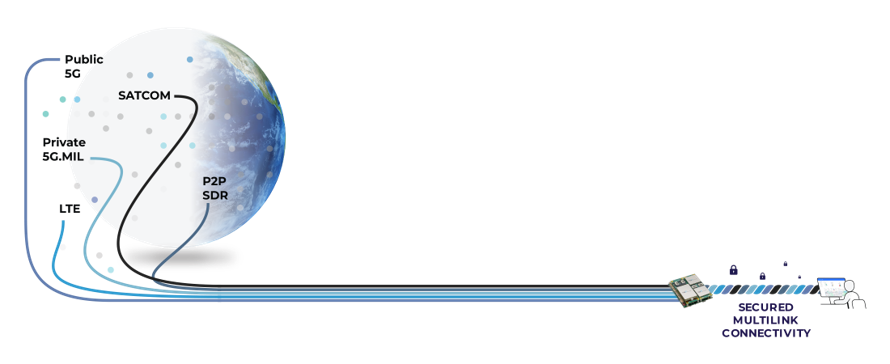
This layer intelligently bonds:
- Public cellular (LTE, 5G from major carriers)
- Private LTE/5G networks (used by public safety, defense, enterprise)
- Satellite links (Starlink, Iridium, Viasat, among others,.)
- Point-to-point RF radios and SDR mesh systems
Halo creates a single virtual data pipe for command-and-control (C2), telemetry, and video, using all links simultaneously—not sequential failover. Unlike many systems that rely on failover, Halo operates all links concurrently.
“We are aggregating together,” he explained. “We’re not doing failover, where if one fails, we go to the next. By using all of them, we achieve better bandwidth, more robust reliability, and improved security.”
Halo can also act as a data prioritization and routing engine. Command and control data can be duplicated and routed through the most reliable channel, while high-bandwidth video is fragmented and optimized for throughput. This enables smarter, mission-specific configurations, which are especially valuable in complex airspace or regulatory environments.
What is Halo?
Elsight’s Halo is a compact, low-power onboard device that supports simultaneous communications over cellular, satellite, and RF. It uses real-time link aggregation to ensure high uptime, low latency, and built-in redundancy for drone and AAM operations. It is available as both a ruggedized box and an ultra-compact (palm-sized under 100 grams) OEM module for easy integration.
Plug-and-Play Performance
This plug-and-play simplicity is no accident. It reflects a deep design philosophy that prioritizes invisible reliability.
Halo is an edge computing system where real-time decision-making algorithms analyze bandwidth, latency, jitter, and packet loss to intelligently manage data streams. That includes duplicating command signals and fragmenting heavier payloads like video.
“We were able to press a very sophisticated algorithm into a super low-SWaP device… the software is so effective… that it requires very low processing power. That’s the secret sauce.”
Elsight’s engineering team continuously balances the constraints of uncrewed platforms—weight, power, environmental exposure—with the increasing demands of software-defined connectivity. “It’s a hardware-software solution, but mostly software,” Amitai said. “We’re a software company that happens to have hardware.”
Smart Software and Cloud Integration
Halo is available in multiple configurations and connects to Elsight’s cloud-based portal. There, operators access diagnostics, live performance metrics, and predictive tools such as coverage heatmaps.
“Our customers are building a lot of knowledge from the platform,” Amitai said. “You can create a kind of coverage map that will say, this is where you have good network, this is where you have bad network.”
These insights are especially useful in recurring or corridor-based missions where route planning and RF risk avoidance can be improved over time. The company is also working toward predictive analytics to support preventive maintenance, mission assurance, and airspace deconfliction through data-driven awareness.
Elsight is also collecting operational metadata to continuously improve its algorithm. With over 400,000 fly/drive hours of real-world data, the system is constantly refined.
Horizontal Integration, Not Vertical Ownership
Elsight’s roadmap is oriented around horizontal expansion—not building airframes or flight stacks, but integrating into them.
“We will not become an airframe manufacturer,” Amitai said. “But we are developing different layers, mainly horizontal integration.”
That includes APIs for fleet and mission planning software, data analysis modules, and more.
Rather than create proprietary operating environments, Elsight’s platform is designed to be modular, adaptable, and OEM-neutral. This makes it easier for partners to bring their systems to market faster while maintaining compliance and operational flexibility.
Inside Halo’s Core Functions
- Multilink Aggregation: Cellular, SATCOM, RF used concurrently
- Traffic Prioritization: C2 duplicated; payload data split
- Cloud Portal: Fleet visibility, diagnostics, coverage maps
- Edge proccesing: Real-time link quality monitoring and switching
- Security: AES-256 encrypted tunnels, failover resilience
Use Cases: Delivery, Security, Emergency Response
Elsight has over 100 active design-win customers. In the U.S., firms use Halo for BVLOS operations, including pipeline monitoring, railroad inspection, and agriculture logistics. Drone as First Responder (DFR) missions are supported by its low-latency backbone.
Healthcare logistics—transporting materials between hospitals and labs—is another high-growth use case, where reliable comms can directly impact patient care. In disaster response scenarios, where public networks may be degraded or overloaded, Halo’s ability to combine commercial and private channels provides life-critical resilience.
Elsight’s systems are also embedded in hybrid UAV/UGV solutions and multirole ISR platforms for defense. The system’s security model includes layered encryption, redundant transmission, and sandboxed software layers.
The Invisible Backbone of AAM
As AAM and BVLOS continue to mature, Halo may remain quietly embedded—but mission-critical. From inspection to defense to delivery, its invisible infrastructure is proving essential.
By abstracting complexity, prioritizing resiliency, and embedding efficiency into a compact footprint, Elsight is quietly stitching together the communications backbone that will hold up tomorrow’s BVLOS and AAM missions.
As Amitai put it, “We just want to actually create impact and help companies perform the mission they’re trying to perform.”