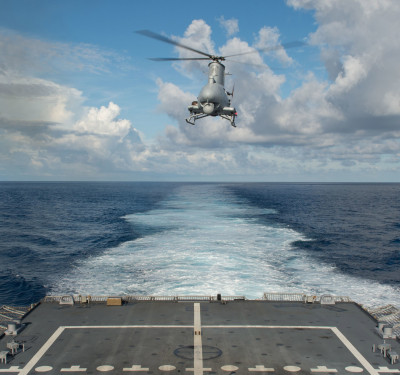

Four years of war have produced one of the most dynamic defense technology ecosystems in the world. Now Ukraine is trying to export it.
For Ukrainian soldiers, war is not an abstract theater but home terrain, where front lines, cities, infrastructure and civilian life overlap.
In the skies over Ukraine, war has become a dense, adaptive aerial ecosystem. Thousands of unmanned aircraft can move through layered airspace at a given time, across overlapping communications links, sensing networks and strike chains. Reconnaissance platforms scan for movement, strike drones dive toward vehicles and trenches, loitering munitions circle in search of targets, and interceptor drones hunt the hunters. It is a system shaped not by theory but by immediate necessity.
One result is the re-emergence of a decentralized air-defense model built around flexible, widely distributed and expendable assets. That shift is already visible in current conflicts.
THE NEW AIR WAR ECOSYSTEM
“The whole world is now shocked by the threat presented by Shahed drones,” said Stanislav Gryshyn, co-founder and CSO of General Cherry. Speaking to Inside Unmanned Systems at XPONENTIAL Europe 2026 in Dusseldorf, Gryshyn said, “They are being used not only in Gulf countries. And it’s not always possible to install a traditional, missile-based air defense system to defend against them. Those types of conventional systems are very expensive and complex, difficult to operate.”
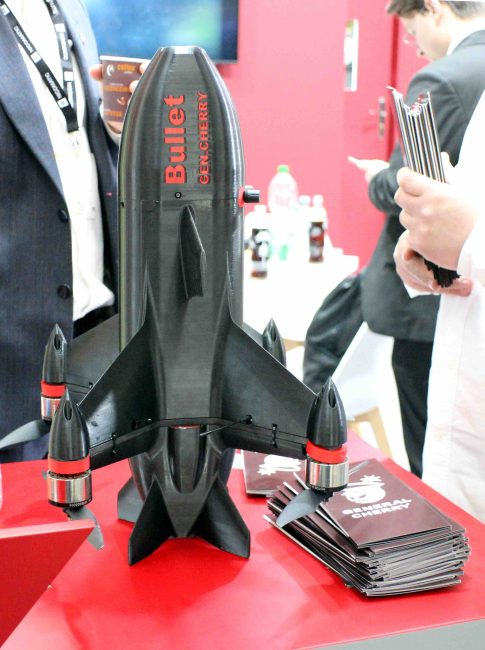
With his company’s Bullet interceptor drone on display nearby, Gryshyn argued that demand for interceptor drones is accelerating and that Ukrainian firms now see export potential for battlefield-tested systems.
Ukraine is not only defending itself; it is also building a defense technology ecosystem capable of producing, scaling and, increasingly, exporting systems developed under wartime pressure.
The scale of that transformation is increasingly visible in the rapid expansion of interceptor-drone use, domestic manufacturing and battlefield iteration. Ukrainian officials and industry participants describe a sector that is moving quickly from improvised wartime production toward sustained volume output, though precise figures remain difficult to verify independently.
At the same time, the geopolitical landscape has shifted. Attacks in the Middle East involving Iranian-designed Shahed drones have created urgent demand for exactly the kind of lower-cost air-defense systems Ukraine has spent years refining. Governments are paying attention. Gulf states are signing cooperation agreements. The United States is exploring partnerships. NATO countries are reassessing their own capabilities. The demand is real. The question is whether Ukrainian firms and the state can move fast enough to translate wartime capability into durable export access. “There is a risk of losing the moment because the international market does not wait,” Gryshyn said.
FROM SURVIVAL TO SYSTEM
There is also an unavoidable tension in the story. These systems were not conceived as commercial products. They were developed under fire as tools of survival, and only later began to attract international demand.
Not many could have predicted the current state of affairs. At the outset of the war, the assumption, for many, was that Russia’s military superiority would overwhelm Ukrainian defenses before any meaningful response could take shape. Instead, something else happened.
“We didn’t have the luxury of slowing down,” said Olha Popovych, Head of Ecosystem Development at Brave1. “We had to adapt, and we did.” Her account of those early months is direct, almost stark in its simplicity. “Four years ago, many thought the war would end in days. Russia expected its victory. And as we see, they were wrong. Ukraine chose to resist, we chose to fight for our freedom. That choice changed everything.” A process was set in motion that would reform not only Ukraine’s military, but its entire approach to technology. “It forced us to move faster, to be smarter, to answer needs, right now.”
The result was not a single breakthrough but a different operating model. In place of long development cycles and rigid procurement structures, Ukraine has built a more fluid network of engineers, startups, military units and government agencies linked by continuous battlefield feedback.
“This allows innovation to move from the idea to the battlefield in a very short time,” Popovych said. “We identify real needs, together with the military. Then we support developers through grants and expert guidance. After that, technologies are quickly tested under combat conditions,” a process that compresses what takes years under conventional development cycles into just weeks.

BRAVE1 BUILDING THE ENGINE
Launched in 2023 by the Ukrainian government, Brave1 is designed to function as a central platform for defense innovation, linking startups, military users, state agencies and investors.
“Our goal is very clear,” Popovych said, “to bring everyone in the defense sector—startups, military, government and businesses—all into one framework.” According to Brave1, the ecosystem already includes more than 2,300 companies and over 5,000 defense technology products. “We’ve created a whole market that didn’t exist a few years ago.”
Entire sectors—unmanned ground vehicles, electronic warfare systems, interceptor drones—have expanded from near zero to hundreds of firms. “In UAVs, in 2022, we had only seven companies and now we have more than 500,” Popovych said. “In UGVs, there were zero companies and now we have 280. In electronic warfare, two companies, now 300. It’s all across the board.”
Crucially, Brave1 works to ensure this explosion of innovation does not become chaos. “We cover the full cycle through to procurement,” Popovych said. “Traditional processes are simply too slow.” To accelerate fielding, Ukrainian officials have also described a digital defense marketplace through which military units can select and order systems more quickly than under conventional procurement channels. Units get credits based on battlefield performance, e.g. destroying enemy equipment, which they can then use to acquire additional systems. “It’s the battlefield user who decides and selects the technology,” Popovych said.
NEW SYSTEMS AT WAR
That selection process is increasingly in effect in drone warfare. Interceptor drones—small, fast and expendable—have become a critical, complementary layer of Ukraine’s air defense. Designed to collide with enemy drones midair, they offer a low-cost alternative to missile-based systems that are too expensive to deploy against low-cost targets. Interceptor use has expanded rapidly since 2024, particularly against reconnaissance drones and loitering munitions operating beyond the reach of small arms.
At the same time, the battlefield has been transformed by electronic warfare, driving innovation in unexpected directions. One of the most significant developments has been the rise of fiber-optic first-person view (FPV) drones. Unlike conventional drones, which rely on radio signals, these systems are tethered to operators by thin fiber-optic cables, making them effectively immune to jamming. Extended fiber-optic systems can operate at distances of several kilometers. The cable is spooled onboard the drone and unravels as it flies.
“One thing we know for sure is that GPS is obsolete,” said Siim Lindmaa, CEO of Estonia-based Electric Wings UAS, a company that works closely with associates in Ukraine. For Lindmaa and his team, the war has become a source of insight. “No one can fly with GPS alone in the modern battlefield.” It’s a realization that’s forcing a fundamental rethinking of drone design. “Anyone developing a UAV needs a second option,” Lindmaa said. “Visual navigation, enhanced GPS, resilient navigation with multiple layers.”
“We are using experience from Ukraine, looking at the tools and products they have in hand, to implement modifications in our own new drones,” Lindmaa said, “so that we don’t make the same mistakes that have been made before.” Those lessons extend to the smallest components. “It’s things like what type of fiber optics, which suppliers, what parts to use, right down to the capacitors,” he said.
COMPANIES AT THE EDGE
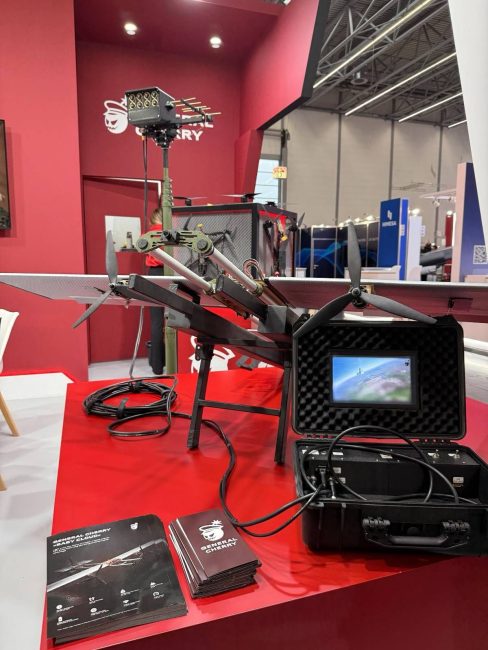
The new knowledge is increasingly being exported. In Dusseldorf, Ukrainian companies showcased systems that are diverse and mature. General Cherry is one example of a Ukrainian firm trying to translate battlefield demand into scalable production. Established in 2023 in Zaporizhzhia, the company now produces tens of thousands of drones per month, including a large number of interceptors. Its product lineup is centered around a layered defense concept, with different systems targeting different types of aerial threats.
“This is the Bullet,” Gryshyn said, pointing to General Cherry’s interceptor platform. “Its main targets are the Shahed-type drones.” Gryshyn described the system as part of a broader architecture. “The interceptor is just the end of the puzzle,” he said. “It must be connected with radar surveillance systems, but it’s also about tactics and strategy, military units being in the right place.”
That systems-level thinking reflects the reality of modern drone warfare. “The whole air defense system is now rapidly changing,” Gryshyn said. And the pace of that change is relentless. “We aren’t finished. We’re going on,” he said. “We’re constantly changing, cameras, software, different electronic boards… to adapt to changing threats.”
FROM PROTOTYPE TO PRODUCTION
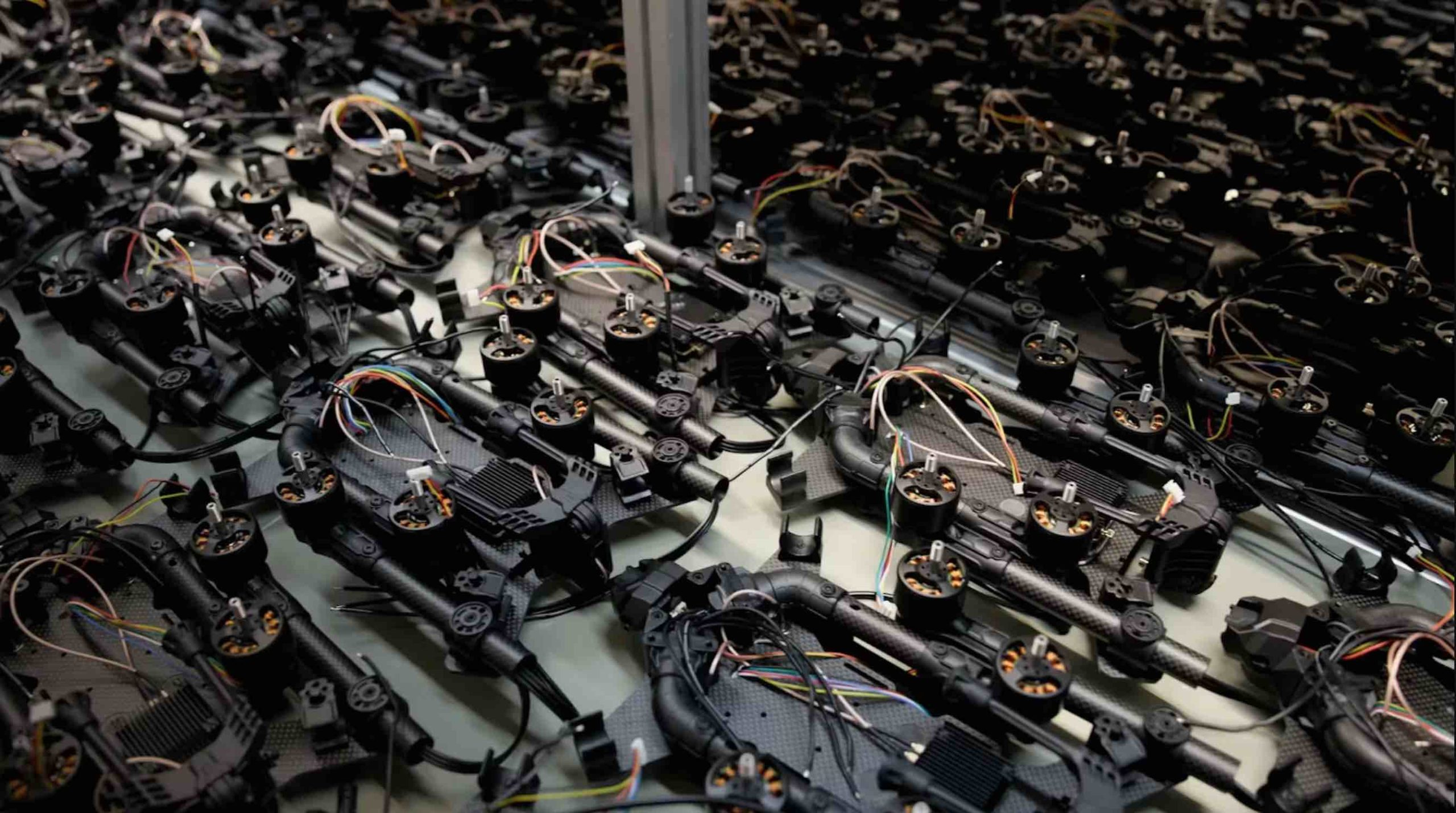
One of the more consequential shifts in Ukraine’s defense sector is now occurring not on the battlefield but on the factory floor. If the first phase of the war was defined by improvisation—small teams building drones in workshops, garages, and converted offices—the current phase is about something much harder. It’s industrialization, moving from rapid, iterative innovation to consistent, scalable production.
“The challenge is not only to invent,” Gryshyn said. “It is to produce in volume, with stable quality, and to do it continuously.” That transition is changing how Ukrainian companies think about design. Systems are being built for performance in combat, but also for manufacturability, how easily they can be assembled, repaired and adapted at scale. “You have to simplify everything,” Gryshyn said, “every component, every process. Because when you are producing tens of thousands, small inefficiencies can become very big problems.”
That pressure has produced a distinct engineering philosophy built around modularity, redundancy and substitution. Components are selected not just for performance but also for availability. Supply chains are designed to be flexible, able to accommodate new suppliers or materials as conditions change. That flexibility is a response to real constraints—disrupted logistics, limited access to certain electronics, and the real risk of strikes on infrastructure.
This has meant developing parallel production strategies, manufacturing critical components domestically where possible, while building partnerships abroad to ensure continuity and scale. International partners are playing an increasingly important role in helping Ukrainian systems move from prototype to industrial product.
“Ukrainian companies have become extremely fast in development,” Lindmaa said. “But scaling production to global standards is where cooperation becomes important.” Cooperation is taking the form of joint ventures, contract manufacturing, or technology transfer agreements, allowing Ukrainian designs to be produced within NATO supply chains, using established industrial processes.
The result is a hybrid model, innovation driven by wartime urgency in Ukraine, combined with industrial capacity abroad. This model also introduces new tensions. Speed, which has been Ukraine’s greatest advantage, can be difficult to maintain in a more structured industrial environment. Certification requirements, quality assurance processes, and export controls all add friction. Meanwhile, the pace of battlefield innovation does not and, indeed, cannot slow.
“You have a situation where the product is changing constantly,” Lindmaa said. “And at the same time, you are trying to standardize it for production. That is not easy.” The dynamic between constant iteration and the need for stability is becoming one of the defining challenges of Ukraine’s defense industry, and it will determine whether its innovations can truly scale beyond the battlefield. Building a system that works is only the first step. Building it again, and again, and again, reliably, affordably, and at volume, is what turns innovation into industry.
GOING GLOBAL
The systems themselves are designed for speed, simplicity, and cost-effectiveness. “All countries can work with drone interceptors,” Gryshyn said. And increasingly, those countries are asking Ukraine for help. “We received very many urgent requests from Arabic countries, from Gulf countries, but not just those,” he said. “I would say that the European, NATO countries are slowly waking up,” Lindmaa said. “They don’t have the kick that the Ukraine companies have.”
That “kick” is the difference between designing for a hypothetical scenario and operating in a real one. In Ukraine, failure is immediate. So is feedback. The country is now uniquely positioned to respond to some of the most pressing global defense needs. According to reports, Ukrainian expertise in air defense strategies is now being shared internationally, including with partners in the Middle East, supporting the integration of interceptor drone systems. The Ukrainian president has also met with parties in the Persian Gulf region, promoting his country’s technology and signing cooperation agreements.
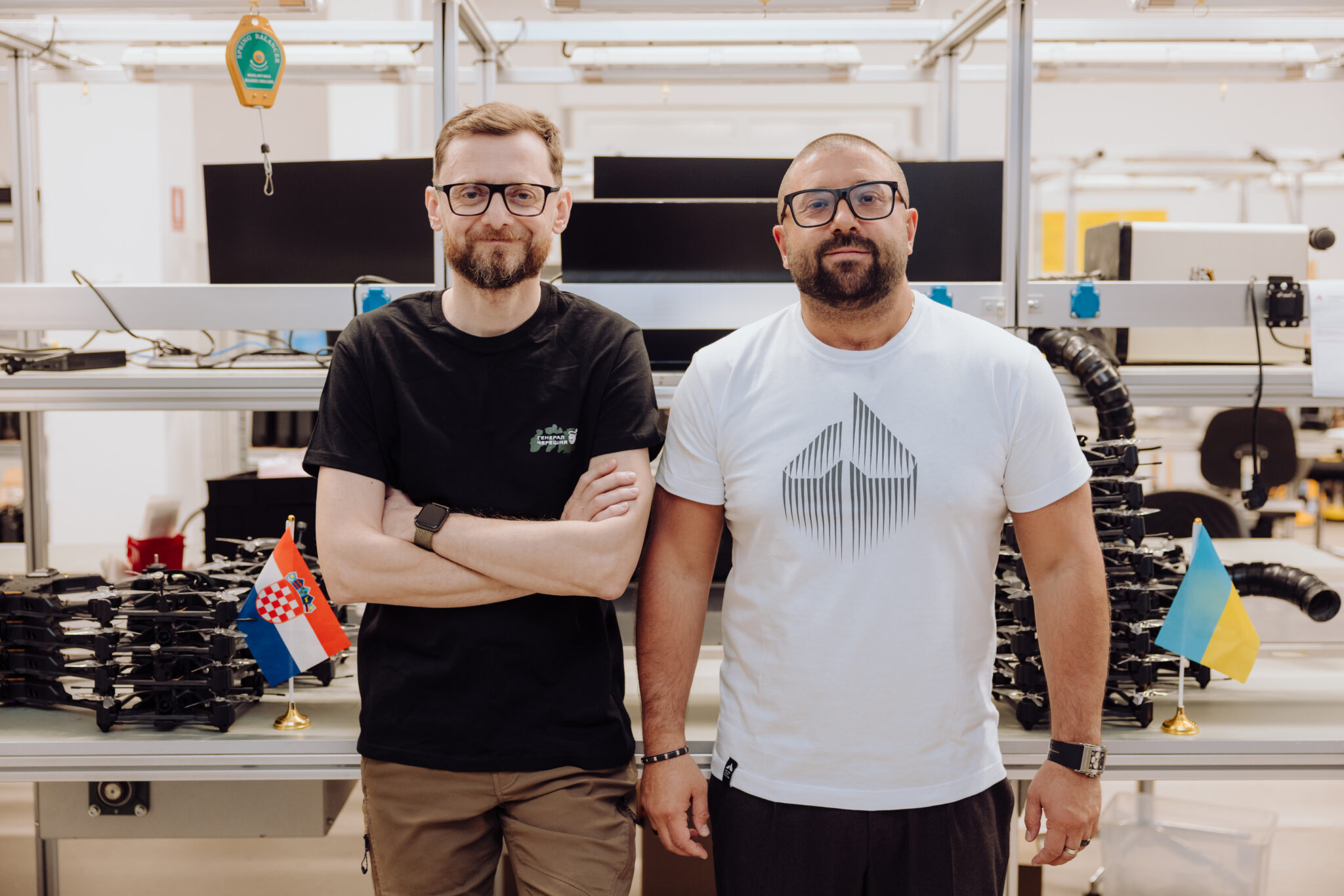
Since the event in Dusseldorf, only weeks ago, the push toward internationalization has accelerated. General Cherry, for example, has moved to establish a distributed manufacturing model spanning Ukraine, Europe and the United States, designed not just to expand production, but to make it more resilient. A reported memorandum of cooperation with Croatian UAV manufacturer Orqa marks a significant step. The agreement will see interceptor drones and counter-UAS systems, developed under combat conditions in Ukraine, produced for NATO markets for the first time outside the country.
The structure is deliberate. Production will be split across two tracks. Inside Ukraine, the partners plan to build an underground facility under the “Build in Ukraine” initiative, initially focused on production of high-value electronics such as flight control systems and communications modules. The aim is to secure the most sensitive components domestically while hardening production against wartime disruption.
In parallel, serial manufacturing will be established in Croatia, leveraging Orqa’s infrastructure and distribution network across NATO countries. This second track provides scale and market access, turning battlefield-proven systems into exportable products. A key feature of the partnership is supply chain sovereignty. Both companies are working to eliminate dependence on Chinese components, aligning production with NATO procurement requirements without significantly increasing costs.
At the same time, General Cherry is expanding into the United States. In a separate agreement signed at the end of March, the company partnered with Wilcox Industries to establish drone production in New Hampshire, focused on interceptor systems and potential Pentagon procurement.
RELEASING THE BOTTLENECK
Taken together, the new agreements point to a clear strategy—distributed manufacturing across allied countries, combined with centralized innovation in Ukraine. For Ukrainian firms, this model offers a way to maintain the speed of wartime development while meeting the scale and standards required by international customers.
Other Ukrainian firms are also pursuing international partnerships, manufacturing agreements and financing channels to scale production beyond the domestic battlefield. The broader pattern is clear: Ukrainian designs are beginning to move into allied industrial networks, even as export rules and production approvals remain in flux.
Companies are still waiting for authorizations, and the policy framework is still being defined. In the meantime, the market is moving. Ukraine has built one of the most dynamic defense technology ecosystems in the world. It has demonstrated its effectiveness against a peer adversary. It has scaled production to levels few could have expected. But it is still building the administrative infrastructure required to export that capability at scale. For General Cherry, the stakes are existential. “If we stay local, we will eventually die,” Gryshyn said. “As a system, as a defense company, we have to be integrated into the global defense system.”
Ukraine’s partnerships in Europe and the United States are opening new channels for manufacturing, supply-chain resilience and export access. But the central tension remains unresolved. Ukrainian firms have demonstrated extraordinary speed in design, iteration and battlefield adaptation; the harder task is converting that speed into repeatable industrial output that can meet allied standards, certification requirements and procurement timelines.
That is now the strategic question. Ukraine has built one of the world’s most dynamic wartime drone ecosystems under extreme pressure. Whether that ecosystem can evolve into a durable defense-industrial base, while the war itself continues, will help determine both the next phase of the conflict and Ukraine’s longer-term place in the global unmanned systems market.