
Virginia Tech’s Mid-Atlantic Aviation Partnership (MAAP) is pioneering university-led AAM infrastructure—from basic off-airport vertiports to custom instrument routing tailored to new aircraft. With state leadership, DoAV support, and NASA alignment, VT is sketching the working blueprint for American aviation’s next frontier.
A University Takes Flight into AAM
Virginia Tech has long stood at the crossroads of research and real-world deployment when it comes to autonomous systems. As one of the original FAA-designated UAS test sites, the school’s Mid-Atlantic Aviation Partnership (MAAP) helped prove out detect-and-avoid, communications resilience, and airspace integration long before the commercial drone industry scaled. Now, the university is channeling that experience into advanced air mobility (AAM), transforming technical theory into concrete infrastructure.
The new Virginia Advanced Air Mobility Smart Airspace Program, announced in June 2025, takes aim at a critical question: how do we build AAM infrastructure that actually works for next-gen aircraft? Funded by the Virginia Department of Aviation and supported through the Virginia Small Aircraft Transportation Systems Lab Inc. (VSATS) program, the initiative combines policy, procedure, and place. In partnership with certified procedure developer Navos Air and Virginia Tech’s Transportation Institute, MAAP is working to design, install, and test vertiports and instrument approaches specifically tailored to electric and autonomous aircraft.
In conversation at the 2025 FAA Drone and AAM Symposium, MAAP Director Tombo Jones laid out the program’s unique objectives—and what sets Virginia apart as an AAM proving ground.
“We chose one vertiport in terminal airspace and one off-airport so we could evaluate the differences in approaches with and without a tower and radar coverage,” Jones explained. “These sites will behave very differently—and that’s the point.”
Infrastructure, Not Speculation
At its core, the Smart Airspace Program revolves around three deliverables:
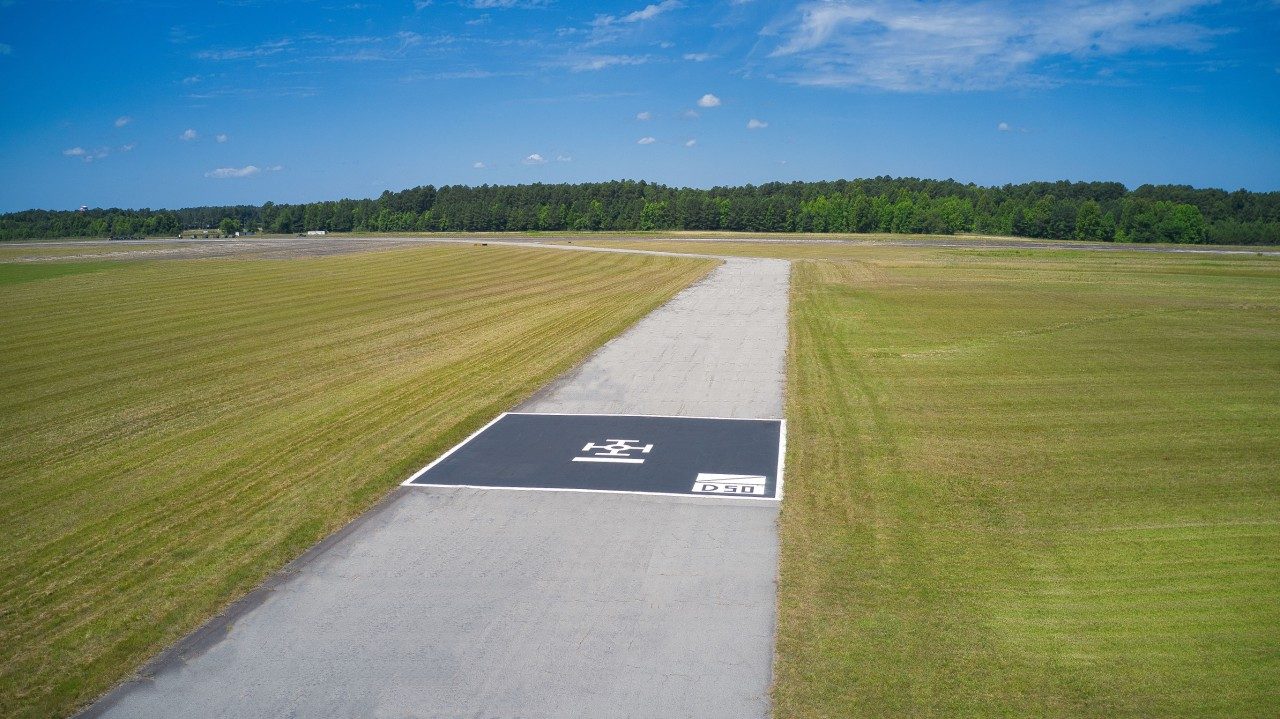
- Construct two vertiports: one on-airport at Roanoke-Blacksburg Regional Airport (in Class C airspace), and one off-airport on Virginia Tech Transportation Institute property in Blacksburg.
- Develop instrument procedures: departures and arrivals adapted to AAM aircraft performance, especially for operations in poor visibility and under instrument flight rules (IFR).
- Demonstrate real aircraft operations: both small fully autonomous drones and larger OEM-supplied electric aircraft will fly the new procedures to validate their design.
These goals aren’t hypothetical. MAAP is already in the build phase—three months into construction and regulatory coordination as of July 2025.
“We’re working under a new FAA engineering brief for vertiport design,” said Jones. “But this is more than a design exercise—we’re actually going to fly these routes and understand how procedures can best accommodate AAM aircraft..”
This practical focus has already drawn in OEM interest. While Jones couldn’t yet name the AAM aircraft manufacturer finalizing its NDA with MAAP, he confirmed that the company was eager to test aircraft on procedures that reflect real operational needs.
“These aircraft have about a 100-mile range. If you waste 25 miles on departure and arrival, you lose a quarter of your flight. So we’re designing steeper, shorter procedures that preserve range—and match aircraft capabilities.”
In aviation, an instrument approach is a precisely charted route that allows an aircraft to land safely in low-visibility conditions using onboard instruments rather than visual cues. For AAM vehicles—many of which have limited range—conventional approaches are too long and inefficient. That’s why Virginia Tech’s team is developing shorter, steeper procedures tailored to these new aircraft and their operational realities.

Designing for a New Kind of Aircraft
That 100-mile endurance threshold isn’t arbitrary. It reflects the emerging architecture of urban and regional air mobility, where flights will be short, energy-limited, and frequent. But existing instrument procedures are built for conventional aircraft—long, shallow approaches with large protected surfaces.
Navos Air, MAAP’s procedure development partner, brings experience in helicopter IAPs and IFR routing. The goal is to develop procedures that meet FAA guidance but better reflect how AAM aircraft operate. This includes:
- Steeper approach and departure gradients
- Shorter legs and turns-in-hold
- Integration with existing IFR routes to avoid isolation
“We’re in this middle ground—taking what works for rotorcraft and adapting it for something new,” said Jones. “We’re not making it up. We’re designing with FAA guidance, just optimized for AAM.”
Off-Airport, On-Point
Blacksburg’s off-airport vertiport site poses a different challenge entirely: regulatory friction. Licensing a vertiport in a non-traditional location means confronting state and municipal zoning laws that were never built for this use.
“We want to document what happens when a municipality has to zone a vertiport, and the state has to license it,” said Jones. “These are learnings no one has had yet—but everyone is going to need.”
This makes the Virginia Smart Airspace Program one of the first attempts to run these processes in real-world settings, generating insights for communities across the country.
Airspace, Stakeholders, and Social License
While aircraft and airspace matter, Jones made clear that community engagement is just as critical. “We’ve learned from years of drone operations that public trust matters,” he said. “You don’t just drop infrastructure into a place without telling people what’s coming.”
To that end, MAAP has already scheduled local outreach meetings, beginning with a mid-August session at the Blacksburg airport, including flying clubs, local pilots, government officials, and the public.
The intent is to surface questions early—about safety, noise, use cases—and avoid public backlash later. “Transparency goes a long way in building confidence,” said Jones.
Economic Development by Design
The Smart Airspace Program isn’t framed as an economic development program—but it could enable one. “We’re setting the conditions,” said Jones. “Future operators need places to go, procedures to fly, and clarity on how to integrate.”
Virginia is playing a long game. Its Department of Aviation, along with the Virginia Innovation Partnership Corporation, has become increasingly active in AAM research and promotion. It also co-founded the Multi-State Collaborative on Advancing Mobility with Ohio’s Department of Transportation—a 37-state effort to standardize AAM readiness.
MAAP’s vision may soon scale: Jones revealed that Virginia Tech has a NASA Space Act Agreement in progress that could expand the Smart Airspace framework to eastern Virginia, linking multiple vertiports across the state.
The Bigger Picture: AAM Testbed in Action
Taken together, this project exemplifies what it means to operationalize AAM. It’s not just about air taxis—it’s about procedures, policy, people, and place.
“We’re helping the FAA understand how to actually fly these aircraft in IMC, not just VFR demos,” Jones said. “And we’re doing it in ways that respect airspace, efficiency, and real-world needs.”
Why Virginia Stands Out
Virginia’s diverse geography—from dense corridors to rural valleys—makes it ideal for testing AAM concepts. Add to that:
- A top-tier research university with airspace authority
- An FAA-designated UAS test site
- Forward-leaning state policy and interagency coordination
- Strong ties to NASA, DoD, and industry
“I’m proud to be in a state that’s leading,” Jones said. “And we’re not slowing down.”
Blueprint in Progress
With smart airspace design, stakeholder outreach, and real operational testing, Virginia Tech is laying the groundwork for how AAM integrates into state airspace—not someday, but now.MAAP’s work stands out for its commitment to concrete outcomes. Jones and his team aren’t just theorizing—they’re breaking ground, testing aircraft, and documenting results.