
Just seven months after the Navy debuted its new Modular Attack Surface Craft (MASC) program aimed at building low-cost Unmanned Surface Vessels (USVs), the service announced it was canceling and rebooting the program allocated $2.1 billion by Congress.
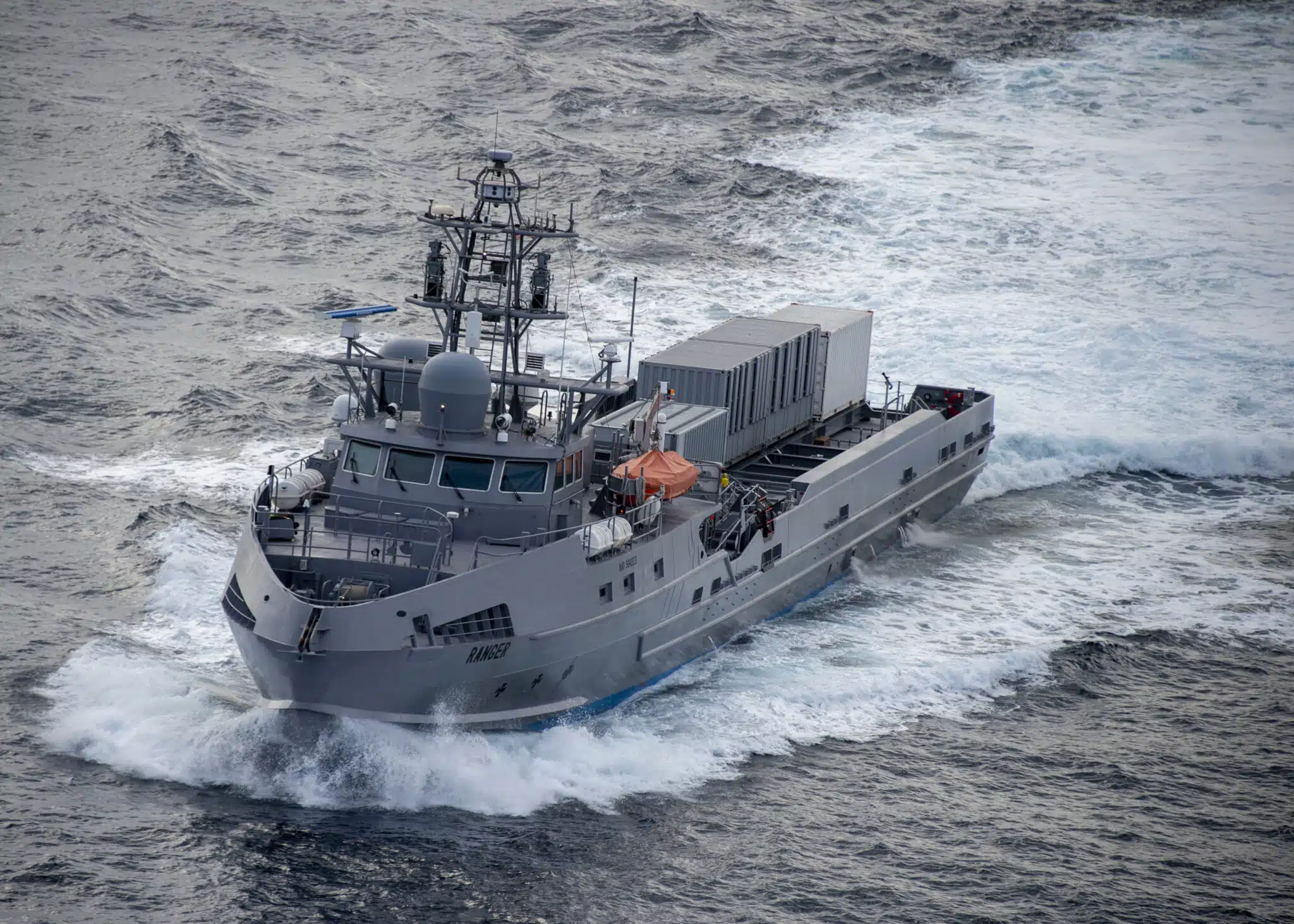
Oddly, program documents show the key requirements for MUSV appear largely the same as for MASC, emphasizing containerized modular payloads rather than mission systems integral to the USVs themselves. Rather the difference allegedly is in procurement strategy and speed, with acquisition executive Rebecca Gassler disparaging MASC to media as an unnecessarily conservative “prototyping” effort, while the MUSV marketplace will see off-the-shelf capabilities delivered into operational service much more quickly.
Gassler said the Navy realized it had underestimated just how mature and sophisticated industry USV solutions already were, so the new marketplace will bypass prototyping in favor of direct ‘on water’ evaluation of off-the-shelf solutions within the next five months, followed by delivery of production vehicles within one year.
In the near term, participating companies must submit plans reflecting proposed business models (whether the USVs are leased, contracted out, or directly sold to U.S. government), manufacturing readiness, supply chains and sustainment concept, design, and testing of their proposed USV solutions.
Following evaluation, down-selected companies will be awarded $10 million contracts to prepare USVs for on-water tests, all of which will be completed by September 30 this year. The six days of testing will include two days of Perception and Situation Awareness, three days for Collision Avoidance protocols and Safety “Vignettes”, and one day testing a long-endurance mission.
Companies whose USVs satisfactorily complete testing will be awarded an additional $15 million. The Navy will then issue selected vendors fixed-price production or leasing contract, with the understanding that first production deliveries must take place by September 30, 2027.
However the marketplace mechanism will be “regular and recurring” and applied to additional vessel types reflecting the growing demand for USVs for diverse missions.
From MUSV to MASC to MUSV Family of Systems
The old is become new again, as MUSV was originally one of two longstanding USV programs aimed at building a ‘Ghost Fleet’ of Large and Medium USVs that were canceled early in 2025 for being deemed too complex and expensive to meet the need for affordable mass. MUSV was intended to encompass sub-500-ton vessels assigned ISR, targeting and information operations.
The succeeding MASC program was billed as being less complex and more open-ended in terms of design elements, with a core concept seeking three tiers of low cost USVs able to carry one, two or four shipping containers packing mission payloads. The primary, middleweight variant was specified with mostly the same performance requirements to the rebooted MUSV (see below.)
MASC had already advanced past the contract-award phase, so its surprise cancelation left some in the industry feeling whiplash.
“Investors poured hundreds of millions of dollars into the MASC program and ultimately we won’t get a single USV from it,” CEO David Jochum of Tridentis Advanced Maritime Vehicles wrote on LinkedIn. “Tremendous waste of resources and time and very bad for an industry that is becoming more reliant on outside investors especially in shipbuilding.”
To be fair, though, it seems platforms developed for MASC should likely be applicable to the reincarnated MUSV requirement too.
The ‘marketplace’ concept seemingly echoes the new ‘marketplace’ devised for the Army to enable mid-ranking offers to independently procure UAVs for their combat units. However, Gassler clarified this did not mean USVs would be procured in such a-la-carte fashion as they will likely exceed discretionary budgets. Rather the term seems meant to invoke how the marketplace will enable the Navy to ‘shop’ for solutions offered by vendors without traditional R&D phases.
Overall that approach very much reflects the Hegseth Pentagon’s materialist preference for rapid procurement of off-the-shelf platforms for operational service, and dislike of prolonged R&D cycles.
Program requirement for MUSV 2.0
MUSV documentation seemingly retains a mission concept based around containerized payloads, just as intended for MASC. While containerized payloads could have diverse functions, it’s no secret the Navy is particularly enamored with Lockheed’s Mk.70 Mod 1 Payload Delivery System—basically a shipping containers can launch virtually any missile compatible with the Mark 41 vertical launch system of Navy destroyers.
That means any vessel carrying a few Mk.70s containers could potentially pack a limited salvo of destroyer-level firepower (provided separate platforms supply the necessary target acquisition, guidance and combat systems, of course.)
Specific program requirement for MUSV include:
- Minimum range of 2,500 nautical miles (2,877 miles) while carrying a 25 metric ton deck payload under Sea State 4 conditions (“moderate breeze” with waves 1.25-2.5 meters high).
- Payload capacity generally of at least 36.3 metric tons (40 tons)
- Capacity for two 40-foot equivalent containers that can receive 75 kW each (ie. total 150 kW)
- Autonomous capability at day and night in compliance with collision avoidance regulations (COLREGSs)
- Ability to autonomy operate in radio frequency ‘stealth’ mode without emissions
- Capacity to receive 2,000 gallons per minute while refueling
- Ability to perform missions in Sea State 5 and remain survivable in Sea State 7
Additional desired attributes, though not strictly required, include:
- Ability to deliver 5-10 operational-grade MUSVs by September 30, 2027
- open-architecture command-and-control, autonomy, and sensing systems that can interface with third-party applications, and integrate external modular updates
- self-monitoring and reporting of system health to external controllers
- command-and-control stations supporting control of multiple USVs
- Ability to execute 5-day pre-planned missions without communication
- 250 kW capacity for deck payloads
- Ability to nest 5 MUSVs abeam at mooring
- Emergency stop capability for offboard operators
However, the rebooted program is hinted to have a broader scope encompassing a “number of missions we could immediately use these vessels for…” per Gassler—though she said further details of those “specific mission profiles” remain outside the “unclassified realm”.
One can imagine potential additional applications ranging from mine-countermeasure and anti-submarine warfare, to reconnaissance and electronic warfare (focus of the original MUSV program), and special warfare and amphibious operations support.
The rebooted MUSV is also being branded as complementing the Trump administration’s ‘Golden Fleet’ program aimed at fielding large new Trump-class ‘battleships’, though building bigger warships concentrating even more firepower is arguably orthogonal to fielding numerous USVs intended to execute the Navy’s official distributed firepower doctrine. However, the ‘Golden Fleet’ imprimatur may help sustain funding from an administration that likes to see ‘Trump’ and ‘Golden’ emblazoned on things.
War with Iran Brings USVs Back into the Spotlight
The Navy USV relaunch comes just as a new conflict plays out in the Persian Gulf reemphasizing the potentially disruptive capabilities of USVs in both offensive and force protection missions.
The watershed moment for USV warfare arrived 2022-2025 as Ukraine successfully deployed a force of home-grown kamikaze and attack USVs that progressively hounded Russia’s powerful Black Sea Fleet out of its Crimean bases, destroying tank landing craft, corvettes and even jet fighters along the way.
However, Iran’s own deployment of remote-control kamikaze USVs technically predates Ukraine’s by several years. On January 30, 2017, the Iranian Revolutionary Guard Corps Navy (IRGCN) helped allied Houthi rebels in Yemen execute a successful kamikaze USV attack against the Saudi frigate Al Madinah, killing two. The Houthi’s steadily evolving Toofan (‘Blowfish’) USVs would eventually assail the U.S. Navy in the Red Sea 2023-2025, though non managed to hit warships.
With Iran now denying passage to shipping via the vital trade artery of the Strait of Hormuz, however, the IRGCN has employed its own kamikaze USVs to attack tanker traffic rather while its notorious ‘mosquito fleet’ of manned motor boats remains nowhere to be seen.
On March 1, the tanker MKD Vyom was struck by a USV in the Gulf of Oman killing an Indian sailor. Then on March 5 the oil tanker Sonangol Namibe had its hull breached by a kamikaze USVs while at port in Iraq. Finally on March 11 the American-owned tanker Safesea Vishnu was struck by two USVs during a ship-to-ship cargo transfer of flammable naphtha to the Greek tanker Zefyros, engulfing both ships in flame. The crew of Vishnu was forced to abandon ship with the loss of one life.
These incidents, combined with UAV attacks, have successfully brought shipping in the Persian Gulf to a near stand-to-still as insurers refuse to authorize passage. This illustrates again how USVs can enable maritime underdogs to exert sea denial even when outgunned in terms of air and traditional sea power.
Iran’s anti-access strategy in the Persian Gulf also involves threat, or actual deployment, of naval mines—a mission it may also be able to execute using USVs. However, mine warfare is also a domain in which mine-sweeping USVs are likely to play a key role—particularly as the U.S. Navy has retired the last of its Avenger class minesweeper in favor of new mine-countermeasure (MCM) USVs deployed from littoral combat ships.
Thus the conflict unfolding along the Persian Gulf will continue to draw attention to the ability of USVs to operate relatively freely in a strategic waterway where both Iran and the United States exert substantial (if very different) anti-access/area-denial capabilities holding commercial and military shipping at risk.