
A turbulent FY2026 landscape favors affordable, modular, and rapidly fieldable unmanned systems—especially sUAS and loitering munitions—while legacy programs face cancellations, pivots to COTS, and a “move-fast” procurement ethos that prizes mass over exquisiteness.
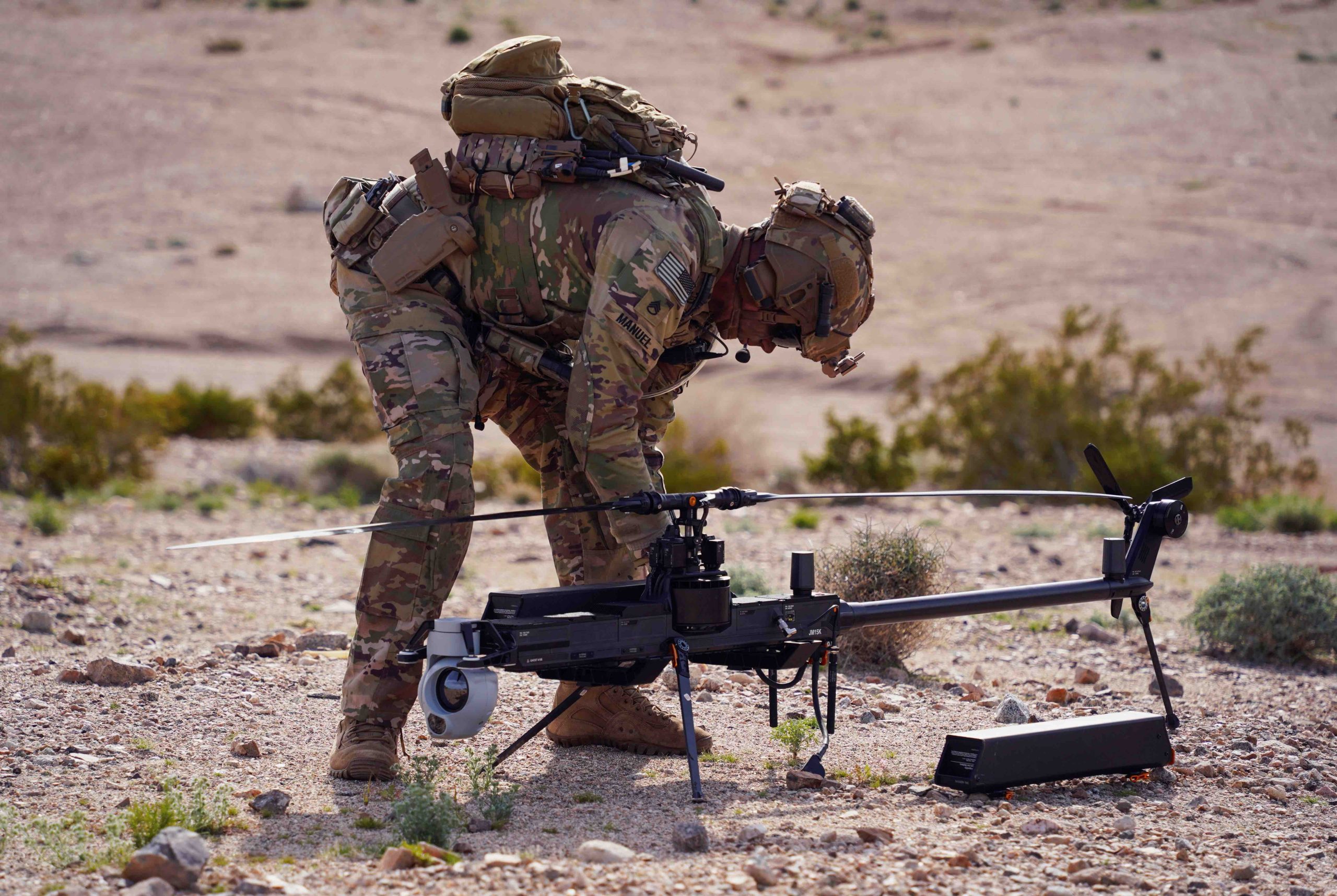
Unmanned platforms have grown dramatically in importance for the U.S. military in the last two decades. However, the Pentagon’s new leadership cadre under the Trump administration is skeptical or even hostile to many pre-established programs while enthusiastically promoting adoption of unmanned platform—especially those available “off-the-shelf.”
The guiding lights of the new defense regime are as follows:
- Preference for UAVs, missiles, special forces and space over traditional manned platforms and combat formations
- Skepticism towards prior administration programs, preference to kill or completely reboot long-running programs that have yet to result in major procurement
- Preference for lower-cost COTS solutions deliverable in short term over military systems tailored to more stringent requirements over lengthier timeframes a
- Faith that unmanned and/or COTS systems will deliver more cost-effectives capabilities more rapidly
- Relaxed arms control to enable more weapons exports, including unmanned systems formerly constrained by the Missile Technology Control Regime
These tendencies are reinforced by the prominence of unmanned systems in wars in Ukraine and the Middle East, which have revealed a pressing need for larger numbers of lower cost missiles, drones and air defenses. The administration’s closeness to tech interests promoting unmanned systems, AI, space, and missiles reinforce these biases.
In the resulting “move fast and break things” spirit, programs nurtured by the services over many years were canceled en masse, including several prominent unmanned programs nearing completion of development. However, administrations official believe they can rapidly acquire unmanned capability at low cost off-the-shelf, thus bypassing the traditional development grind.
Still, unlike civilian government agencies, the defense sector has broader political support to resist painful cuts. The proposed FY2026 defense budget ended up matching the prior year’s $848 billion in spending and may be supplemented by $113.3 billion in requested reconciliation funding.
Another trend to watch for in the forthcoming National Defense Strategy is a shift away from China-focused “Great Power Competition” in favor of withdrawal from commitments to overseas allies—in Asia as well as Europe—instead emphasizing military deployments in the Americas and on U.S. soil. That should theoretically impact force structure, but Congress, the services and the defense industry will likely remain firmly behind counter-China competition.
In recent budget negotiations, the House tends to defer to DoD’s agenda, while the Senate has a more independent and critical approach. The House’s favors cuts to force posture, legacy platforms, U.S. security partnerships, and sustainment, accountability and analytical offices. It favors R&D for capabilities in a post-2030 timeframe particularly for Air Force and Space Force.
The Senate is more concerned about readiness, maintaining near-term force capability and security partnerships, correcting mismanaged programs, protecting the Army from major cuts sought by DoD/House. When it comes to unmanned systems, this means House is more favorable to large UAVs and missiles used by the Air Force, while Senate policies will protect legacy platforms and support the Army as integrates SUAS.
Agility versus standardization
Modern militaries often prefer to standardize platforms to achieve economies of scale and keep logistics and training uncomplicated. But there exists the contrary model of agility—moving quickly with R&D and procurement for timely acquisition, then discarding/expending them as superior technologies become available. That agile dynamic, typical of rapidly evolving warplanes between 1910-1960, is most realistically achievable today with small unmanned systems and cost-efficient munitions.
However, continual competition and uncertainty on platform longevity may prevent price-reducing economies of scale, despite reducing costs for futureproofing, service-life extension and modernization. And though promising sustained infusions of improved technology, highly diversified and continually changing unmanned system fleets could lead to interoperability, logistics and training difficulties. Mitigating at least some of these problems requires consistent Modular Open System Architecture (MOSA) designed to ensure commonalities, interoperability and adaptability between an ever growing pool of platforms and payloads.
What this means for industry
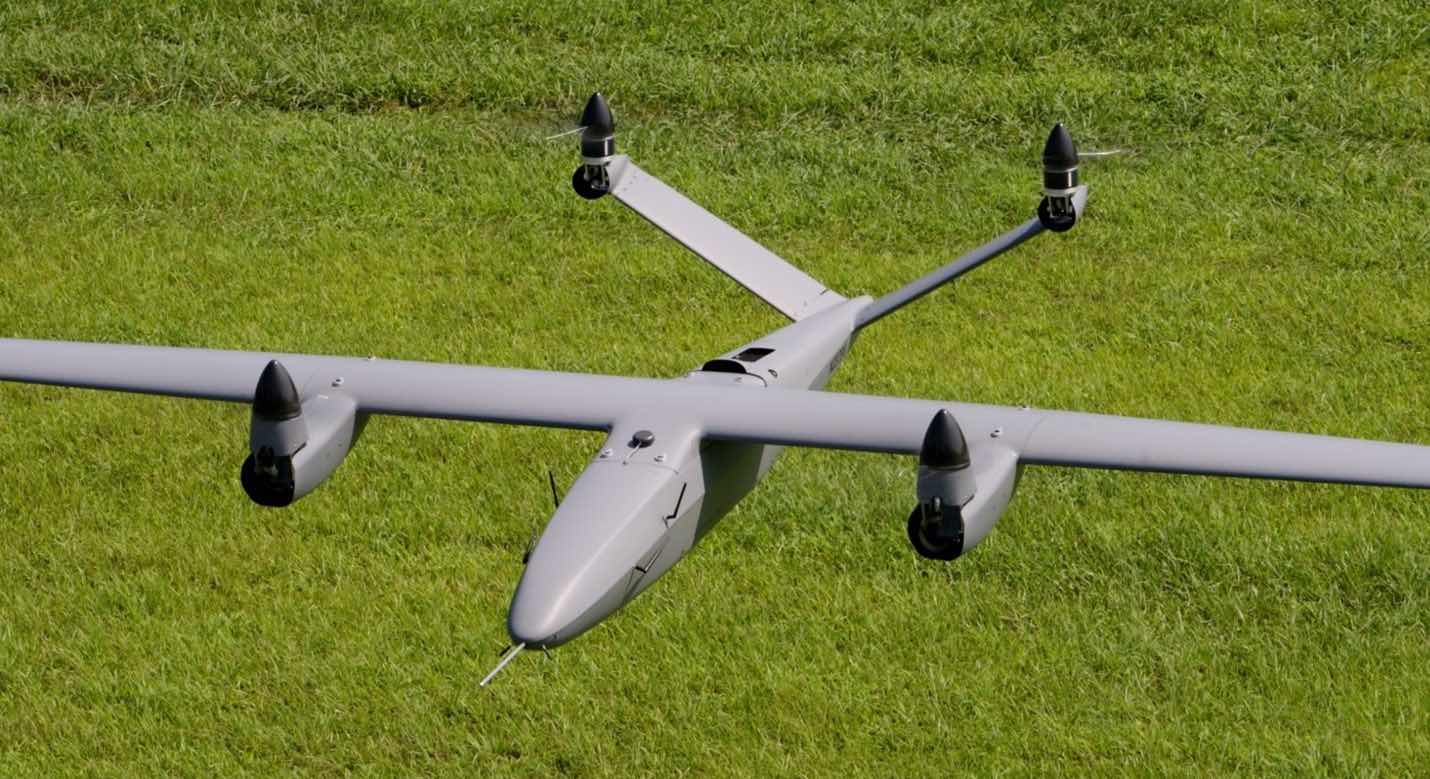
The new management in the Pentagon favors affordable rather than exquisite; the readily available and mass-producible over the bespoke. Companies that can deliver functional near-complete products on short notice—and with credible capacity to scale mass production—seem best positioned. This transfers R&D risks to industry but may accord industry more freedom to present products they have rather than spend years jumping through the hoops of an R&D treadmill.
Versatility through open systems architecture and support for modular payloads is valued over perfection, as the most exquisite systems and payloads of today are liable to be surpassed in a few years’ time anyway.
Newer companies have more opportunity than ever to compete in designing SUAS, USVs and UUVs, and may even be favored over traditional primes. However, they run risks of being unable to deliver prototypes or scale mass production fast enough, which could result in lost or split contracts.
There are other risks to consider in the rapidly evolving market for military unmanned systems:
- the Pentagon may think it wants rapid COTS solutions—only for the services to feel dissatisfied when they don’t receive the degree of tailoring and prolonged evaluations they’re used to
- MOSA platforms are appealing to buyers, but may deprive vendors of profits from future payloads and systems integrated into their base platforms.
- Manufacturers expecting mega contracts lasting decades to secure their financial future may be disappointed by the high turnover model as SUAS are routinely replaced with more advanced models (see “The Army’s Drone Revolution” below)
- Levels of agility, risk and COTS-use reasonable for SUAS could lead to unrealistic expectations for larger unmanned systems.
The Army’s drone revolution
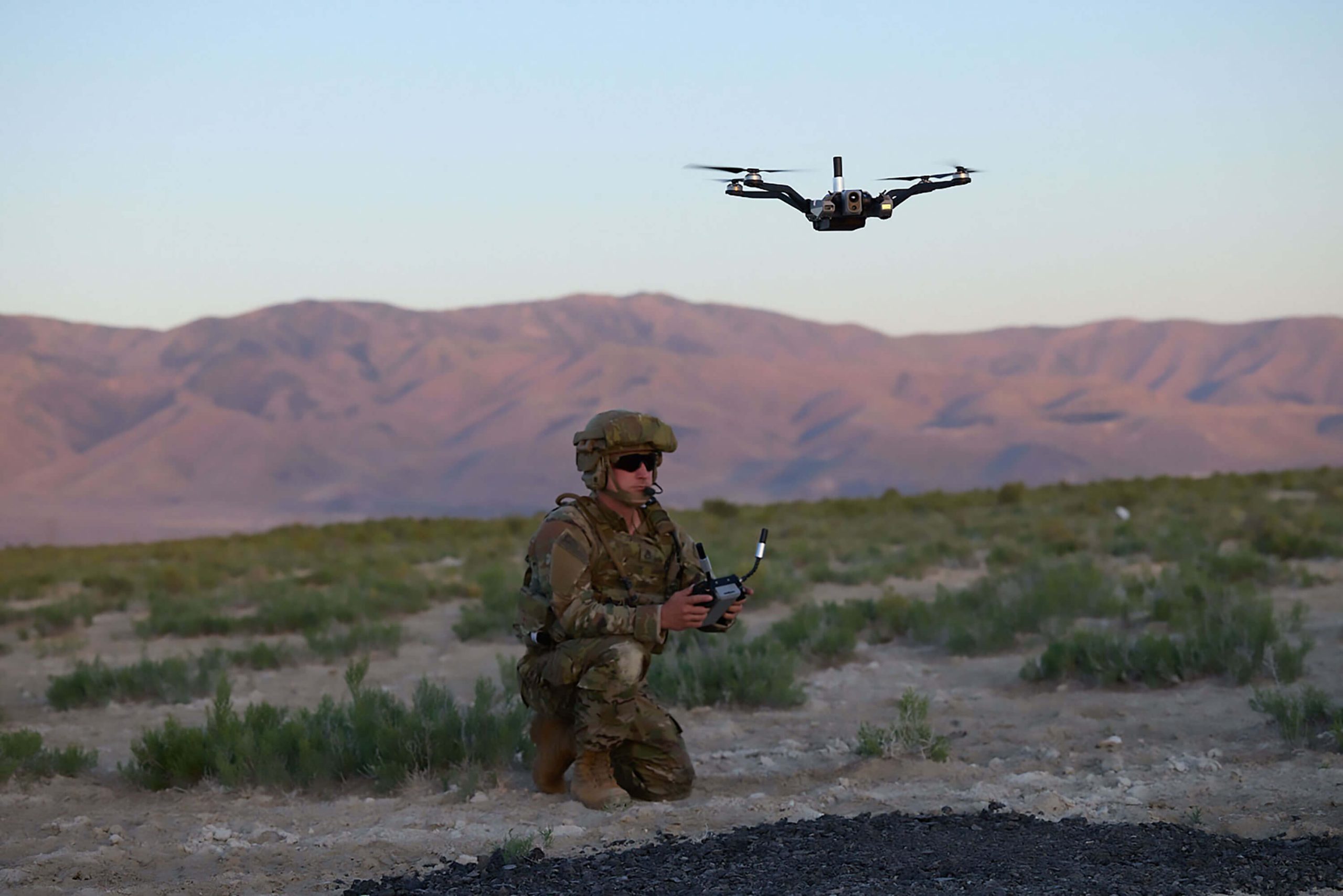
Compared to the other services, the Army’s recent drive for SUAS amounts to more of a revolution informed by the disruptive impact of drone warfare in Ukraine—particularly SUAS. The service is moving ahead with plans to integrate different types and weight classes of drones at every level of the order of battle from infantry squads to brigades, divisions and theater-level Multi-Domain Task Forces.
Broadly the Army requested $726 million for SUAS in its 2026 budget proposal plus another $56 million R&DTE for 2026; compared to $98.4 million collectively the preceding year. The service wishlisted an additional $581 million for SUAS specifically.
Already in 2024, the service began its Transformation in Contact program seeking to rapidly supply SUAS to lower-level combat units from the ground up. The aim: to leverage SUAS to achieved “no blood in first contact,” as historically scouts often discover the positions of concealed enemies by getting shot at.
In April 2025, Secretary Hegseth announce the Army Transformation Initiative redirecting funding towards SUAS, C-UAS, missiles and infantry while cutting ongoing procurement of armored vehicles and large Army combat and ISR aircraft.
Then, an executive order in June followed by a video announcement in July, the secretary proclaimed a program of “Unleashing American Drone Dominance” encompassing policies intended to hasten SUAS adoption:
- Reclassifying Group 1 and 2 drones as expendable ammunition, making it easier for mid-ranking officers to authorize use, purchase and testing of Blue UAS drones, or for soldiers to design and produce their own drones
- Reduced training requirements for drone operators and FAA regulations near bases
- Reduced service-specific regulations and interoperability requirements affecting UASs
- Requiring formation of drone programs and national drone training ranges
- Require that “every squad” field an SUAS by the end of FY2026
- Encouraging practices including digital twinning, modularity, agile development
The ‘drones as munitions’ policy does reflect the observable reality that in high-intensity combat in Ukraine SUAS must be sustainably replenished as UAVs are expended in kamikaze attacks or inevitably lost to enemy fire and EW. In other words, SUAS must developed, procured and modified less like large valuable aircraft with people inside, and rather a low cost resource in need of continual resupply and adaptation.
Reports from Ukraine suggest the life cycle of reusable SUAS can average as few as 10-15 sorties, improving recently to 45 sorties for dedicated ISR systems. Loss rates were reportedly even higher in the 2022 prior to adaptations to adversary EW—to which U.S.-supplied military UASs were notoriously vulnerable.
Fortunately, a roughly $2,000 Group 1 SUAS like PBAS and Neros Archer still costs less than an unguided 155-millimeter howitzer shell (typically $3,000.)
Platoon-level UAVs
Purpose Built Attritable System (PBAS)
FY2026 Request: $34.3 million (pooled with SRR) for 500 PBAS UASs, each with two 10” rotor UAVs and four 6” rotor UAVs plus GCS, charger, and batteries. $2.8 million in testing & evaluation.
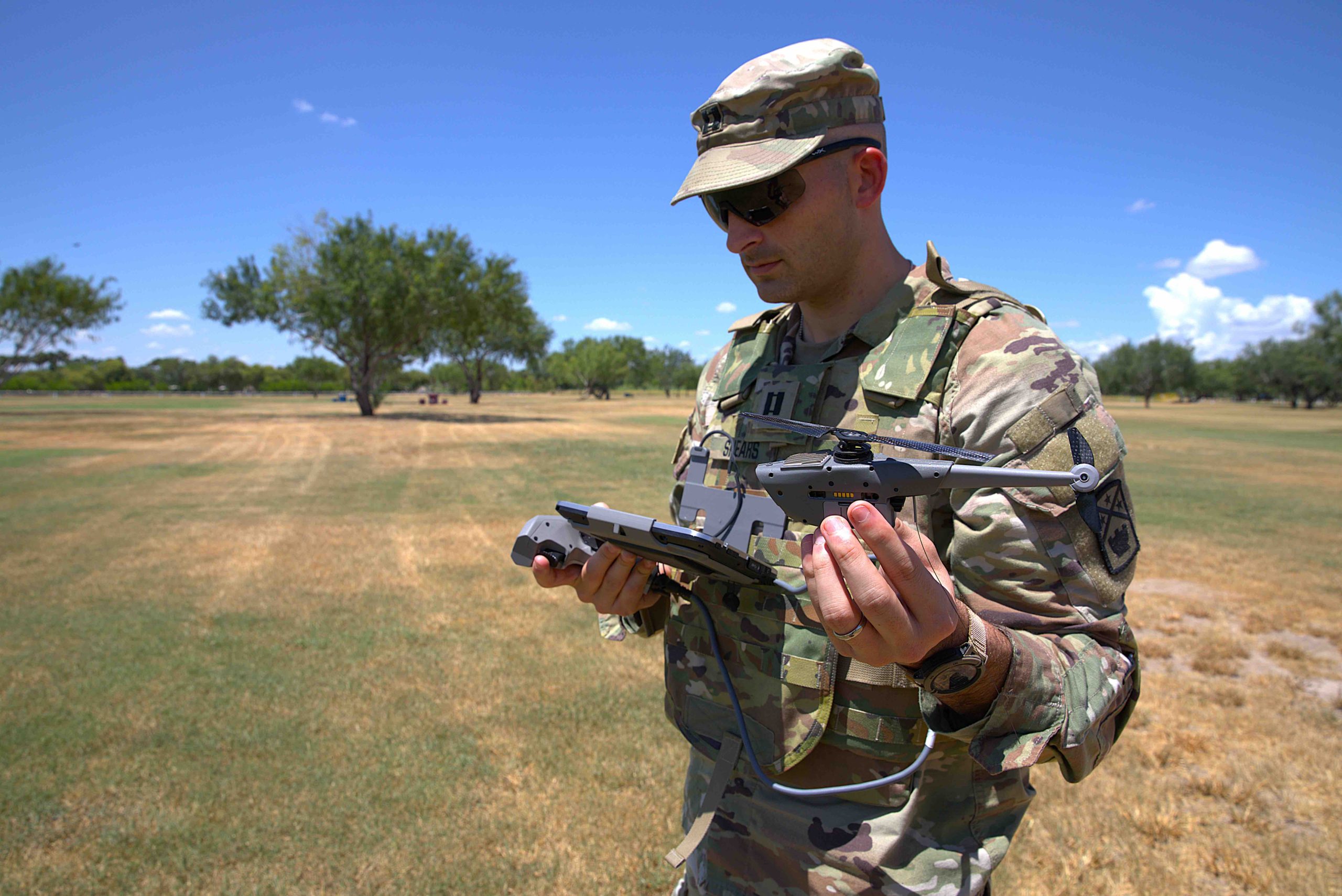
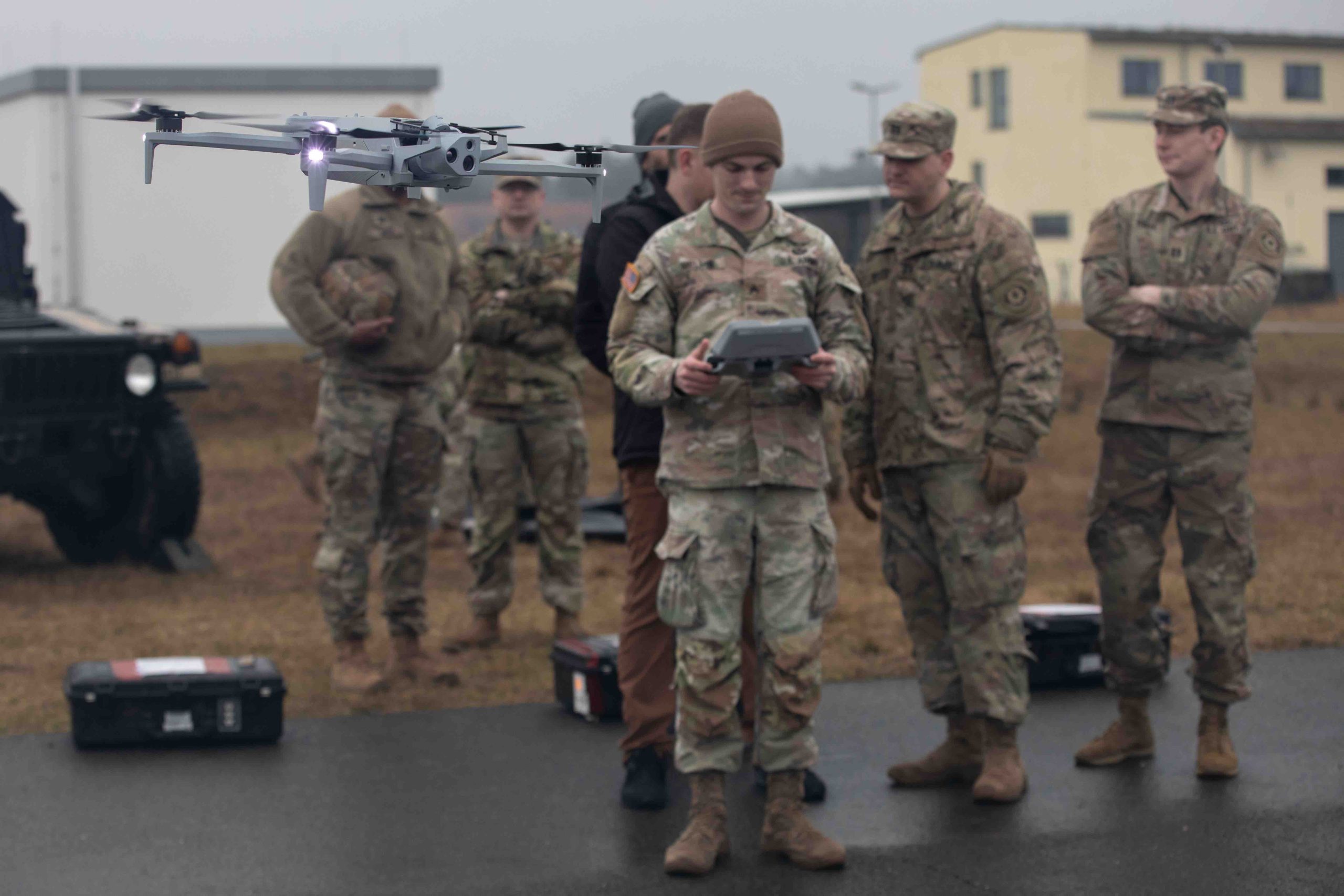
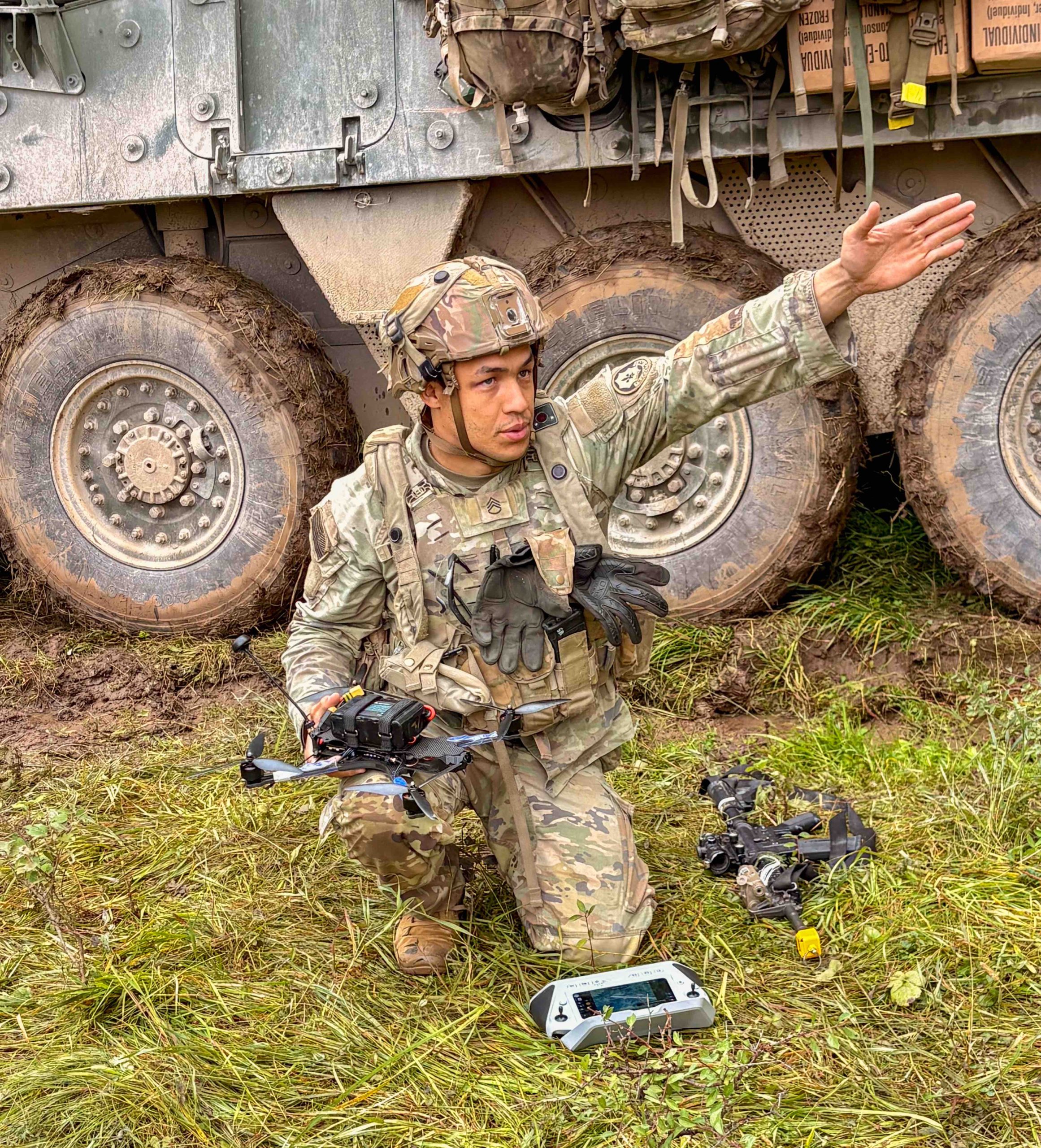
The new PBAS program emphasizes low-costs, mass, speed of delivery and adaptability. The goal: highly maneuverable Blue-UAS certified Group 1 FPV drones that small combat units can reconfigure rapidly in the field for diverse missions and expend with minimal concern without leaving behind sensitive recoverable components. PBAS should support both remote FPV-piloting and tablet-style control systems.
PBAS requirements emphasize modular multi-mission payloads supporting ISR and target acquisition, communications relaying and “added flexibility to execute kinetic operations as needed.” Army sources have also variously expressed interest in a tethered overwatch functionality, and attachments for dropping grenades or anti-tank mines.
The initial PBAS procurement reportedly was designed by U.S. Army units. Each UAS reportedly cost $35,000 including 6 UAVs of two different types.
After a call for industry solutions elicited 60 responses, a subsequent RFI in July specified a unit cost under $2,000 per UAV, support for third-party payloads and repair in the field, and the ability to follow an initial delivery to military on September 30 with 10,000 more UAVs over the next 12 months. Presumably the Army expects UAVs mass-produced by industry to cost less than Army-assembled ones.
Short-Range Reconnaissance Drones (SRR)
FY2026 Request: $34.3 million (pooled with PBAS) for 265 SRR Tranche 2 UASs, plus $17.86 million in development enginering
Preceding PBAS by years, SRR requirement sought sub-5-pound SUAS useable for reconnaissance, surveillance and targeting, with a range of 2-3 miles and 30 minutes endurance. In contrast to PBAS, SRR is intended to leverage more capable sensors for ISR/targeting missions. Ultimately, the Army wants 5,880 SRR UASs (two UAVs each) over five years, though the Army may reconsider SRR platforms every 2-3 years.
For SRR Tranche 1 between 2022-2024 the Army procured 1,138 RQ-28As (Skydio X2Ds) to equip 16 brigades. Based on feedback requesting improved autonomy, ground control systems, and modular architecture, the Army competed Tranche 2 between Skydio’s X10D and Red Cat/Teal Drones’s Black Widow UAS, ultimately awarding contracts to both. The shared $35 million request shared with PBAS, however, falls below expected spending.
Squad Multi-Purpose Equipment Transport (S-MET)
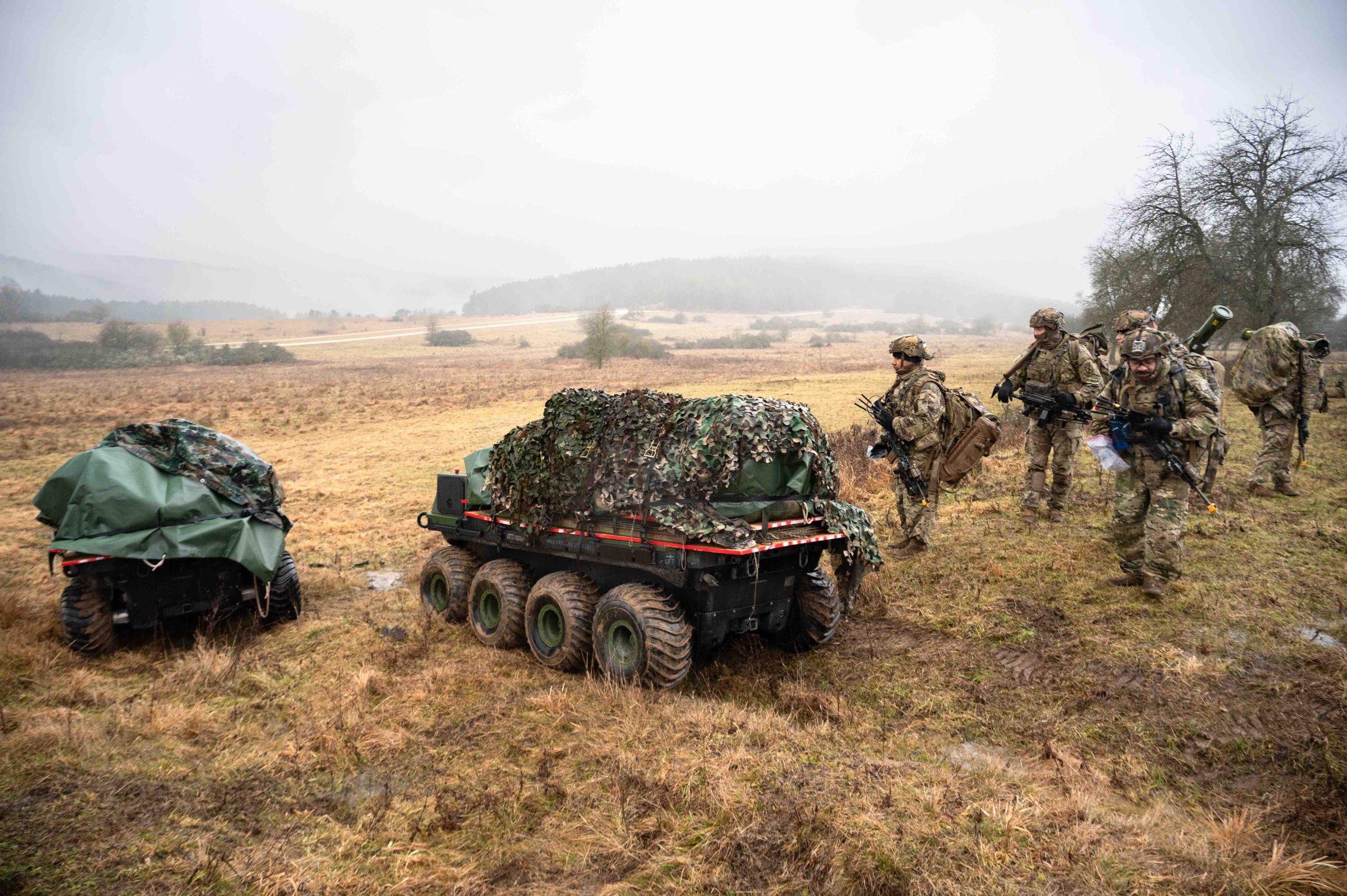
The Small Multi-Purpose Equipment Transport is less robot tank than robot mule, intended to accompany infantry and engineering platoons while lugging heavy equipment and supplies. But unlike a mule, it contributes additional capabilities like battery recharge, comms relay, sensors and autonomous casualty evacuation.
S-MET increment 1 involved evaluation and procurement of GDLS’s 8×8 MUTT vehicles able to carry half-ton payload. Increment 2 is to be quieter, support a one-ton payload, and offer additional utility through improved battery recharging and payload flexibility including supporting drone launchers. Other payloads may including EOD/mine-clearance, sentry sensors and breaching capability. In the 2024 the Army spent $22 million to fund procurement and evaluation of eight UGVs from Rheinmetall/Textron and HDT Expeditionary Systems: Rheinmetall/Textron’s Mission Master UGV series and HDT’s 6×6 Hunter Wolf. Both have quiet hybrid propulsion.
If the Army is satisfied with Increment 2 evaluations, it may order up to 2,195 systems in FY2027.
Company-level UAVs
Medium-Range Reconnaissance Drone (MRR) FY2026: $90 million for 85 company-level UASs (two UAVs plus controls systems and EO/IR payloads). Other sources indicate 107 UASs. $11.65 million for testing evaluation including cybersecurity.
MRR seeks a multi-role drone with a minimum range of 6.6 miles, endurance of 8 hours, APNT navigation and substantial lift capability to facilitate payloads for day/night reconnaissance, laser targeting, battlefield delivery, and strikes dropping grenades/mortar shells. For Tranche 1, the Army tapped the PDW C100 heavy quadcopter (see IUS’s 2025 ISR issue), and Anduril’s rail-thin Ghost-X UAV single-rotor helicopter drone. These differ profoundly in weight, complexity, range, and undoubtedly cost. Both platforms have seen combat testing in Ukraine. In 2025, a C100 demonstrated ability to direct Paveway glide bombs released by an F-35 jet to targets from standoff range using a laser designator.
| Anduril Ghost-X | PDW C100 | |
| Weight | 55 lbs. | 21.4 lbs. |
| Endurance | 75 minutes | 60 or 74 minutes(heavy battery) |
| Range | 15.5 miles | 6.2 miles |
| Max. Payload | 20 lbs. | 10 lbs. |
| Propulsion | Heavy quadcopter | Single-rotor helicopter |
MIA: Company-level tethered drone and drone swarming?
A Congressional report indicated plans for company-level tethered drones and drone swarming capability, but these aren’t discernible in budget documents. Tethered UAS could provide long-endurance overwatch and comms relaying/extension support. In preceding years, the Army procured Hoverfly’s Sentry and Blue UAS certified Spectre tethered drones for the service’s VHA-L and VHA-H requirement related to the Nett Warrior situational awareness system (now folded into the Army NGC2 network program.) Meanwhile, Army exercises and programs like Project Convergence have revealed experimentation with drone swarms, but not yet a specialize UAS.
Battalion-level UAVs
Long-Range Reconaissance (LRR) FY2026 Budget Request: $125.2 million for 101 LRR UASs each comprising two UAVs, two HGCSs, datalink and payloads
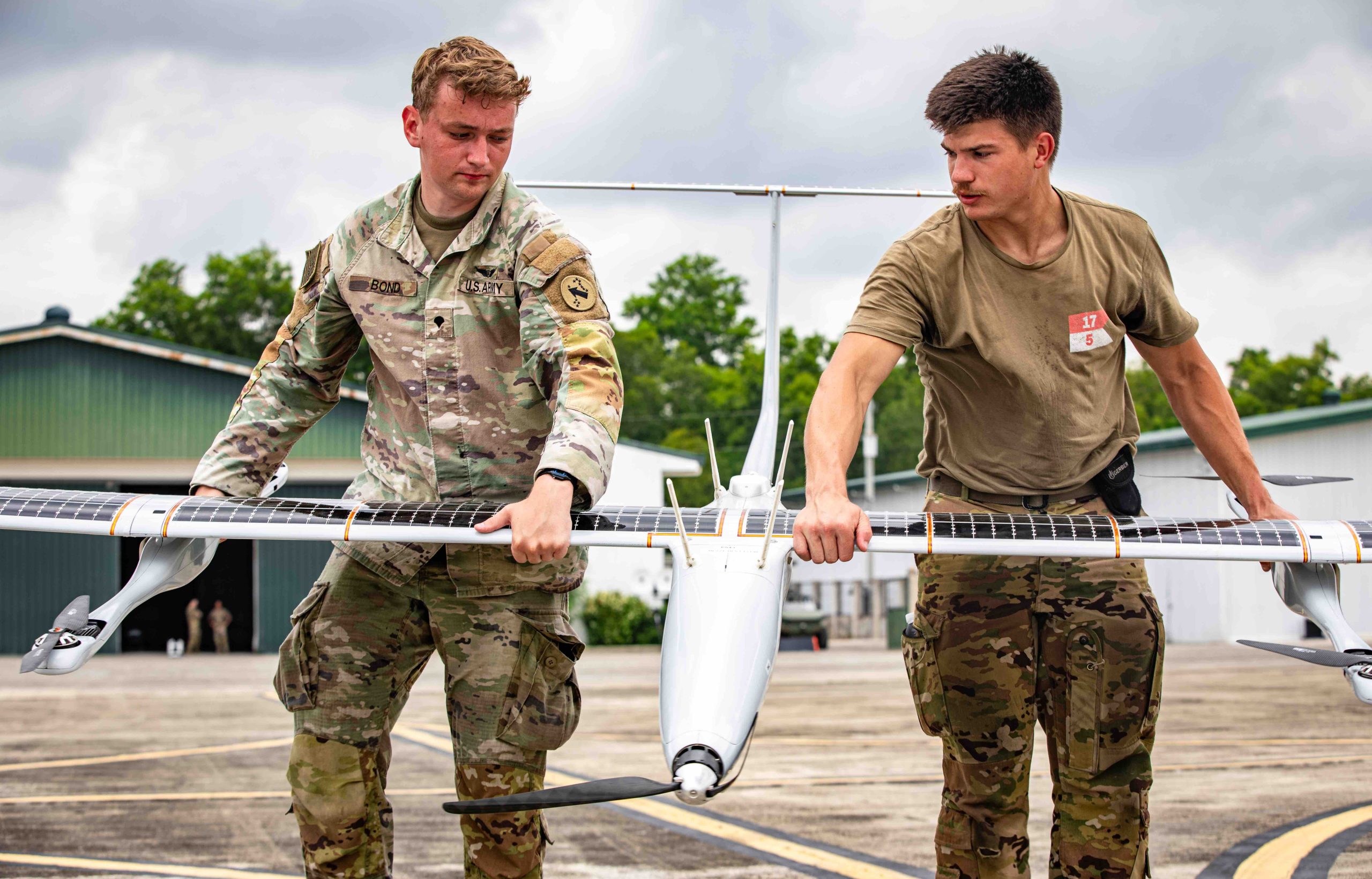
LRR seeks to replace the RQ-20 Puma fixed-wing catapult-launched ISR drones with a Group 2 UAV with at least 25-37 miles range and endurance of 5-10 hours. Key mission capabilities include laser designation, real-time FMV, and either autonomous or single-person launch and recovery. This August, the Army downselected AeroVironment and Edge Autonomy to deliver their P550 and Stalker Block 35X UAVs respectively for evaluation—both vertical takeoff systems.
Brigade-level UAVs
Shadow Retired. FTUAS canceled. Now what?
AAI’s RQ-7 Shadow, a Group 3 fixed-wing UAV, served as the high-end ISR asset supporting Army brigade headquarters for roughly two decades. After extensive service over Iraq and Afghanistan, the last Shadow was retired in 2024 without yet fielding a replacement.
The Future Tactical UAS (FTUAS) program sought a runway-independent, low-maintennace Group 3 UAV to replace Shadows. Ultimately the Griffon Valiant and Textron Aerosonde Mk.4.8 Hybrid Quad were competed with evaluation concluding early in 2025 (Jane’s reports the Valiant was likely the winner). But then the Trump administration canceled FTUAS, claiming it would take too long to field and that its requirements were obsolete.
A Shadow-replacement will instead arrive via a separate Brigade ISR requirement aiming for a rapid-fielding Group 3 COTS drone—though Griffon and Textron were invited to resubmit their UAVs for the competition.
LASSO and Switchblade for the Army’s Tank Busting Drones
FY2026 Request: $67 million for 294 rounds for $170,000 apiece and 54 control stations, with potential additional $13 million in reconciliation funding for 19 LASSO systems
Observing the advent of FPV kamikaze drones in Ukraine, the Army kicked off the Low Altitude Stalking and Striking Ordnance program in 2023 seeking to urgently outfit infantry brigades with portable, tube-launched anti-tank loitering munitions. Ultimately AeroVironment was awarded a sole-source contract for Switchblade-600s initially to equip five infantry brigades (some documents claim at the battalion-level). The current unit cost of $170,000 in budget documents apiece is only moderately less expensive than a Javelin anti-tank missile. The successful air-launch of a Switchblade-600 from an MQ-9A this year however highlighted its potential to execute very long-range strikes over dozens of miles.
In 2025, LASSO was folded into the Army’s Launched Effects program (see below). Follow-on LASSO increments may be aimed at company-level capabilities.
Joint Tactical Autonomous Aerial Resupply Vehicle (JTAARS)
FY2026: 19.46 million $5 million for research pooled with SRR and LRR
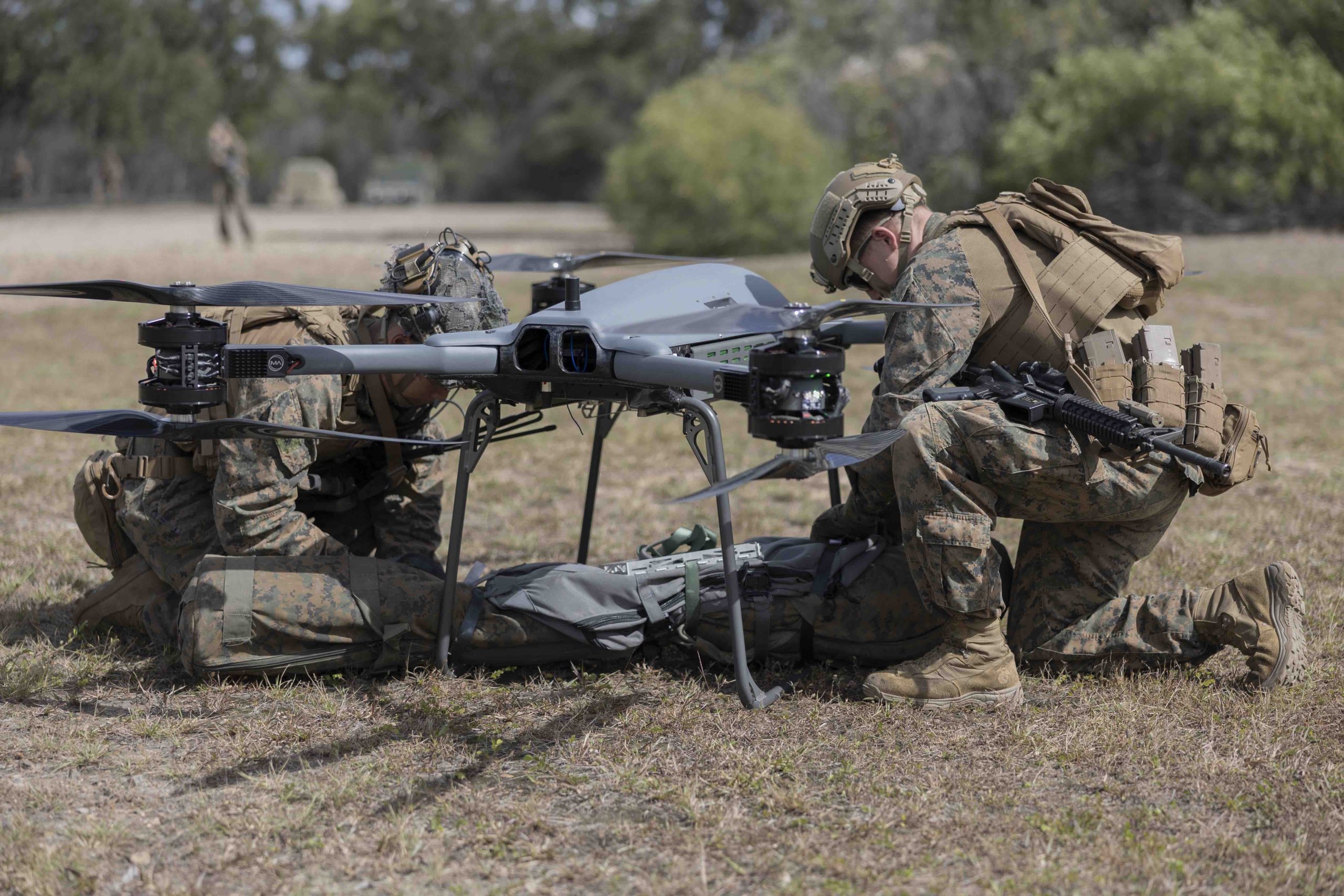
JTAARS is a Group 3 UAS program developed to support Army brigades and Marine regiments through fully autonomous battlefield delivery across the dangerous “last tactical mile” carrying items ranging from MREs, water and ammunition to batteries and medical supplies. Minimum requirements call for ability to lift 125 pounds over 8 miles range.
Division- and Corps level UAVs
Fall of the Gray Eagle FY2026: RDT&E halved to $3.4 million, $12.35 million for upgrades. A House bill seeks $240 million to procure 8 MQ-1Cs.
Adapted from the classic Predator drone, General Atomic’s MQ-1C Gray Eagle serve as an in-house fixed-wing air support platform for Army divisions (and certain special forces units) capable of ISR, EW, Comms-relaying missions, and Hellfire missile strikes. The service planned to team MQ-1Cs with AH-64E attack helicopters as combat tested in Afghanistan.
However, in 2025, Gray Eagle and Apache Guardian procurement were cancelled, on the grounds large UCAVs and helicopters had exhibited limited survivability over Ukraine.
Now the plan is to retire older MQ-1Cs Block 15s by 2028, while retaining upgraded Block 25s as divisional assets. However, by late 2025 the Army will reportedly announce a Group 4 or 5 UAV to succeed Gray Eagle for fielding in 2028—though General Atomics is also promoting improved MQ-1C STOL and 25M variants to fulfill that requirement.
Launched Effects
FY2026: $187 million requested for R&D and testing
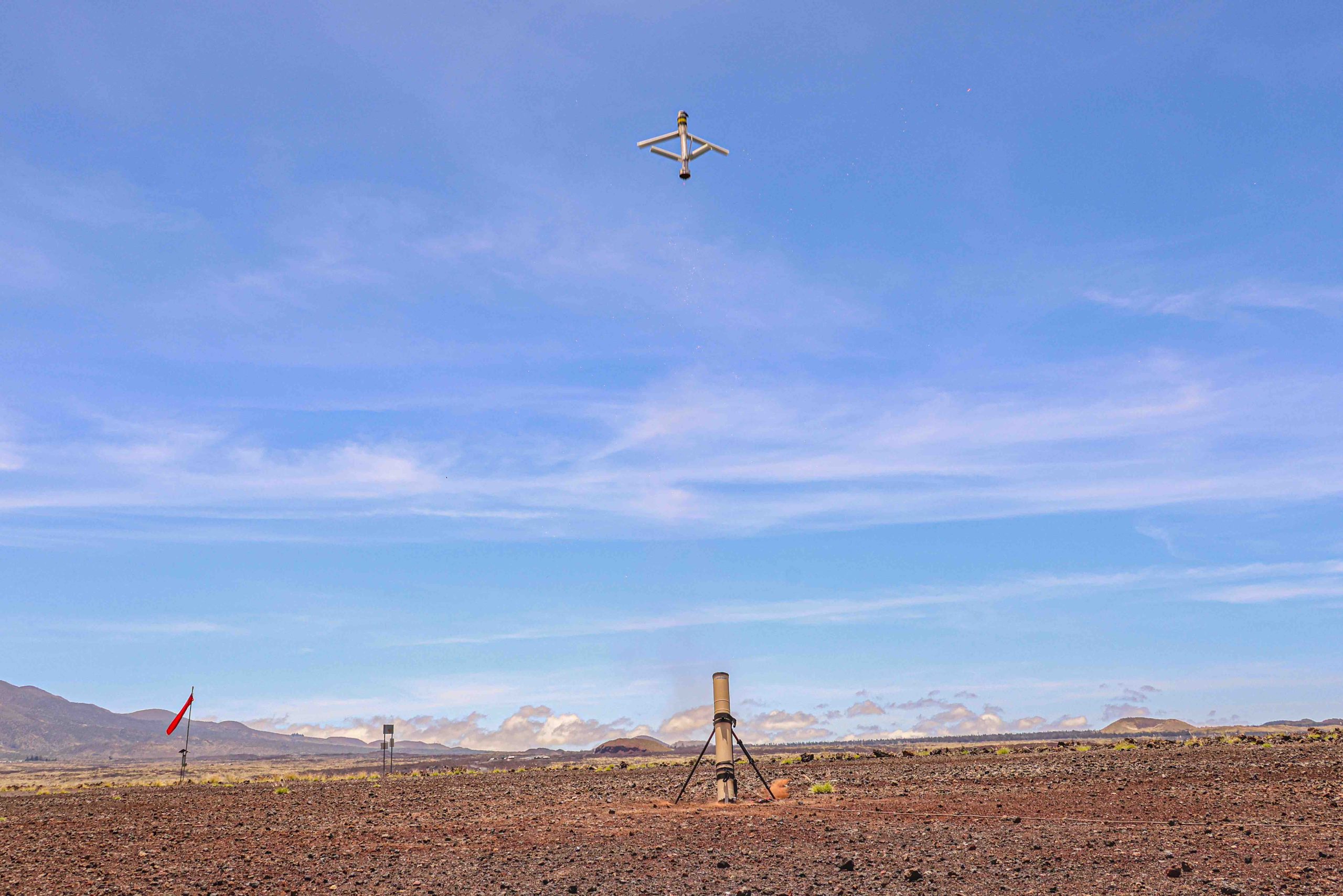
The Army’s Launched Effects Family of Systems originally concerned UAVs/loitering munitions launched from aircraft—making helicopters into survivable platforms for standoff strikes. However in 2025 the portfolio expanded into ground-launched effects, notably including LASSO (see above).
Launched Effects leans on MOSA to support modular payloads and interoperability with Army communications and mission control systems. Originally the Army worked on short- and medium-range systems (LE-SR and LE-MR), while planning longer-range and 1,000-mile-range iterations down the line.
LE-MR tests in 2024 involved the Anduril Altius-700. For LE-SR, this March the Army demonstrated AEVEX’s Atlas (the Group 2 variant of Ukraine’s notorious “Phoenix Ghost”), Anduril’s Altius-600 and a new LE-SR multi-role model of the Coyote Block 2 drone interceptor test-launched from a Bradley and helicopter.
In April Hegseth directed that every Army division and theater-level Multi Domain Task Force unit receive LEs by 2026. A new solicitation in August required “complete systems…interoperable, modular, and ready [for delivery within 4-6 months”. The concept is to re-open this solicitation every six months.
| LE-LR Launched Effects Requirements (August 2025) | |
| Primary Requirements | Secondary |
| Systems supports ground and/or air launch | Low-observable characteristics. |
| Able to perform missions full autonomously while supporting man-in-the-loop intervention | Ability to operate in GPS-denied and EW-contested environments. Interoperable with existing Army C2 networks. |
| Minimum operational range of 25 miles | Time on station at 25, 62 or 124 miles. 138+ mph dash speed |
| Use electro-optical sensors and cooms for Detect-Locate-Identify-Report missions (DLIR) and target acquisition | Use RF sensors in conjunction with DLIR/target acquisition payloads. Aided or automatic target recognition (ATR) capability |
| Engage targets with inert lethal payloads | Engage targets with live lethal payloads. Ability to release smaller drones. |
| Collision avoidance with other LEs | Swarming capabilities. Can launch drone swarms. |
| Useable as decoy, comms relay, or Electronic attack capability affecting comms, radar and GNSS. | |
Other Army Endeavors
Drones versus Drones: Coyote C-UAS in the Army and Navy
FY2026: $111 million requested to procure 6,000 Coyote Block 2 interceptors, and 700 Block 3s. Separately, procurement of 304 launchers, and 151 KuRFs radars, the majority fixed.
The Army’s modern C-UAS efforts kicked off in 2016 in response to experiences battling ISIS, resulting in the stationary FS-LIDs and mobile M-LIDs. These integrate KuRFS radar to direct rocket-launched Coyote Block 2s and recoverable electric-propulsion Block 3 armed with a non-kinetic microwave ‘warhead’. In their initial year of combat service, Coyotes executed over 170 drone intercepts.
M-LIDS has evolved from a two M-ATV truck platform to a single Stryker armored vehicle. The Army is also experimenting with a loitering munition Coyote variant. The Navy and Air Force are also employing Coyotes for C-UAS. The USAF is spending $836 million on rapidly deployable C-UAS to help avert incidents like Ukraine’s devastating drone attack on Russia’s strategic bomber fleet.)
Ukraine’s successes with cheaper drone interceptors suggest potential for a lower-end drone interceptor to complement Coyote.
Unmanned Blackhawk
With the retirement of older UH-60 Blackhawk helicopters, the Army is interested in converting them into unmanned logistics aircraft. In 2025, Near Earth Autonomy and Honeywell received $15 million to refit a retired UH-60L for autonomous flight. Lockheed and Sikorsky have demonstrated their own autonomous Blackhawk concept using the latter’s MATRIX system late in 2024.
Aerial Tier Network Extension Extension (ATNE) and solar-powered drones
Maintaining communication and control links across a sprawling theater like the Eastern Pacific poses serious challenges—but is necessary for the Army and Marine Corps’ new long-range missiles arsenals to receive target data in timely fashion. It’s also key to extending connectivity with unmanned platforms.
One sustained connectivity solution involves relaying via long endurance UAVs using built-in solar panels to slow battery depletion. In 2024, an Army Multi-Domain Taskforce test deployed Kraus Hamdani’s K1000ULE solar-powered Grou-2 UAV to relay comms for target acquisition supporting concurrently deployed anti-ship missile batteries. BlueUAS certification obtained in 2025 could pave the way for additional procurement beyond a $20 million order.
That Army also tested the peculiar-looking AeroVironment Horus-A UAS with solar panels and eight piston engines—a long-endurance pseudo-satellite with applications for ISR and communications. And this summer the Navy conducted a record 73-hour flight with the solar-powered Skydweller UAS, acquired in 2020 with an eye towards ISR applications.
Autonomous Trucks
FY2026: $8.3 million towards PLS Extended Service Program budget, with funding to outfit HEMTT PLS A2 trucks for By-Wire Active Safety (BWAS) prerequisite for future ATV-S capability
After several false starts, in 2025 DIU tapped Carnegie Roboticvs and Forterra to begin prototyping an Autonomous Transport Vehicle Systems (ATV-S), with a winter selected 2026. The endgame: procuring new HEMTT PLS2 trucks with built-in autonomy suites, including collision avoidance. ATV-S may increase sustainment throughput by up to 50%. An autonomous medium truck program (MMET) may follow.
Robotic combat vehicles: a bumpy legacy
In May, the Pentagon canceled its Robotic Combat Vehicle program debuted in 2019. Never lacking for impressive-looking UGV prototypes, it struggled with the non-material aspect: satisfactory autonomy software and connectivity. In 2024 an officer told Defense News “industry is nowhere near where people think in terms of off-road autonomy.”
The Army sought to develop in-house a universal autonomy and control platform called RTK (later RCS) intended to support all industry-supplied UGVs. The industry complained it was taking too long to perfect, while their own tailored solutions were ready. Finally in March the Army anointed Textron Ripsaw 3’s a winner—but was then canceled, the Trump administration arguing it was too expensive and taking too long to develop.
In August the Army rebooted its combat UGV efforts in the Unmanned Ground Commercial Robotic Vehicle (UGCRV) program seeking a cheaper UGV able to accompany moving armored brigades while carrying a 2,200 lb. payload, and costing less than $650,000 per unit. This UGV should support both remote-control and autonomous operations (navigation by waypoints, collision avoidance, vehicle-following and patrol behaviours). Minimum specs include 25/35 mph road/offroad max speed, a range of 140 miles, and 360-degree optical, thermal and audio sensors. Payloads might include non-line of sight weapons, C-UAS and electronic warfare capabilities.
Industry takeaways:
- The U.S. defense industry must reckon with the low unit costs and immense production scales achieved by Russia and Ukraine—which China can undoubtedly replicate at even greater scale. These aren’t just artefacts of financial disparities—they reflect U.S. vulnerability to large-volume attrition warfare. Thus procurers may favor UASs that can be procured in volume at acceptable cost, rapidly scaled for production and modified in response to changing requirements on short timeframes.
- PBAS is notably the first Pentagon initiative for attritable systems at costs approaching those in Ukraine—merely four times more expensive than common FPV kamikaze drones.
- Higher expendable UAS costs can be justified by multiplying mission success rates (20-40% for crude FVPs), reducing manhours needed per success, and improved safety. But usually not by a factor of 100. Yet until 2025, many loitering munitions proposed by U.S. industry approached or exceeded that cost ratio compared to crude FPV UAVs.
- Ensuring unmanned systems are resilient to GNSS denial and control-signal loss is necessary for effectiveness in high-intensity warfare, even though that can cut against costs minimization. Studying how low-cost FPV used by Russia and Ukraine are constantly evolving to overcome countermeasures and extend range can ensure PBAS-style UAVs reflect two year’s of non-stop evolution under fire rather than the tech and TTPs of 2023. That includes solutions ranging from fiber-optic cables, relaying drones, payload innovations, big drones carrying small drones and frequent changes to control link frequencies.
- The Army might consider experimenting with Ukraine’s approach to UGVs: smaller, cheaper, short-ranged task-specialized vehicles intended to operate well within the friendly comms umbrella for resupply, CASEVAC, minelaying, fire support, and perimeter defense missions. These have grown more impactful since 2024.
- Evolving upwards from mule-style UGVs like SMET rather than formulating “robot Bradleys” may be an easier pathway to fielding practical combat-capable UGVs. Autonomous mortar carriers could make sense as limited range exposes mortars to enemy SUAS and counter-battery fires, while conversely target acquisition is ordinarily handled externally to the platform anyway.
U.S. Air Force Programs: Thinking Big
The Air Force’s biggest (public) efforts are currently weighted toward new manned jets and B-21 stealth bombers—and finally Collaborative Combat Aircraft ‘fighter drones’ for buddying with manned fighters. Meanwhile, the service’s most advanced operational UAVs remain shadowed in secrecy.
Collaborative Combat Aircraft
The Air Force expects to procure as many as 1,000 CCA drones, including 100-150 Increment 1 aircraft designed to assist with air-to-air combat (at least for now.)
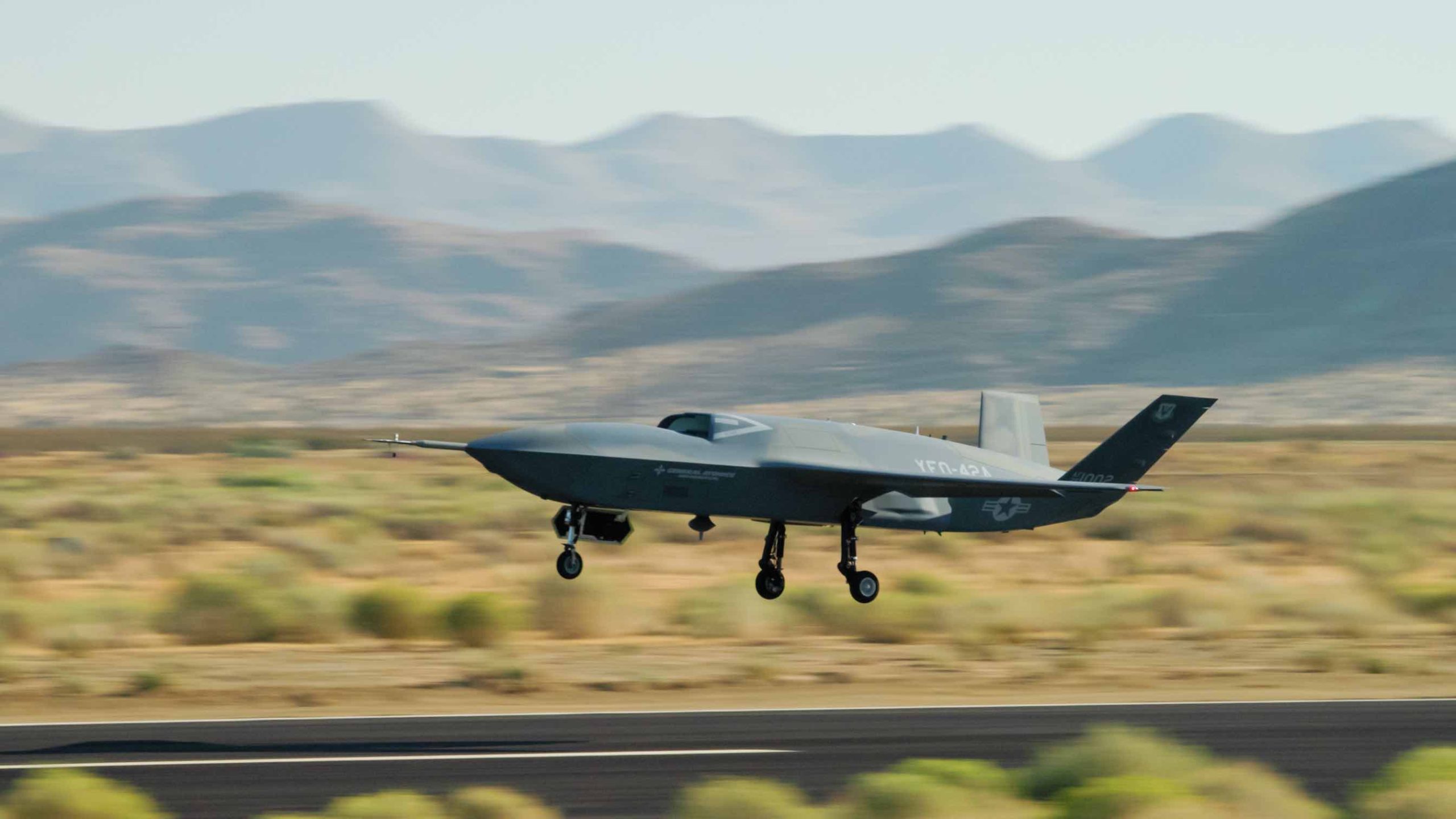
Increment 1: General Atomics YFQ-42 and Anduril YFQ-44
FY2026: $789.4 milllion for prototypes and component development, the vast majority via reconciliation
General Atomics’ YFQ-42A began flight testing in August, while Anduril’s rival YFQ-44 is said to begin trials soon. Congress wants evaluation and down-selection done by July 2026. Differences already apparent between these aircraft include range and capacity for internal weapons storage. Increment 1 CCAs are initially narrowly focused on air-to-air missile launches supporting manned fighters (starting with F-35s and future F-47s) which will support controlling multiple CCAs simultaneously.
What comes next?
CCA Increment 2 should begin development in FY2026. Though earlier implied to be 20-30% more expensive, this April Maj. Gen. Joseph Kunkel stated in a conference that “at least some [of] Increment 2 drones would be cheaper to provide mass.” That implies Increment 2 could be as “system of systems” with several UAV types of varying cost. Kunkel also suggested CCAs may eventually support runway-independent operation, solo (unteamed) missions, and teaming with B-21 bombers and E-7 Wedgetail AWACs aircraft.
MQ-9: Popular and retirement-bound
FY2026: USAF spending on MQ-9s increased from $7.1 to $26.7 million. The Coast Guard is spending $266 million to integrate the first of four MQ-9As
The Air Force plans to progressively retire its MQ-9 Reaper fleet between 2030-2035 and isn’t openly pursuing a direct successor. Recently revealed footage shows a Reaper downing a Houthi drone using a Hellfire missile (likely laser-guided). However, MQ-9s have also suffered heavy losses battling the Houthis, highlighting vulnerability to medium-range air defenses.
Regardless, Reapers remains highly in demand with operational commands, and for export. The USAF is pursuing upgrades to the Block 25 Multi-Domain Operations (M2DO) variant with improved navigation systems, nose-wheel steering, power management and sensors, with new Open Mission Systems architecture.
The Marine Corps has completed procurement of 20 MQ-9As for maritime reconnaissance and anti-ship targeting and is now upgrading them with Skytower II networking pods, EW and networking capabilities. SOCOM is also investing in MQ-9 mission kits, payloads, and open-architecture upgrades. The Coast Guard is standing up a new fleet of up to four MQ-9As for maritime surveillance. And CBP and CIA meanwhile are using MQ-9s for border surveillance, or intrusion into Mexican airspace.
While there’s no public MQ-9 replacement for now, the AFRL’s GHOST program has awarded General Atomics $99 million for a hybrid propulsion long endurance ISR/strike UAV with ducted fans, possibly informed by that company’s prior proposed stealthy MQ-Next UAS.
sUAS and the Air Force
FY2026: $5 million for offensive SUAS
SUAS are ordinarily a ground forces concern, but the Air Force’s Task Force 99 and other actors have been studying ways to employ them for tasks ranging from comms relay and aircraft inspection to ISR and kinetic strikes.
Whither the RQ-170 and RQ-180?
The Air Force maintains secrecy around its fleet of stealthy Lockheed RQ-170 Sentinel drones though reports suggest the service had 20 or 30 in service by the early 2020s . These have seen operational use over/near Afghanistan, Iran, Pakistan, the Koreas, and the western Pacific Ocean.
An even tighter cloak of secrecy surrounds the larger RQ-180 penetrating high-altitude long-endurance stealth drone, quietly developed by Northrop Grumman. Though its appearance remains unknown, there have been a spate of plausible sightings, and evidence it has acquired the nickname “White Bat.”
Industry takeaways:
- CCA Increment 1 will enter service in a mode of experimentation and doctrinal innovation. Yet the service’s plans to order 100+ Increment 1 CCAs conveys these have potential as operational capabilities too, not just testbeds, which helps secure procurement.
- While aerospace giants dominate Air Force procurements, space is opening for middleweights that can offer promising autonomy solutions and lower cost UASs, particularly munitions blending the characteristics of drones and cruise missiles that inherit the latter’s reduced costs and flexibility carrying diverse payloads.
- Interest abroad in CCAs means that failing to secure Air Force contracts need not doom a company’s CCA offerings to irrelevance (see Boeing MQ-28 and Australia; XQ-58 and Germany).
- SUAS retain untapped potential as aircraft-launched effects, or for aircraft inspection role.
- AFWERX testing of unmanned cargo aircraft may be receptive to autonomy solutions for such platforms, or autonomous conversions of manned aircraft
American Shahed drones?
An Air Force RFI in august sought to purchase at least 16 radio-controlled Group 3 UAVs closely replicating Iran’s notorious Shahed-136 long-range strike drone used for massed attack against Ukraine and Israel. By now Russia is churning out an estimated 50,000 of its domestic Geran-2 variant annually.
The USAF Shahed clone could aid development of C-UAS methods at Eglin AFB. However, the Pentagon has shown little interest in offensive use of such low-cost ‘numbers game’ strike drones, despite analogous proposals from U.S. industry like SpektreWerks’ LUCAS UAS. Perhaps inaccuracy and low individual odds of penetration with such drones is contrary in spirit to a service that strives for lossless precision strikes.
U.S. Navy Unmanned Programs
For 2026, the Navy is requesting spending $5.3 billion on unmanned systems—a roughly 70% increase. That includes $1.7 billion going towards autonomous USVs, $1.2 billion to software and $734 million to UUVs.
Arguably the Navy has struggled most in fielding unmanned platforms, at the same time struggling with huge shortfalls in shipbuilding capacity. Navy UAVs generally lack stealth, constraining their applications in contested airspace.
MQ-25 Stingray
FY2026: $1.04 billion, including $305.5 million for procurement of first three LRIP aircraft, potentially supplemented by $100 million in FY2025 funding
The MQ-25 Stingray is the Navy’s lead attempt to operationally deploy fixed-wing UAVs for catapult launch from super carriers, with a planned total order of 67 operational and ni9ne testing aircraft. It addresses a pressing need for more efficient aerial refueling than possible with current fighter-on-fighter refueling. Unfortunately, it’s fallen years behind schedule, causing component obsolescence problems, contributing to a 65% increase in projected unit costs to $209 million per a GAO report. Carrier aviation is one area where a cheap COTS approach is likely impractical.
However, if MQ-25 integrates successfully into carrier air wings, it has potential for adaptation to diverse additional roles—notably, an MQ-25 was photographed in 2025 carrying an LRASM anti-ship missile.
MQ-4C Triton
FY2026 Request: $376.4 million, primarily for upgrades rather than procurement.
The Navy still see utility in the long endurance, high altitude surveillance capability of the huge Global Hawk HALE drone—particularly for maritime surveillance using radar and electrooptical sensors, and assuming electronic support and SIGINT missions performed by retired EP-3Es planes.
However, perhaps due to platform vulnerability, the service’s MQ-4 buy downsized from 68 to 27 aircraft in 2023, with 20 were delivered by March 2025. This September a Defense Inspector General report criticized the Navy for hastening Triton service entry without completing IOT&E despite outstanding deficiencies.
RQ-21 Blackjack and MQ-27 ScanEagle
FY2026 Request: $102.3 million contract in early 2025 to procure 21 RQ-21As and 47 MQ-27 Scan Eagles for completion by June 2026. SOCOM is requesting $3.8 million to resolve parts obsolescence and safety and payload upgrades for MQ-27s.
The Marine Corps is retiring recently acquired Blackjack UAVs, instead turning to MQ-9s and experimenting with MQ-35 V-BATs. However it remains in service with the Navy, which has continued procurement. A recent buy also 47 venerable MQ-27 Scan Eagle ISR UAVs. Both Group 2 UASs have piston-engines and use pneumatic launchers and the Skyhook recovery system.
MQ-8C Fire Scout, Dearly Departing
Based on the Bell 407 helicopter, Northrop Grumman’s MQ-8C Fire Scout supported a range of ISR and attack capabilities combined with impressive endurance and speed. However the Navy plans to retire the last of 38 Fire Scouts by 2026 just a few years after entering service, having decided smaller drones could perform Fire Scout missions more efficiently.
Shipborne Counter-UAS Systems
The Navy is spending $3 billion in C-UAS systems in 2026. This March the service announced it was deploying Raytheon Coyote and Anduril Roadrunner drone interceptors onto the Arleigh Burke-class destroyers escorting the carrier Gerald Ford in the Red Sea, where the Navy has expended many costly missiles against cheap drones. By August photos revealed twin Coyote box launchers mounted on USS Bainbridge and Winston Churchill.
The Navy had earlier procured Coyote LE-SRs for expertiments swarm autonomy, as well as ISR duties launched from aircraft sonobuoy dispensers.) The Pentagon ordered 500 Roadrunner VTOL interceptors for $250 million in 2024 following combat evaluations.
F/A-XX and the Naval Loyal Wingmen Drones
FY2026: $58 million for CCA prototypes
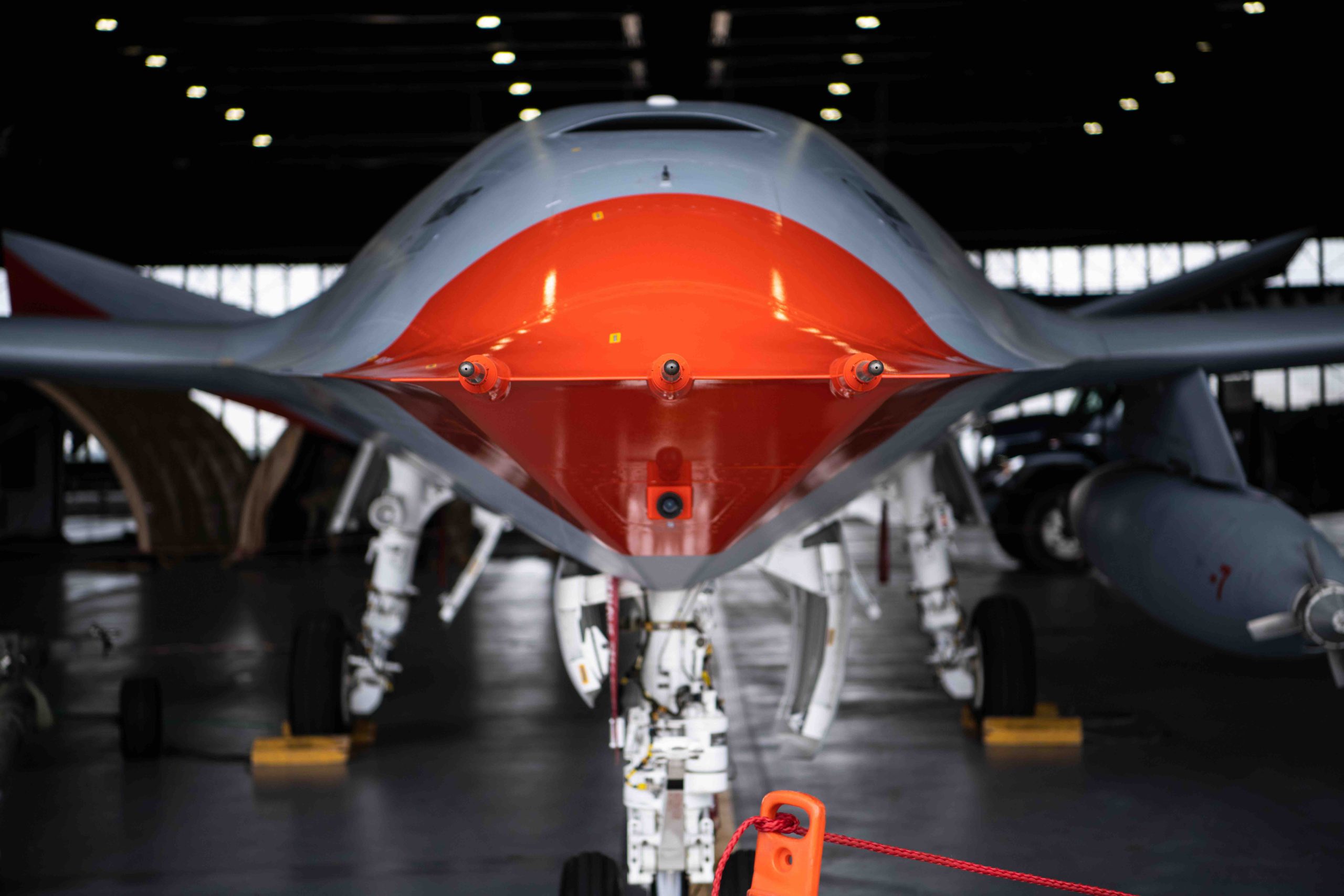
Navy leaders had expressed limited eagerness for near-term integration of carrier-based Collaborative Combat Aircraft, preferring to observe the Air Force’s effort. But abruptly this September it was revealed the service had issued contracts to Anduril, Boeing, General Atomics and Northrop Grumman requesting proposals for carrier-based CCAs. A fifth contract was awarded to Lockheed for its MDCX autonomy platform.
This change may reflect clashes with the Trump administration over funding procurement of the Navy’s sixth-generation F/A-XX fighter—a platform intended to control CCAs. Time will tell how quickly the Navy CCA program advances. Past Navy statements implied a concept for using relatively cheap, attritable CCAs for ISR and strike missions.
The Ghost Fleet is Dead. Long live the Ghost Fleet?
FY2026: $43 million for MUSV and $72 million for LUSV. House reconciliation funding is requesting between $1.2 and $2.1 billion for MASC medium-USVs
For six years the Navy planned a ‘Ghost Fleet’ of unmanned ships in two distinct classes: MUSVs under displacing under 500 tons for ISR, targeting and information ops; and corvette-sized LUSVs hefting arsenals of long-range missiles. Procurement of LUSVs was scheduled for 2027 with an expected unit cost of $330 million per vessel.
But by early 2025, the surface warfare community indicated they found the current strategy “exquisite, expensive, unpalatable”, preferring a cheaper alternate concept (Project Overlord) developed by the Strategic Capabilities Office’s for COTS unmanned ships supporting containerized mission payloads of surface- or land-attack missiles, or ISR/information ops equipment.
By mid-2025, the service confirmed it had deep-sixed planned LUSV and MUSV procurement, instead merging them in search of COTS-tech-heavy Modular Attack Surface Craft with containerized payloads. The Navy has solicited more open-ended proposal than typical for maritime platforms, emphasizing creativity, rapid development and fielding.
Despite the ostensible merge in USV types, MASC requirement suggest several incremented sub models. The basic MASC should support at least two 40-foot containers and 75 kilowatts electrical consumption, meaning it could, for example, carry eight SM-6 missiles. MASC should have a minimal range of 2,500 nm (implying a littoral forward-basing model) and maximum speed of 25 knots in Sea State 4. While optional/light manning CONOPS are not intended, limited passenger accommodations are desired.
The base model could be followed by a “High-Capacity MASC” supporting four containers while maximizing “speed and range to the extent practicable”; followed by a Single Payload MASC.
Small USVs in choppy waters
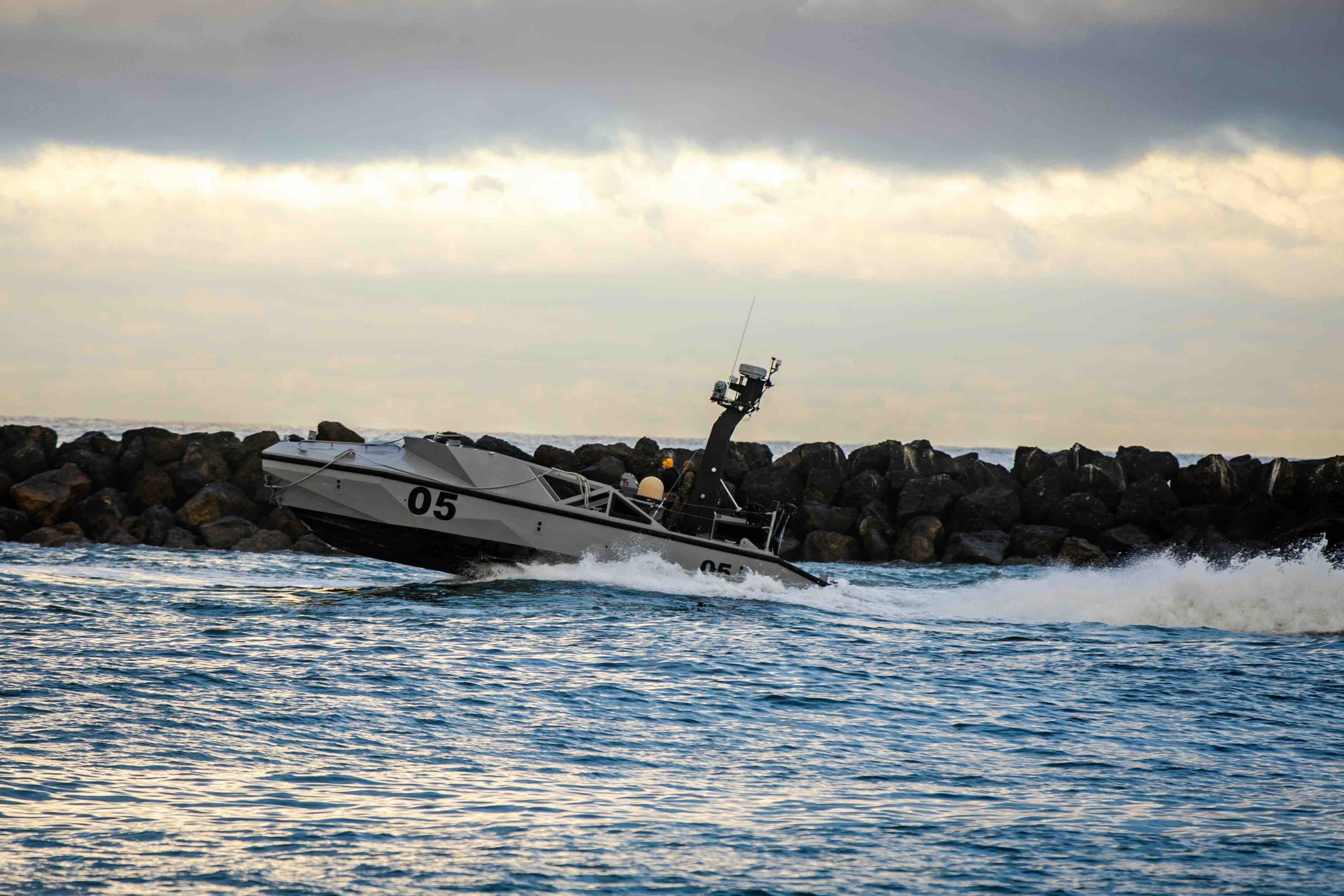
Inspired by Ukraine’s USV exploits, diverse programs have experimented with creation of autonomous swarms of small USVs. However, these projects have encountered hostility from administration officials as well as technical challenges. A Reuters report in August revealed autonomy failures resulting in a damaging USV collision and capsizing of a manned boat in two different incidents. Consolidation of small USV programs could follow in 2026.
Mine Countermeasure USVs
FY2026: in 2025 $65.7 million awarded to upgrade the MCM fleet and increase fleet size from 3 to 7
Perhaps the Navy’s least well-known unmanned success story are mine-countermeasure USVs built by Bollinger Shipyards that will assume the duties of gradually retiring Avenger-class MCM ships and MH-53E helicopters, using minesweeping and mine hunting payloads from Textron and Raytheon respectively. These vessels are the Navy’s first non-prototype Program of Record to deliver USVs. The Navy may purchase as many as 18 MCM-USVs.
Thinking Big: Large UUVs
Orca XLUUV FY2026: $113 million under “Other Procurement” to procure one Orca, supplemented by $21.5 million for R&D
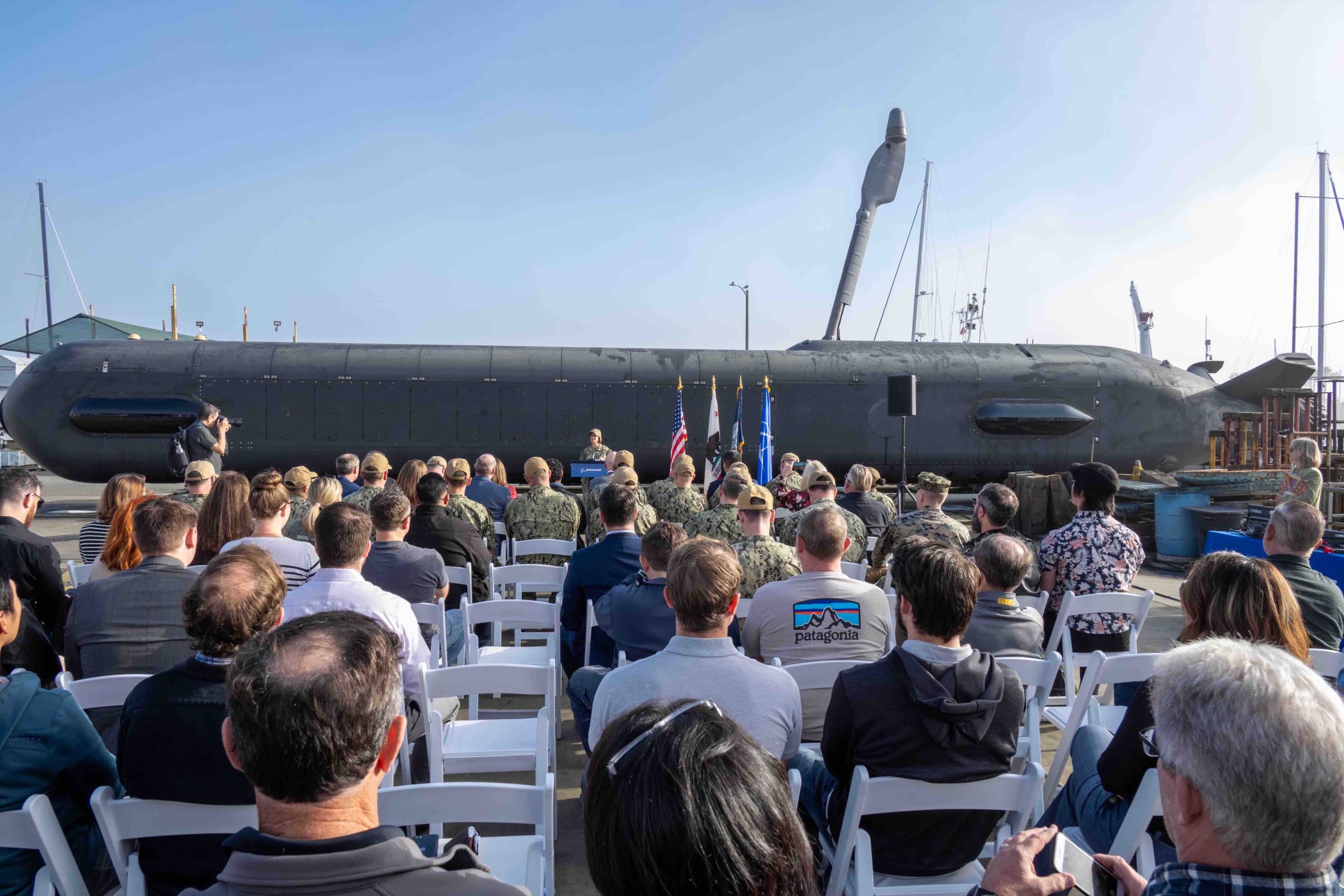
The U.S. Navy’s first large submarine drone should Boeing’s Orca XLUUV. This 50-ton hybrid-propulsion UUV can endure underwater for months, has a range of nearly 7,500 miles and can carry 8-ton payloads. For now, it’s intended to tether to the seabed Hammerhead mines armed with torpedoes. Deliveries of one Orca per year are planned through 2029. However, the program is years behind schedule due to supplier issues and technical challenges of autonomy, battery life, and navigation. Despite investments totaling $885 million since 2017, Orca isn’t yet a program of record and a 2025 GAO report claims it risks never becoming one due to lack of clear niche in Navy doctrine.
Other large-displacement UUV programs and solicitations currently active include Ocean Explorer (OEX) for long-endurance missions with modular payloads, the DIU’s Combat Autonomous Maritime Platform (CAMP) solicitation for combat-capable UUVs armed with heavyweight torpedoes, and DARPA/Northrop Grumman’s large Manta Ray UUV. The Navy also requested $50 million for Project Liberator, seeking to develop a containerized undersea launcher for heavyweight torpedoes perhaps envisioned for USVs and UUVs.
Industry takeaways
- The Navy is eagerly testing USV and UUVs, but its love of experimentation is failing to transition platforms to large scale operational capabilities—a tenedency which chafes current DoD leadership with its materialist emphasis on platforms delivered rather than experiments conducted. Industry must acknowledge the current reality and encourage the service to articulate clearer plans to Congress for the kinds and numbers of USVs (and how they will be used) to meet operational requirements.
- MASC’s potential to transform small vessels into pocket guided missile platforms with the addition of a few Mk.70 Mod 1 PDS container launch systems have many intriguing applications—especially as unmanned platforms costly survivability and self-defense features. But MASCs carrying 8 to 16 large missiles each (compared to 96 on Arleigh Burke destroyers) must remain truly cheap and quick to produce to facilitate deployment in effective volumes while retaining adequate speed, range, electrical generation, and resilient comms/control systems to support naval taskforce in operational theaters.
- Focusing on smaller, less complex USVs may mitigate some impacts of the U.S.’s shipbuilding deficit, with MCM-USVs offering a hopeful example
- Acceleration of the Navy CCA program is theoretically exciting news for the aerospace sector. But it’s to soon to tell how enthusiastically the service intends to pursue it while F/A-XX procurement remains unresolved.
- Many current Navy UAVs lack survivability in contested airspace, curbing relevance in high-intensity conflicts. Thus, manufacturers must consider how proposed UASs can sustainably execute combat missions under those conditions.
Drones for Force 2030’s New Model Marine Corps
While the U.S. Army experiences tumult today, the Marine Corps’ ordeal began nearly a decade earlier implementing General Berger’s Force Design 2030 program which aimed to refocus the Corps away from Army-style inland ground warfare towards expeditionary and littoral operations. The new model Corps has eagerly embraced MQ-9s to enable the Corps’ expanding shore-based anti-ship capabilities, SUAS and loitering munitions to enhance infantry, and XQ-58 Collaborative Combat Aircraft.
While the Marine Corp’s official small UAS program decreased from $101 to $82 million in FY2026, RDT&E funding increase to $153 million for UASs and loitering munitions—effectively doubling UAS expenditure. This may reflect completion of earlier procurements of SUAS, causing spending to redirect towards next-generation designs and force integration.
XQ-58 Valkyrie
FY2026: $58 million for its CCA development and systems integration, plus $270 million requested to procure additional XQ-58s
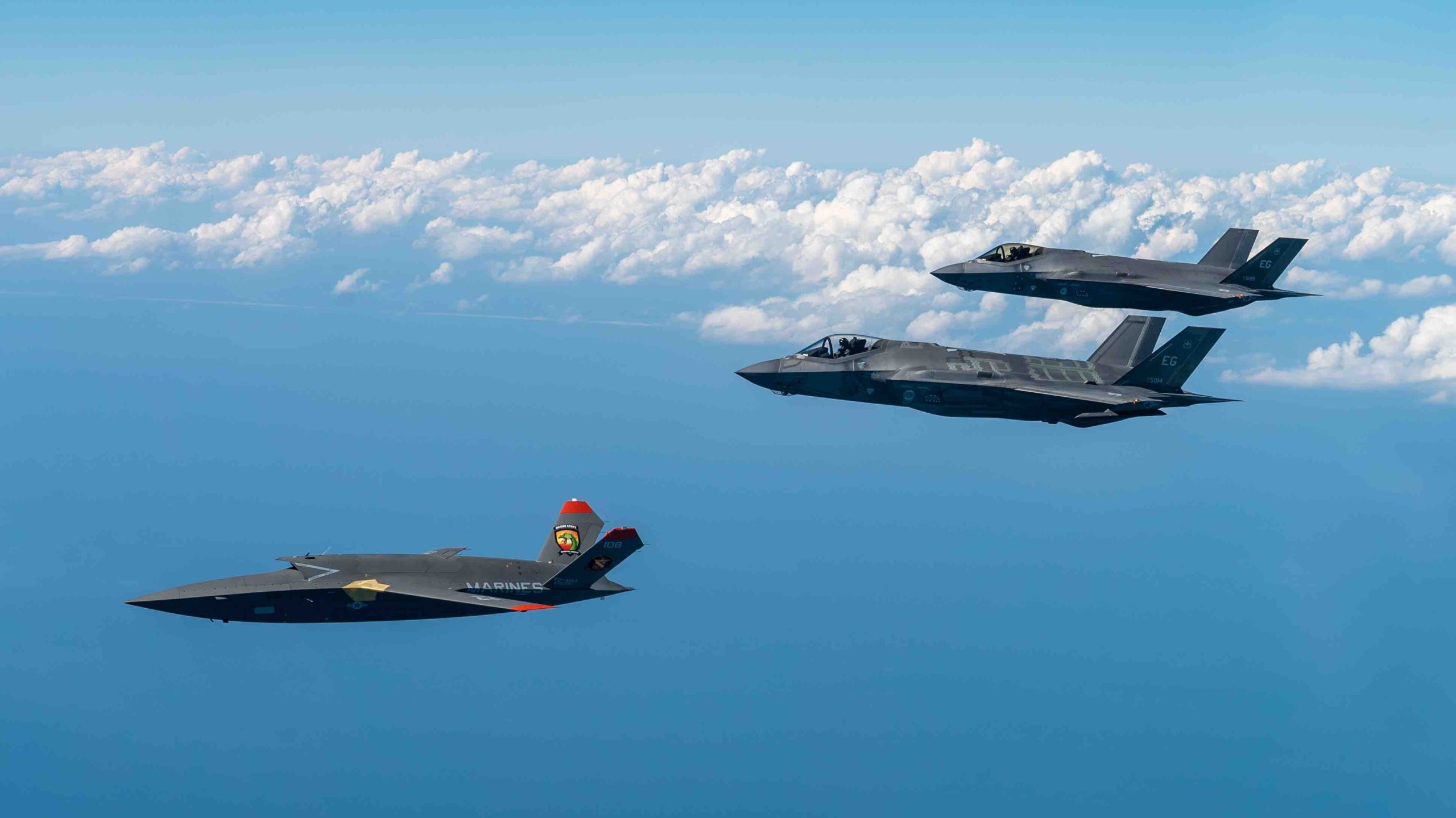
While both the Air Force and Navy didn’t invite Loyal Wingmen pioneer Kratos to their CCA competitions, the Marine Corps has enthusiastically adopted the company’s XQ-58 Valkyrie. Kratos is developing an MQ-58B model for the Corps specialized in suppression of enemy air defense (SEAD), leveraging electronic attack capabilities tested in tandem with manned F-35 jets. By fall 2025 the Corps began preparing procurement of additional Valkyries, transitioning towards becoming a program of record. Kratos itself is preparing to produce 24 more XQ-58s, though some may be sold overseas.
LRUSV: A Second Life?
In 2021 the Marine Corps began its Long-Range Unmanned Surface Vessel program combing USVs, C4 systems and loitering munitions into a platform capable of combat and reconnaissance missions. Louisiana-based Metal Shark delivered a demonstrator USV, while HII supplied autonomy integration. Tests demonstrated LRUSV’s capabilities in autonomous navigation, loitering munition launch, and collision avoidance. However, the program was terminated in 2023 due to slow progress. However, the service plans to resurrect LRUSV on a “major capability acquisition pathway” in FY2027.
Marine Corps sUAS
FY2026: $2.1 million for SR-SE drones, $12.8 million for LR-LE drones; down from $50.59 million collectively for FY2025. Also $12.23 million for LR/LE payloads.
The Marine Corps spent big on SUAS in prior years, but for2026 the service deemed it has acquired enough short-range drones, but would continue more modest purchases of long range ones.
SR-SE refers to a diverse array of SUAS (seemingly including the R80D SkyRaider and Skydio X2D) integrated into squads and platoons for ISR, situational awareness and target acquisition purposes. SR-Ses must have at least 3 miles range and endurance of at least 50 minutes. They are described as attritable, though budget documents report an average $78,558 unit cost.
The battalion-level LR-LE capability is being fulfilled by Edge Autonomy’s VXE30 Stalker, with over 200 delivered by early 2025. This Group 2 VTOL UAV has an endurance of 4-6 hours and range 100 miles on battery power alone but can multiply range/endurance 2-4 times using propane fuel cells. LR-LE is tasked with target-acquisition for OPF loitering munitions.
A requirement for a company-level MR/ME UAS hasn’t received recent funding. This would require a minimum 6-12 miles range, 4 hours endurance, and support IED detection, laser targeting and comms-relay capabilities.
Organic Precision Fires: OPF-M, OPF-L and Neros Archer
FY2026: $75 million for delivery of 614 live fire and 130 inert loitering munitions each from Anduril and Teledyne-FLIR.
In 2021, the Corps tapped the Israeli UVision Hero-120 loitering munition to serve as its heavier vehicle-mounted OPF-M loitering munition systems for JLTVS trucks, USVs, and LAV-M armored vehicle.
The separate OPF-L program seeks a mass-producible man-portable munition deployable at the squad and platoon level leveraging existing technology under IDIQ contract ceiling of $249 million. In 2024, the following companies were down-selected:
- AeroVironment received $8.9 million for tube-launched Switchblade 300 Block 20s
- Anduril received $6.4 million for Bolt-M quadcopter
- Teledyne FLIR received $12 million for Rogue 1 quadcopter
The Corps may select both fixed-wing and vertical-lift UASs. Initial OPF deliveries to two Marine battalions are planned by January 2026, followed by mass production. Budget documents characterize live Bolt-M unit cost at $30,129 and Rogue 1s at $61,706.
MADIS and Anvil Drone Interceptor
In 2024, the Marine Corps awarded $200 million to integrate Anduril Anvil drone interceptors into its MADIS Mark 2 C-UAS system, followed by another $642 million base defense C-UAS in March 2025 also including Anvil systems.
Neros Archer FPV and the Marine Corps Attack Drone Team
This August, the Marine Corps issued a $17 million contract for 8,000 Neros Archer UAVs, making it the service’s lead operational FPV drone. The Blue UAS system is currently going to testing and training units. Another 6,000 Archers are being delivered for operational use by Ukraine.
Looking to rapidly devise and deploy doctrine and TTPs for offensive use of SUAS, this January the Corps stood up the Marine Corps Attack Drone Team (MCADT) in Quantico for experimental testing, doctrine development and UAV training. The Corps has also begun organizing drone competitions to build force proficiency with UASs.
Unmanned Expeditionary Systems
FY2026: $24 million in R&D
TRUAS
The Marine Corps is currently receiving 114 TRUAS TRV-150 Tactical Resupply Unmanned Aircraft Systems, quadcopters that can carry up to 150 pounds out to 9 miles. Up to 172 may be fielded in logistics battalions by 2028. However, this September the Navy posted an RFI seeking a new TRUAS VTOL system able to autonomously deliver 150 lbs out to 11.5 miles. It should support shipborne and JLTV deployment, with up to four controllable by a single operator.
MARV-EL
A tier above TRUAS, NAVAIR’s Marine Aerial Resupply Vehicle-Expeditionary Logistics seeks a medium-weight UAV that can deliver 600 pound cargos fully autonomously out to 28.7 miles away, or 300 pounds over 57.5 miles. A fly-off pitting Kaman’s Kargo and Leodos-Elroy’s SeaOnyx UAVs left the Corps unsatisfied. Reportedly airframe limitations, or possibly specifications, were culpable. NAVAIR decided to recompete the competition in May 2025.
Industry takeaways
- Filling medium SUAS and anti-armor loitering munition capability gaps at the company level may be the next focus after OPF-L is awarded.
- The Corps’ Neros Archer procurement (averaging $2,100 per UAV) shows it too is interested in low-cost PBAS-like FPV drones.
- The service may be receptive to multi-role VTOL UAVs deployable on amphibious carriers that can reduce demands on the Corp’s helicopters and jump jets, though the MARV-EL competition highlights the difficulty of achieving targeted performance thresholds
- The MQ-58 Valkyrie shows that besides attritability, CCAs may offer an affordable means to fielding specialized combat aviation capabilities.
Looking Ahead
In 2026 it bears following whether the new administration’s optimism that it can acquire rapid, low-cost results with new solicitations for COTS platforms after canceling programs many years in the cooking pot ends up being validated by the course of events.
Especially SUAS are likely to make their faster to operational units in the Army. However, some illusions may also be shattered as to how readily COTS technologies will satisfy military requirements, especially for larger platforms.
Thus, companies must not only have a ready portfolio of generalist platforms, but the flexibility to adapt them quickly as military requirements and preferences come more clearly into focus. For example, following Lockheed’s elimination from the CCA Increment 1 competition, senior executive explained that in retrospect they overestimated how much the Air Force was willing to pay for greater stealth/survivability. The company’s recently revealed Vectis CCA proposal sought to retain the ‘stealth/survivability’ as a differentiating descriptor while also trying to play up affordability.
Given the current focus on generating affordable mess, industry should resist the allure of gold-plating in favor of demonstrating cost-efficiency and adaptability. But in practice, it’s worth observing specific competitions contrasting more exquisite versus less-costly solutions (see for example Army MRR) to assess whether procurers in practice end up rewarding lower-cost solutions or remain drawn towards higher-end options. What customers say they want does not always align with their actual purchases.
Niches yet to explore
Broad as the Pentagon’s unmanned systems plans may be, there remain capability gaps that vendors might exploit—if they can persuade the services they’re effective, affordable and sufficiently mature. Below are examples of unmanned system concepts observable abroad that are not yet in general U.S. military service. The U.S. military certainly doesn’t all of these capabilities—but probably can benefit from some of them
- Large-capacity long-range/endurance UAVs with modular payload bays configurable for cargo delivery, missile or drone launch, or other large payloads
- Medium or long-range multi-role VTOL UASs suitable for operations from amphibious carriers
- Fiber optic SUAS and marsupial carriers
- Tethered UASs in for infantry units offering WAMI surveillance, early warning, comms relaying etc.
- low cost SUAS integrated into armored vehicles, either tethered or free release, for reconnaissance, early warning, targeting, comms relaying, perhaps even C-UAS
- Cheaper drone interceptors (below $10,000, as observable in Ukraine) to cost-efficiently attrit large-scale Shahed-style attacks, and harry enemy tactical UASs near frontline
- Small, low-cost armed UGVs deployable as mobile perimeter-defense systems to defend more territory with fewer personnel
- Even smaller, cheaper low-profile UGVs to plant mines and recover or deliver battlefield equipment in interdicted areas; or use as demolition and ambush kamikaze system
- low-cost small multi-role USVs akin to Ukraine’s that can transit from Hawaii or Guam to allies in Western Pacific without airlift to assist with littoral missions (ISR, anti-surface and even air-defense); or serve as blue water communication nodes or sensor pickets
- Drone-dispensing air- or surface-launched container munitions paired with suitable SUAS, autonomy capabilities and control systems.
Are We over-learning from Ukraine?
The stunning, multi-faceted drone war between Russia and Ukraine can and should compel adaptation in response. However, critics argue there’s risk of universalizing lessons learned while disregarding the specific context in which UAVs have come to dominate that conflict: Ukraine and Russia’s geographic proximity, inadequate forced proficiency for large-scale maneuver operations, and the limited capabilities of combatant air forces compared to the U.S. military. For example, a conflict in the Pacific might have a more limited role for SUAS than observed in Ukraine. Another unknown factor is the degree to which forthcoming C-UAS systems deployed in response to Ukraine can sustainably mitigate drone threats. There are risks in assuming that platforms unsuccessful in Ukraine cannot be successful elsewhere or be made effective with reasonable adaptations.