
The U.S. Air Force’s Experimental Operations Unit has completed its first hands-on exercise with the YFQ-44A Collaborative Combat Aircraft at Edwards Air Force Base, California, marking the earliest stage at which Air Force operators — not engineers or test pilots — have taken independent control of a CCA prototype.
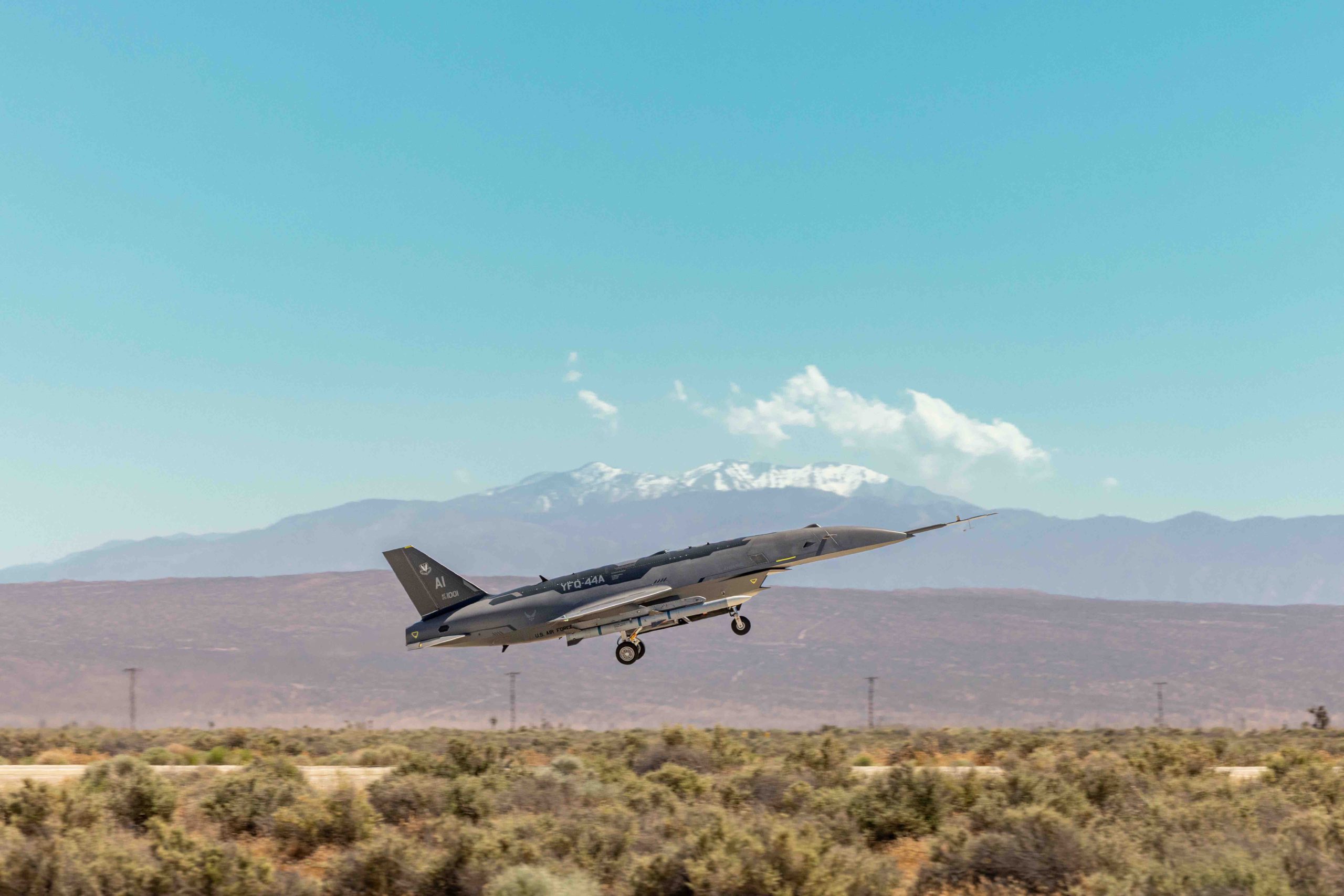
The exercise, conducted under Air Combat Command with the 412th Test Wing of Air Force Materiel Command providing test support, put the principles of the Air Force’s new Warfighting Acquisition System into practice. EOU Airmen executed a series of daily sorties covering the full operational cycle: pre- and post-flight checks, weapons loading and unloading, autonomous taxi and takeoff initiation, in-flight tasking, and post-flight data management. Anduril personnel, who had previously led those functions, handed off operations entirely to the Air Force crew.
“This experimental operations event was executed by EOU members from start to finish. Every sortie generated and flown was done with a warfighter, not an engineer or test pilot, kicking the tires and controlling the prototypes,” said Lt. Col. Matthew Jensen, EOU commander. “We are learning by doing, at a speed and risk tolerance accepted by the USAF’s most senior leaders, to ensure CCA is ready to operate and win in the most demanding combat environments.”
The exercise came six months after YFQ-44A’s first semi-autonomous flight and less than two years after prototype contract award. Anduril front-loaded autonomy development from the outset — conducting all taxi and flight tests semi-autonomously from the start — on the basis that doing so would accelerate long-term progress. That decision is credited with enabling the rapid handoff to EOU operators, who turned the aircraft between sorties with days of training rather than weeks.
A central objective of the exercise was validating YFQ-44A’s fit within the Air Force’s Agile Combat Employment concept, which calls for dispersing aircraft and personnel across multiple small, flexible forward locations to reduce vulnerability in contested environments. Anduril’s Menace-T command, control, communications, and compute solution served as the ground element — a ruggedized laptop managing mission plan uploads, autonomous taxi and takeoff, in-flight tasking, and post-flight data ingestion. Operations that previously required fixed base infrastructure were managed from two Pelican cases and a laptop, validating the reduced logistics footprint that ACE concepts demand.
The CCA program is explicitly structured as a pathfinder for the Warfighting Acquisition System, a deliberate effort to compress the timeline from concept to combat-credible capability by breaking down the traditional barriers between requirements, acquisition, and operational communities. The EOU’s role is to embed the warfighter’s voice at the earliest stages of development, generating tactics, techniques, and procedures in parallel with the aircraft rather than after it.
“The collaboration we saw in this exercise is the cornerstone of our acquisition transformation,” said Col. Timothy Helfrich, portfolio acquisition executive for fighters and advanced aircraft. “By embedding the operators from the EOU with our acquisition professionals, we create a tight feedback loop that lets us trade operational risk with acquisition risk in real-time. This isn’t just a test; it’s a demonstration of how we are adopting a more agile process. An 85% solution in the hands of a warfighter today is infinitely better than a 100% solution that never arrives.”
The YFQ-44A flew from Edwards back to Anduril’s Southern California test site following the exercise. Future EOU exercises will continue evaluating the aircraft against ACE concepts and generating the operational data the Air Force will use to refine CCA doctrine ahead of its target fielding date at the end of the decade.